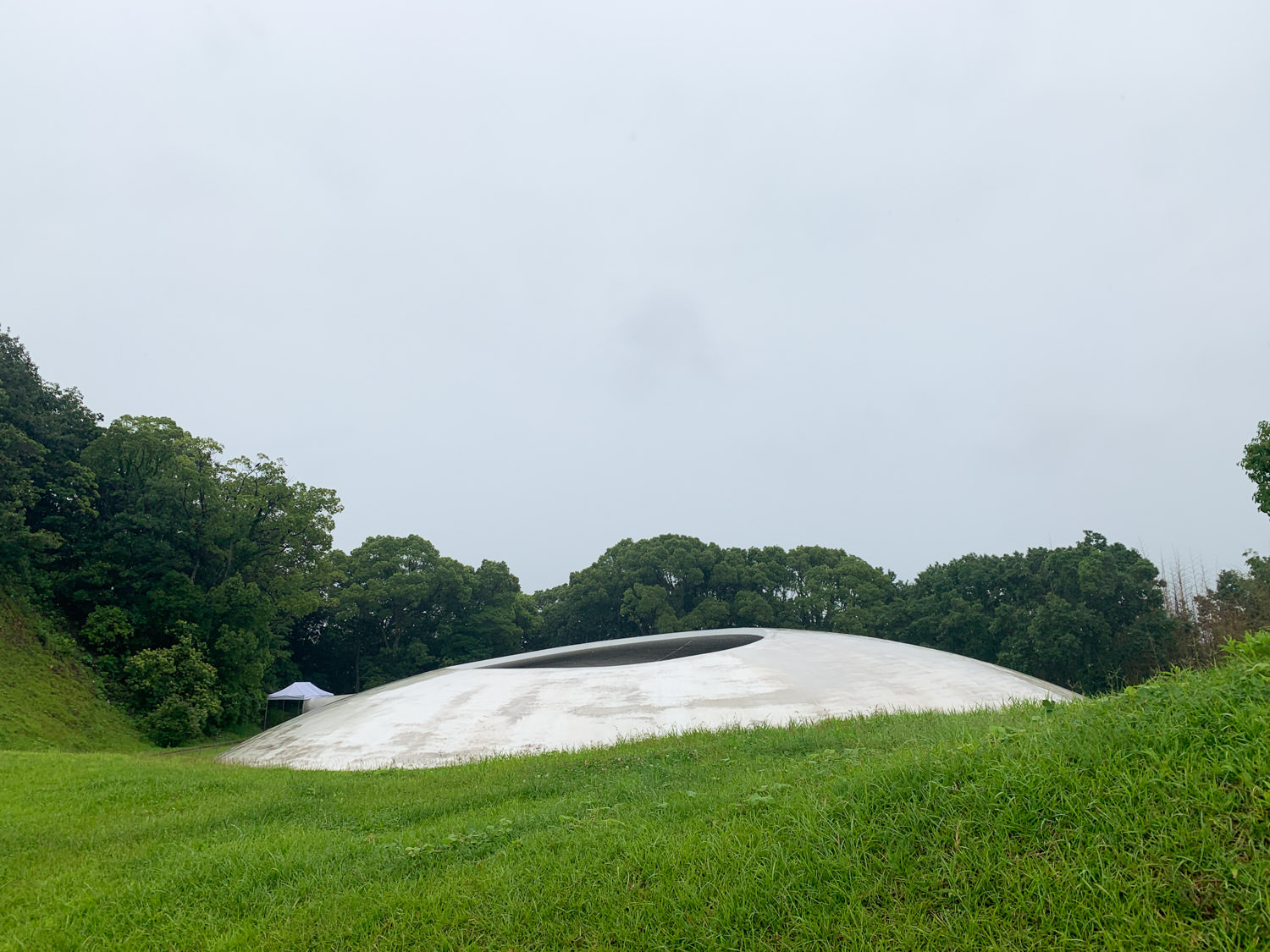
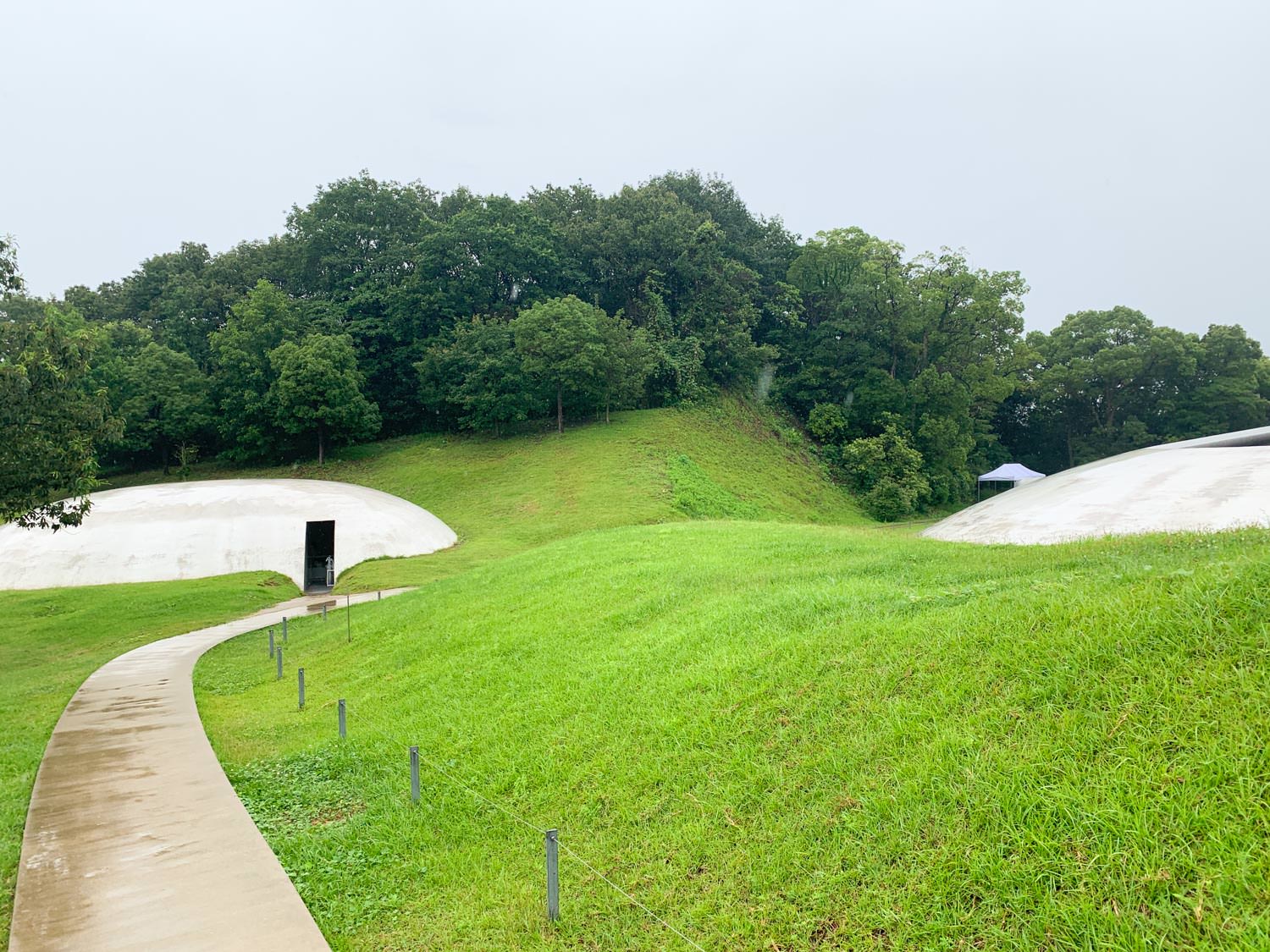
On Teshima, one of the islands floating in the Seto Inland Sea, “Teshima Art Museum” was built on a small hill climbing up from Karato Port.
Teshima Art Museum — exterior
Teshima Art Museum is a white architectural work whose shape evokes a “water droplet.”
Designed by architect Ryue Nishizawa, it is a shell-shaped concrete museum measuring approximately 40 × 60 meters and 4.3 meters high. Inside the building, a work titled “Matrix” by artist Rei Naito is on display.
The approach to Teshima Art Museum is by walking along a small path.
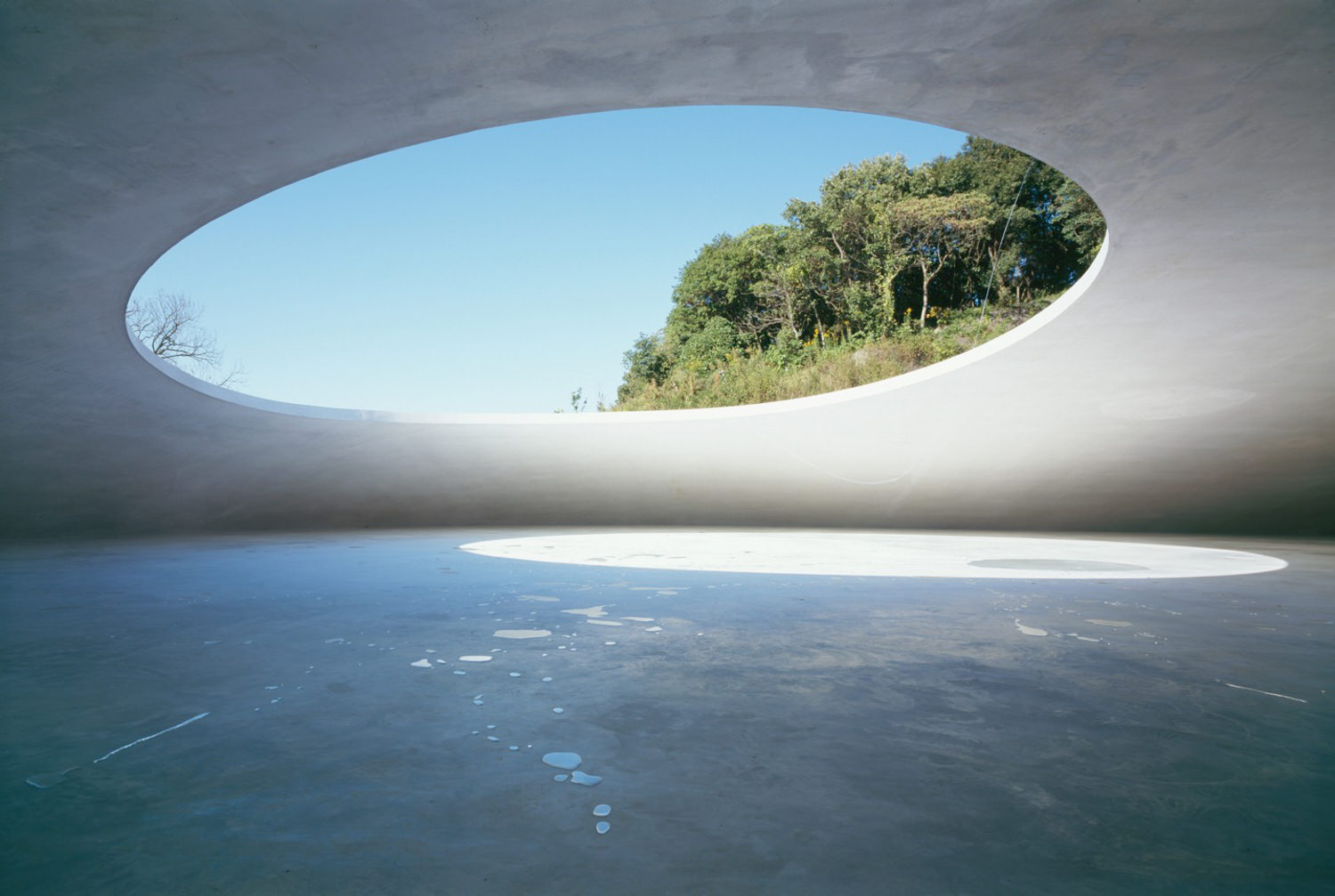
The interior floor has 186 tiny openings, each about 2mm in diameter, from which groundwater irregularly springs up.
The water that suddenly surges up is pushed out into small droplets, guided by gentle breezes and slight undulations, drifting across the floor — designed with delicately calculated slope angles — as they roll about crisply and delightfully.
Viewers, their gaze captured by the many water droplets teeming here and there, sit down on the floor and spend a while chasing the movements as they occur.
Springing droplets flow and form small pools, which then flow and merge with other pools, forming even larger pools — the scene unfolds everywhere.
At the same time, breezes reaching in through the two openings, light streaming in, and the greenery growing lushly all around create an experience of coexistence with nature through sight, touch, and hearing.
Teshima Art Museum is not the kind of usual museum where multiple artworks are displayed.
Rather, this is a space that receives states that change according to the surrounding environment and the passage of time.
As time flows onward in a serene setting, the heart seems to grow gently attuned.
Teshima Art Museum is not a place designed to sharpen one’s nerves or sharpen thought, but the fact that “hidden items,” which you cannot see unless attentive, exist here is apparently not widely known.
In fact, the author did not notice at all on my first visit. On my second visit, when they suddenly became clearly visible, that discovery brought no small change to my inner state.
[1] Three Threads
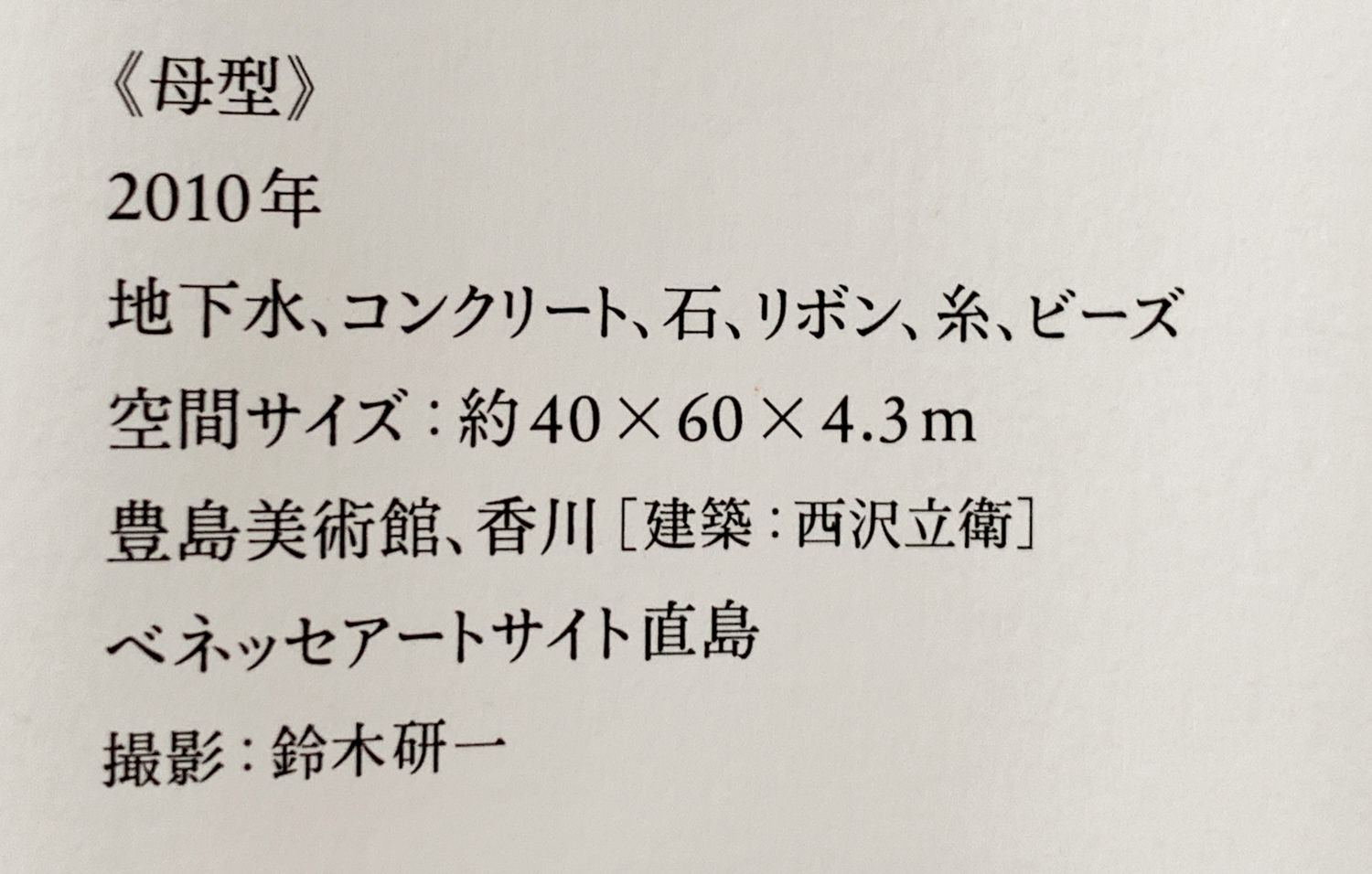
The hidden materials become clear when you look at the work credits for Rei Naito’s “Matrix.” Reading the following credits, you’ll notice materials that go unnoticed in the space.
One of them is “thread.”
Work credits
At the two openings, “ribbons” — evident to everyone — flutter, but scarcely anyone can easily find the “threads.” Within such a broad space, finding an ordinary thread is a daunting task.
Yet, while attentively wandering the museum, mindful of the springing water and pools, at last I found them! Dangling and floating from the ceiling — I unmistakably found the threads!!
The threads I discovered were red, white (silver), and yellow (gold) — three threads.
Depending on the lighting, white may appear silver, and yellow may appear gold, so the perception of color may change.
Because they are truly fine threads, without attentive searching, even the red thread is hard to find.
For reference, when the author found them, the three threads were fixed to the ceiling at 1–2 meter equal intervals at one end, and the other end dangled at a length reaching the viewer’s line of sight.
The three threads, drifting as they swayed in the breeze, seemed to contain a message from Rei Naito, and I was moved.
[2] Beads
And another hidden item mentioned in the work credits is “beads.”
Although “beads” often appear in Rei Naito’s works, even searching with the awareness that they are a hidden item, the author was unable to find them.
Since they seem to be in quite hard-to-find locations, I would like those who are curious to please try their best to find them.
Conclusion
The two hidden items concealed within Teshima Art Museum — three threads and beads.
Did you notice? And were you able to find them?
In both cases, why those materials were used is not clarified by their creator, Rei Naito.
How do we, as viewers, receive and process the emotion of touching those small discoveries in situ…? While staying attuned to changes in one’s heart, there is also a joy in unraveling their meanings.
And even if you ask the staff on site, they will absolutely not tell you what is where…
Overview
Teshima Art Museum
From July 11 (Sat), 2020, an advance-reservation system (online ticket system) is introduced.
Opening hours:
March 1 – end of October: 10:00 – 17:00 (last entry 16:30)
November 1 – end of February: 10:00 – 16:00 (last entry 15:30)
Closed days: Tuesdays (March 1 – November 30); Tuesdays through Thursdays (December 1 – end of February)
※However, when a national holiday falls on a closed day, the museum opens on the holiday and closes the following day.
※When a national holiday falls on a Monday, the museum opens on Tuesday and closes the following Wednesday.
Admission: 1,570 yen ※Free for those 15 and under
Phone: 0879-68-3555
Address: 607 Karato, Teshima, Tonosho-cho, Shozu-gun, Kagawa 761-4662
Teshima Art Museum
在浮于濑户内海的岛屿之一——丰岛,从唐柜港爬上一处小丘之处建造的,正是”Teshima Art Museum”。
Teshima Art Museum 外观
Teshima Art Museum是一座令人联想到”水滴”形状的白色建筑。
由建筑家Ryue Nishizawa设计的,约40m×60m、高4.3m的壳型混凝土建筑美术馆,建筑内展示着由艺术家Rei Naito创作的《Matrix》这一作品。
세토내해에 떠 있는 섬 중 하나인 데시마, 가라토항에서 나지막한 언덕을 올라간 곳에 지어진 곳이 “Teshima Art Museum”입니다.
Teshima Art Museum 외관
Teshima Art Museum은 “물방울”을 연상시키는 형상의 흰 건축물입니다. 건축가 Ryue Nishizawa가 설계한, 대략 40m×60m, 높이 4.3m의 쉘 형 콘크리트 건축 미술관으로, 건물 내부에는 예술가 Rei Naito의 《Matrix》라는 작품이 전시되어 있습니다.
Teshima Art Museum으로의 접근은 좁은 길을 걸어 나아가는 방식입니다.
관내 바닥에는 지름 2mm 정도의 작은 구멍이 186곳에 뚫려 있어, 지하수가 불규칙하게 솟아나오게 되어 있습니다.
순간적으로 솟아나온 물은, 밀려 나오듯 작은 알갱이로 변화하고, 미풍과 미세한 기복에 이끌려 표류하며, 정교한 경사각으로 설계된 바닥면을 또르르 하고 경쾌하게 굴러갑니다.
관람자는 여기저기서 꿈틀거리는 물방울들에 시선을 빼앗겨, 여기저기서 벌어지는 그 움직임을 쫓아가며 잠시 바닥면에 앉은 채로 시간을 보내게 됩니다.
솟아나는 물방울이 흘러, 작은 물웅덩이를 형성하고, 작은 물웅덩이가 흘러 다른 웅덩이와 합류해, 다시 더 큰 웅덩이를 만들어 가는 모습이 곳곳에서 펼쳐집니다.
동시에 두 개의 개구부에서 들어오는 바람, 내부에 쏟아지는 빛, 주변을 둘러싼 우거진 초록 등이, 시각, 촉각, 청각을 통해 자연과 공존하는 듯한 체험을 안겨 줍니다.
Teshima Art Museum은 여러 미술 작품이 전시된 일반 미술관이 아닙니다.
이곳은 주위 환경과 시간의 흐름에 따라 변화하는 상태를 받아들이는 공간입니다.
정적인 장에서 새겨지는 시간의 흐름에 마음이 잔잔히 정돈되어 가는 듯합니다.
Teshima Art Museum은 신경을 예민하게 하고 사고를 날카롭게 하는 곳은 아니지만, 주의하지 않으면 보이지 않는 “히든 아이템”이 존재한다는 사실은 별로 알려져 있지 않은 듯합니다.
실제로 필자도 처음 방문했을 때는 전혀 눈치채지 못했지만, 두 번째 방문 때 갑자기 명확히 보였을 때, 그 사실에 적잖은 마음의 변화를 느꼈습니다.
[1] 세 가닥의 실
숨겨진 소재는, Rei Naito의 《Matrix》에 관한 작품 크레딧을 보면 명확해집니다. 아래 크레딧을 보면 공간에서 미처 알아채지 못한 소재가 눈에 들어옵니다.
그중 하나가 “실”입니다.
작품 크레딧
두 개의 개구부에는 누구의 눈에도 뚜렷하게 비치는 “리본”이 흔들리고 있지만, “실”을 쉽게 찾을 수 있는 사람은 거의 없을 것입니다. 넓은 공간 속에서, 이른바 평범한 실을 찾는 것은 지난한 일입니다.
그러나 솟아나는 물과 물웅덩이에 주의하며 미술관 안을 신중히 헤매던 중, 마침내 찾아냈습니다! 천장에서 늘어져 떠 있는 틀림없이 실을 찾았다!!는 것을.
발견한 실은, 빨강, 하양(은), 노랑(금), 세 가닥의 실이었습니다.
빛의 정도에 따라 하양은 은색으로, 노랑은 금색으로 색이 달리 보일 수도 있습니다.
정말 가느다란 실이므로, 주의 깊게 찾지 않으면 빨간색 실조차 찾기 어렵다고 생각합니다.
참고로 필자가 발견했을 당시, 세 가닥의 실은 1~2m의 등간격으로 한쪽 끝은 천장에 고정되어, 다른 한쪽 끝은 관람자의 시선 높이에 오도록 매달려 있었습니다.
바람에 흔들리며 떠도는 세 가닥의 실은, Rei Naito의 메시지를 담고 있는 듯해, 마음이 움직였습니다.
[2] 비즈
그리고 작품 크레딧에 기재된, 또 하나의 히든 아이템이 “비즈”입니다.
Rei Naito의 작품에 자주 등장하는 “비즈”이지만, 히든 아이템임을 인식하고 찾아도, 필자는 발견할 수 없었습니다.
꽤 찾기 어려운 위치에 있는 듯하니, 궁금하신 분들은 열심히 찾아보시길 바랍니다.
정리
Teshima Art Museum에 숨겨진 두 가지 히든 아이템 — 세 가닥의 실과 비즈.
여러분은 궁금하셨는지요? 그리고 찾으셨는지요?
어느 쪽이든, 왜 그 소재가 사용되었는지에 대해서는 작가인 Rei Naito가 밝히지 않았습니다.
우리 관람자들은 현장에서 그 작은 발견을 접했을 때의 감정을, 어떻게 받아들이고, 어떻게 소화해 나갈까……? 자신의 마음 변화에 다가서면서 의미를 풀어 가는 즐거움도 있을 듯합니다.
참고로 관내 스태프에게 물어봐도, 무엇이 어디에 있는가? 등에 대해서는 절대 알려 주지 않습니다……
개요
Teshima Art Museum
2020년 7월 11일(토)부터 사전 예약제(온라인 티켓제)를 도입.
개관 시간:
3월 1일~10월 말: 10:00~17:00(최종 입관 16:30)
11월 1일~2월 말: 10:00~16:00(최종 입관 15:30)
휴관일: 화요일(3월 1일~11월 30일) 화요일~목요일(12월 1일~2월 말)
※단, 공휴일과 겹치는 경우 개관, 다음 날 휴관.
※단, 월요일이 공휴일인 경우 화요일 개관, 다음 수요일 휴관.
관람료: 1,570엔 ※15세 이하 무료
전화번호: 0879-68-3555
주소: 〒761-4662 카가와현 쇼즈군 도노쇼초 데시마 가라토 607