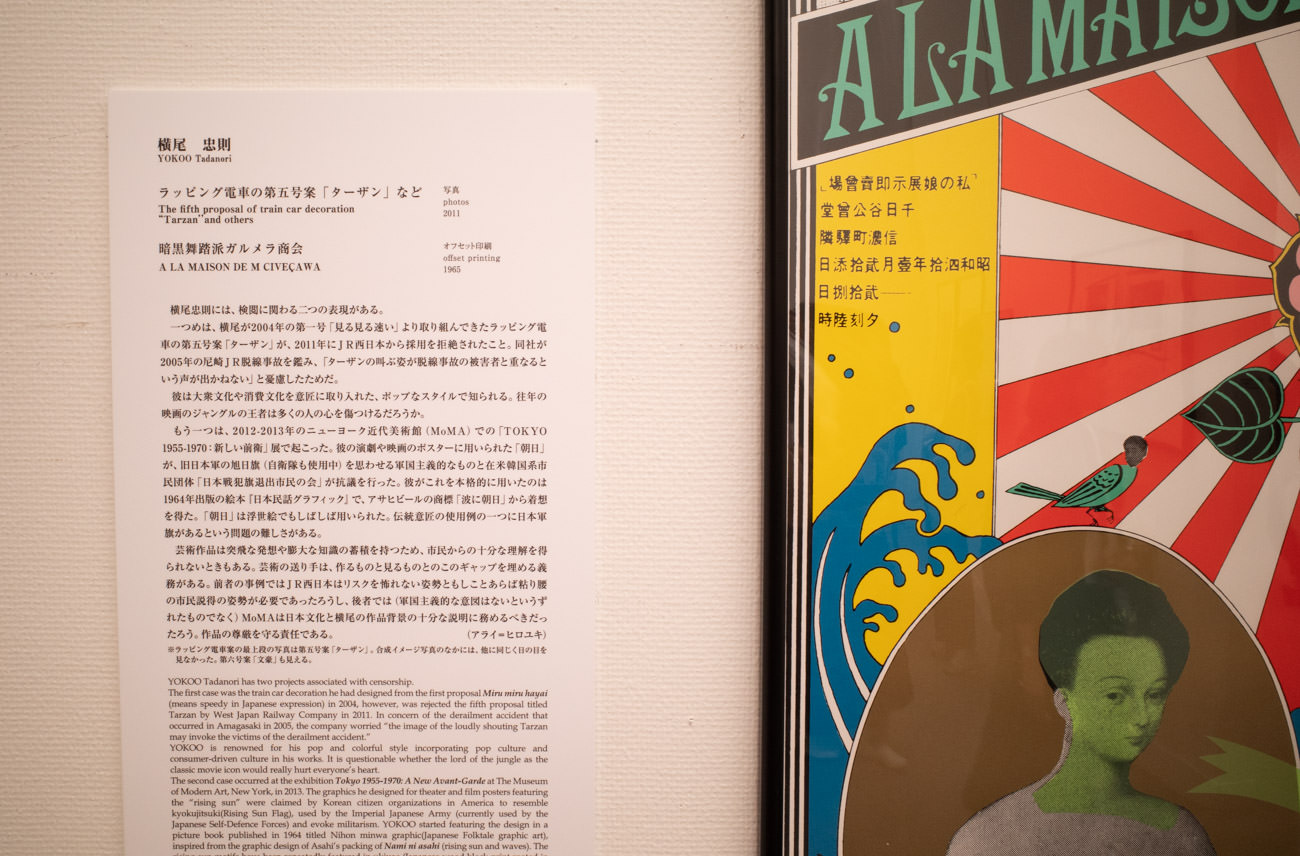
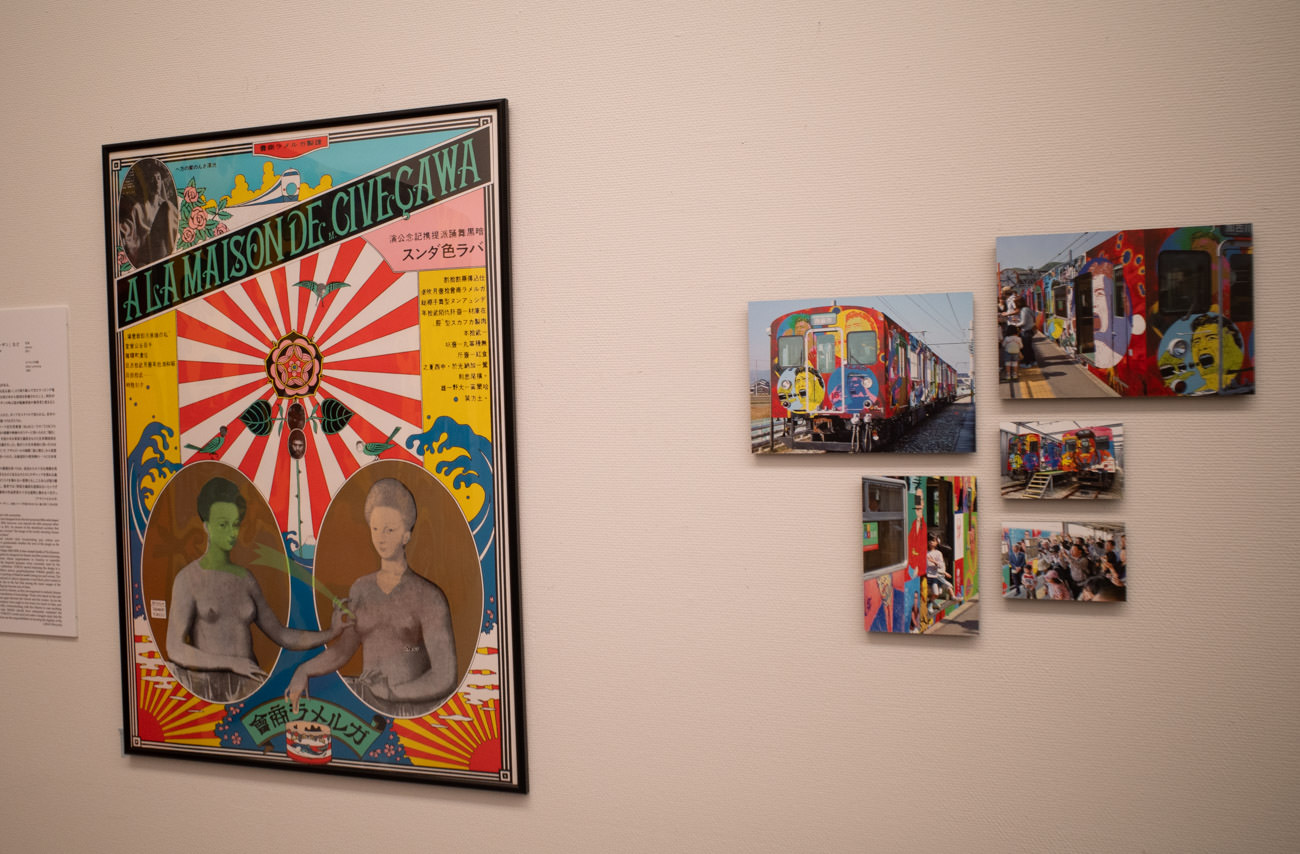
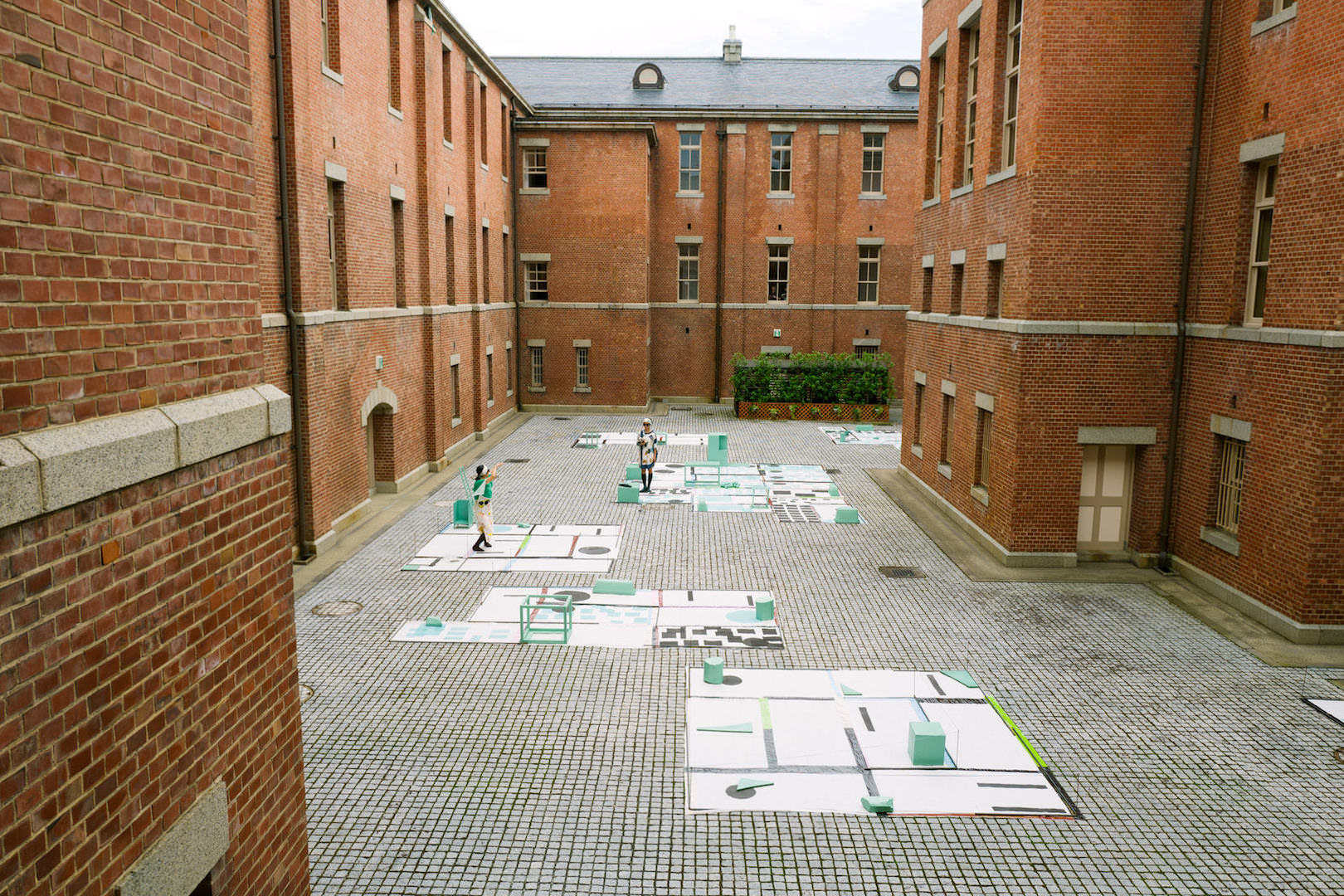
横尾忠則 YOKOO Tadanori ラッピング電車の第五号案「ターザン」など 写真 2011 The fifth proposal of train car decoration “Tarzan’and others, Photos, 2011 暗黒舞踏派ガルメラ商会 オフセット印刷 1965 “A LA MAISON DE M CIVEÇAWA”, Offset printing, 1965横尾忠則 《暗黒舞踏派ガルメラ商会》1965年・《ラッピング電車の第五号案「ターザン」など》2011年
I visited twice: once at the press preview on July 31, 2019, the day before the opening, and again on August 10, 2019, timed to Sakanaction’s darkness live show.
Several months have passed since it opened, and the memory has begun to fade. Yet looking back, I’d say the Aichi Triennale 2019 — its overall curatorial framework and its individual works — was superb and rewarding. In a sense, I may have been lucky to view it before the flood of information started swirling.
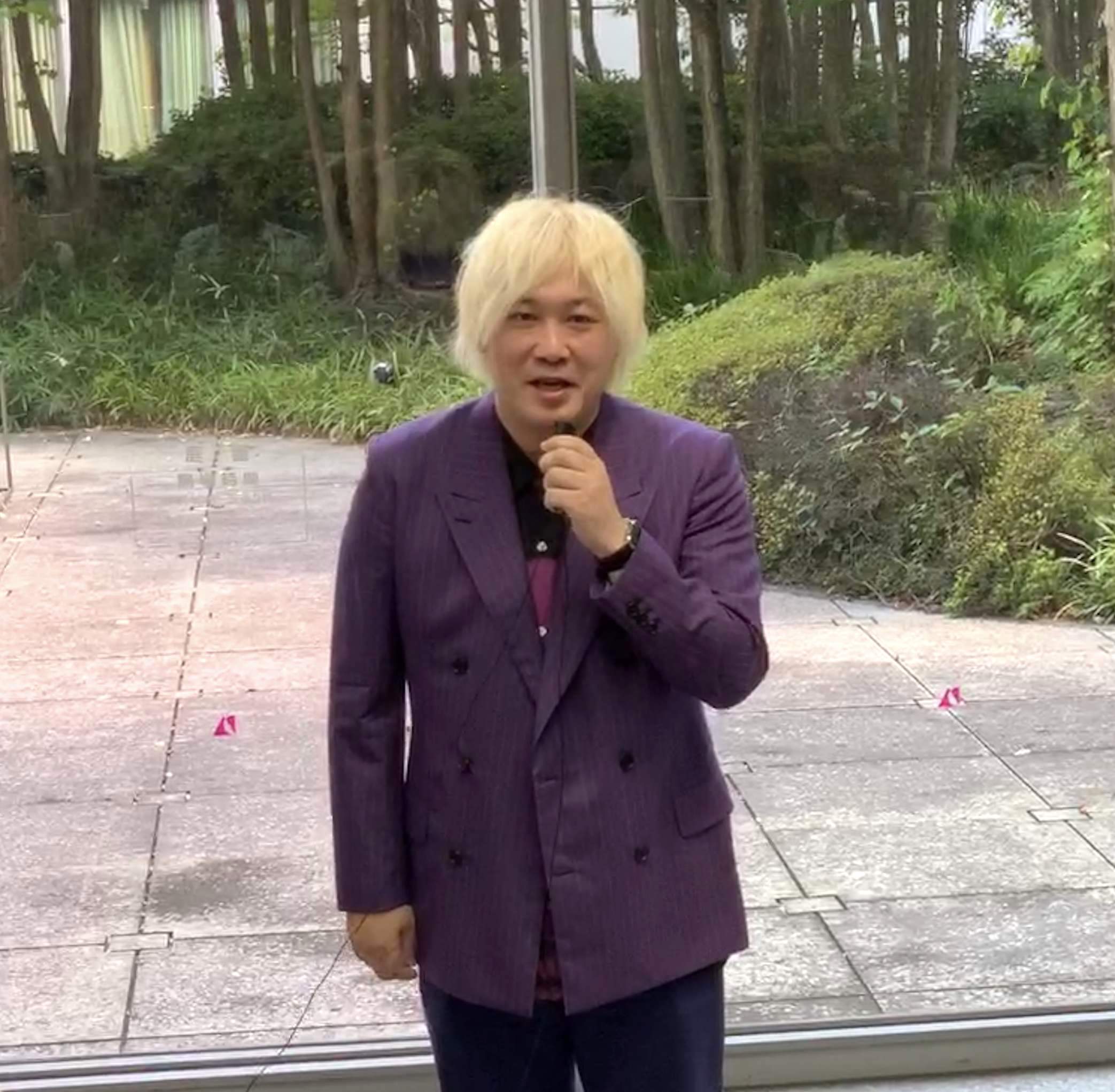
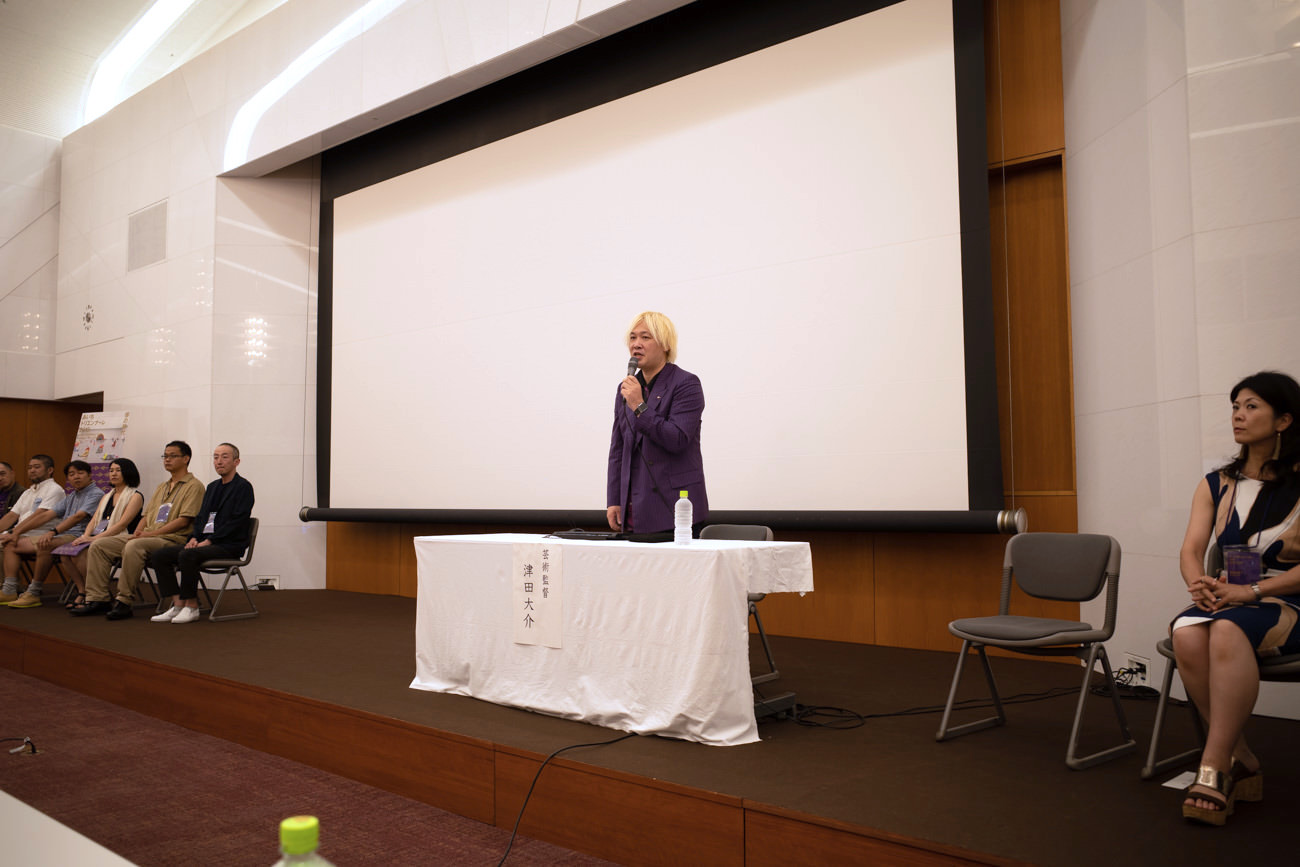
At the start of the press preview, artistic director Daisuke Tsuda declared: “Success is certain. I want this to be an art festival that will be spoken of as a legend.” In the end, his words did not lie — not about the success, but about the “legend.”
Daisuke Tsuda declares: “Success is certain. I want it to become a legend.” * Photographed July 31, 2019.
The heavily reported “After ‘Freedom of Expression?'” section was apparently first revealed at the press preview. At the press conference held later that evening, once the exhibited works were disclosed, the questions came in a flood.
The press conference the day before the opening — at this point, he confidently asserted, “We’ve anticipated every scenario. There will be no problem.”
But Tsuda’s read was off. As everyone knows, it flared up far beyond what he had assumed.
What I felt at that press conference was that “this is exactly the way he operates on Twitter.” Grab public attention with a sensational hook or hot topic — the manner of a native of the web.
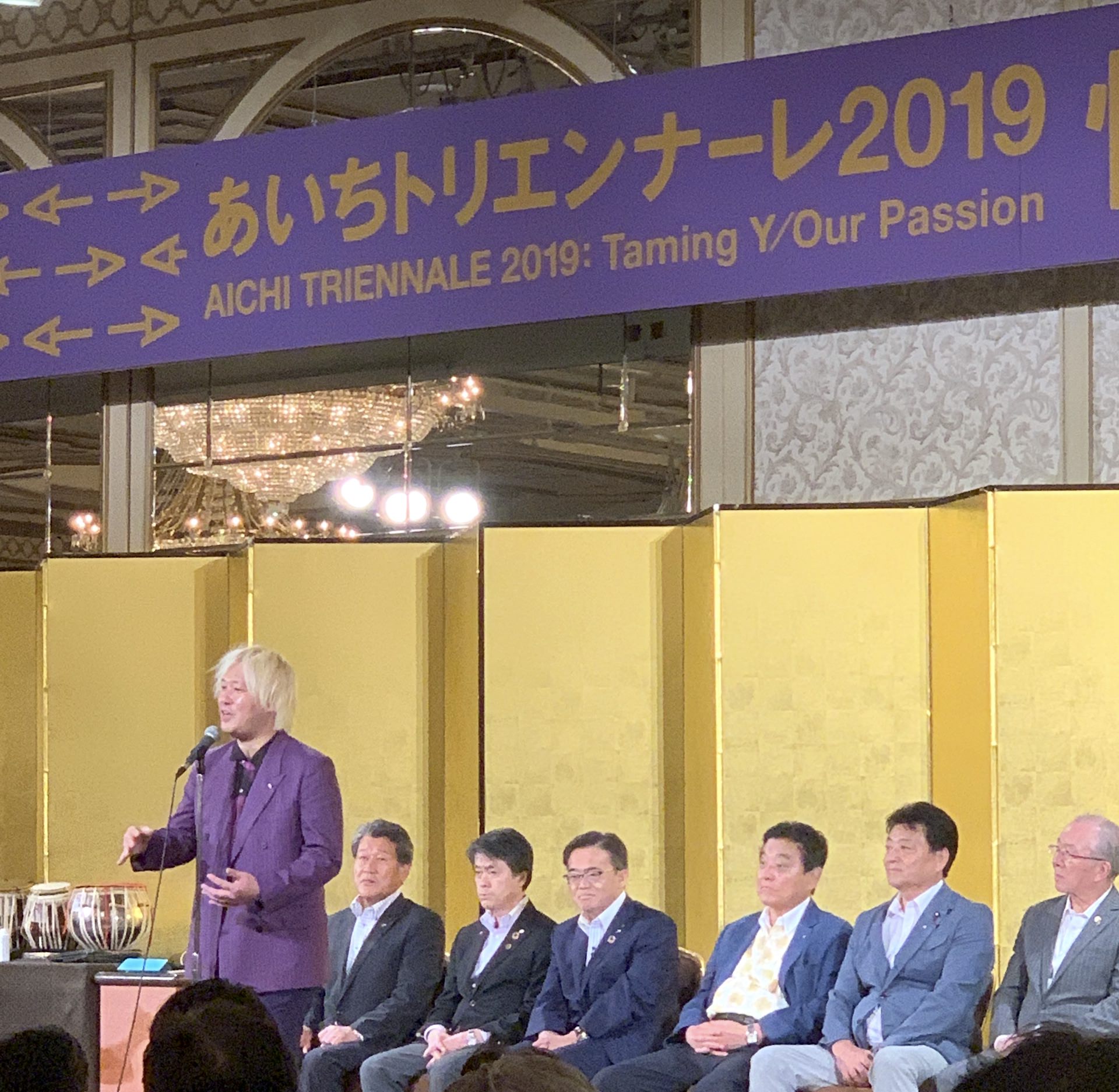
The reception party the day before the opening — a certain governor and a certain mayor sat right next to each other.
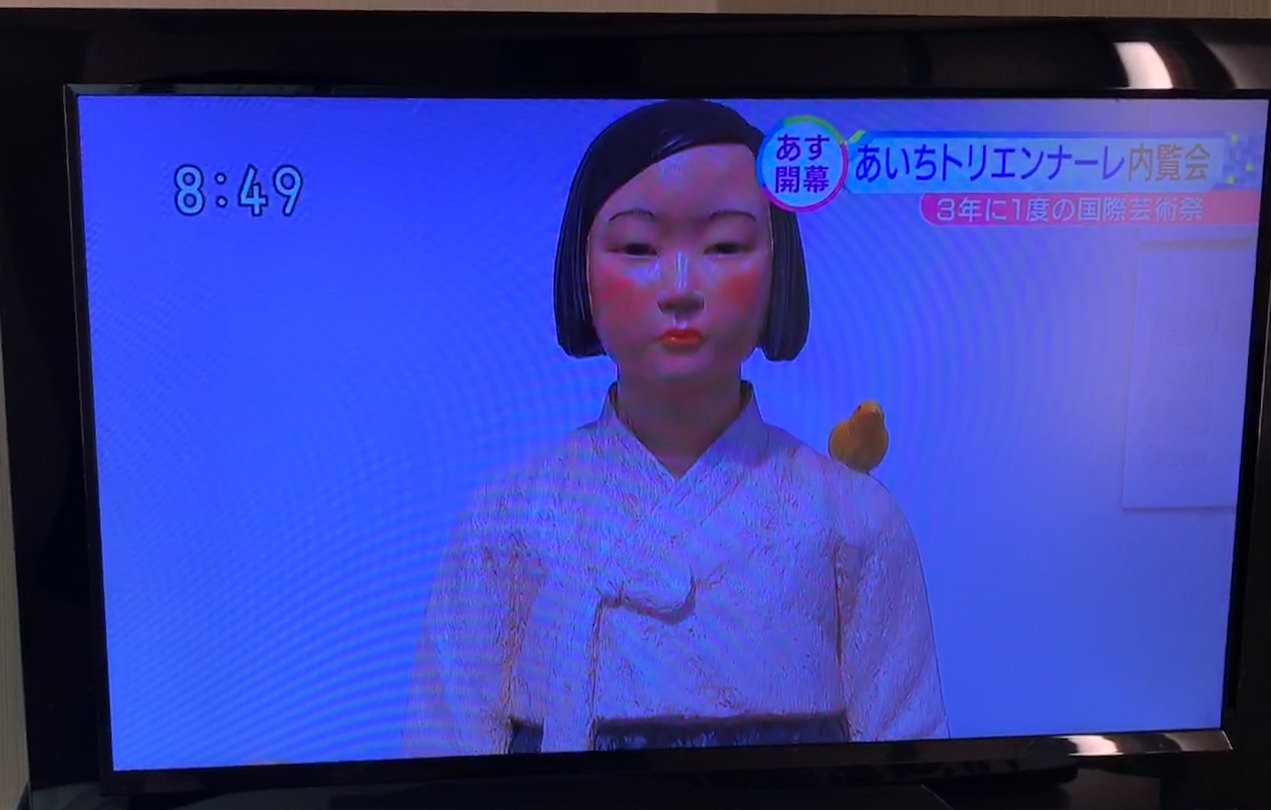
Just as Tsuda had hoped, the media immediately began to report.
From the previous evening’s NHK news (Aichi)
Press previews at any art exhibition take place within a limited amount of time.
It’s hard to view works at your own pace — between photography and interviews, the time simply evaporates.
The Aichi Triennale 2019 preview was no different, moving through each venue like a conveyor belt. It was in that rushed flow that I ended up viewing “After ‘Freedom of Expression?’.”
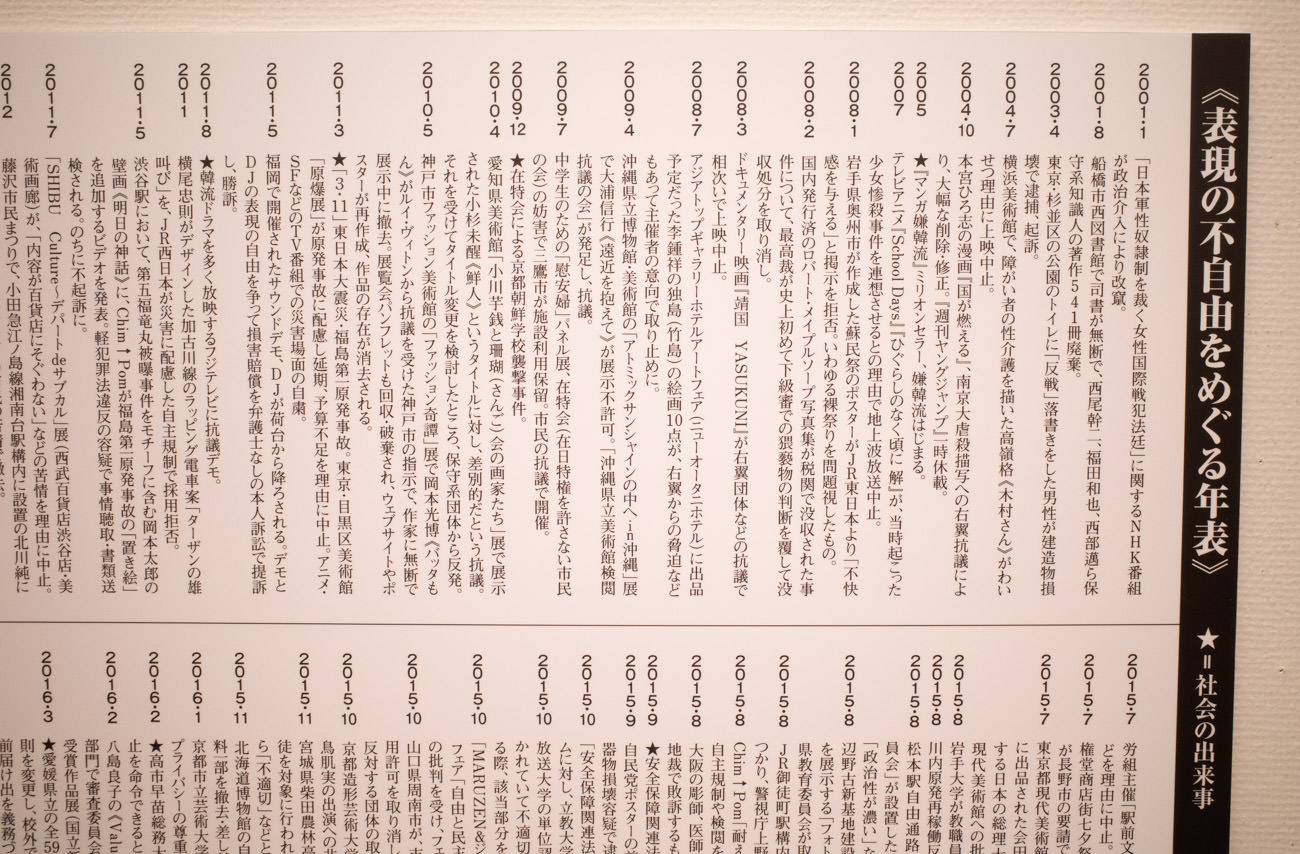
A chronology of the freedom-of-expression issue — displayed just inside the entrance.
The entrance is relatively narrow, and as I recall, the chronology corner set at the very beginning wasn’t a space where you could take your time.
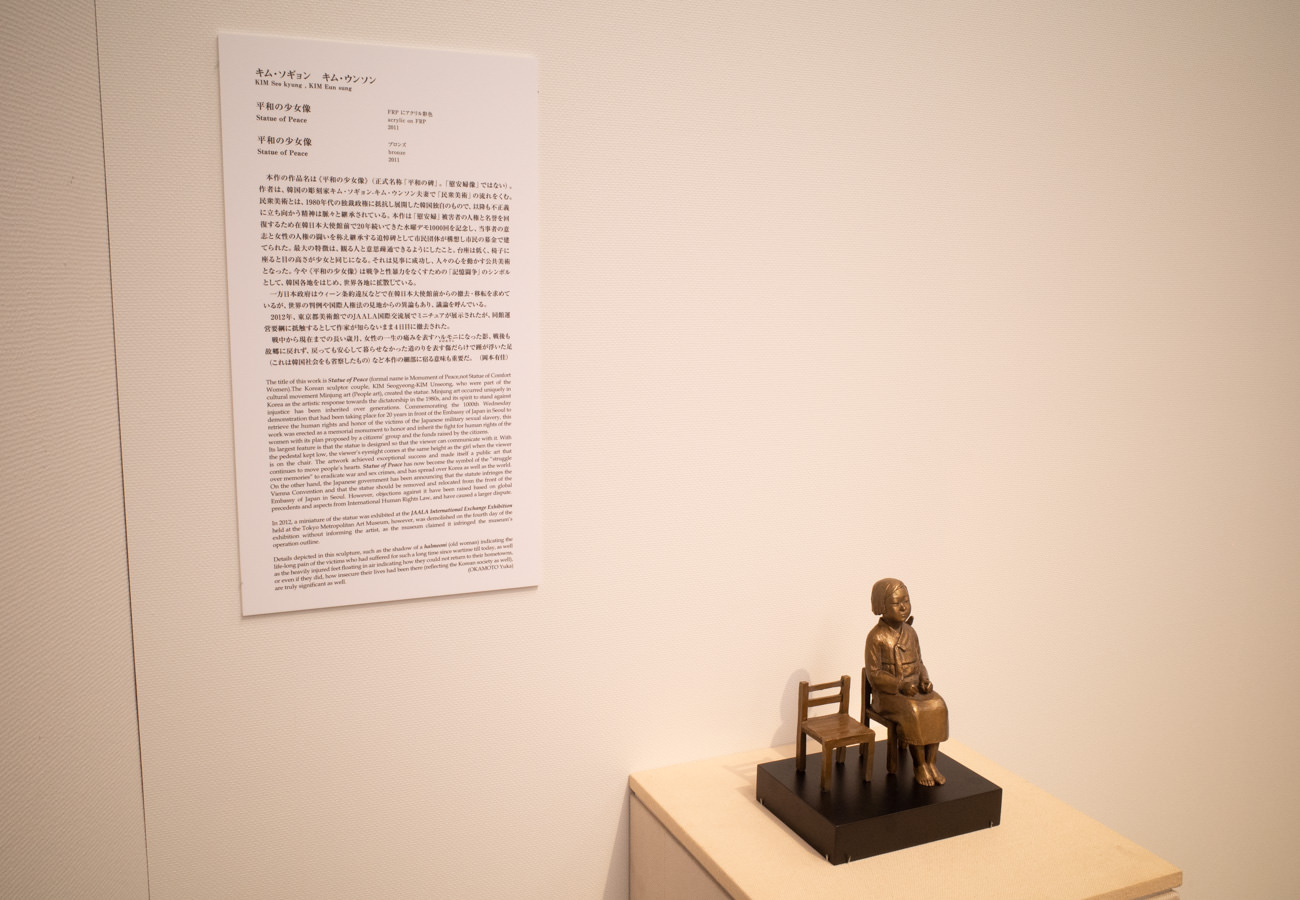
The controversial “Statue of a Girl of Peace” did startle me when I first saw it. Even knowing of its existence from news reports, seeing the physical object in front of me was less like taking in an artwork and more like a moment of “so this is it.” A woman near it — presumably the artist — was answering media questions with visible delight. The scene remains etched in my memory.
Kim Seo-kyung / Kim Eun-sung, “Statue of a Girl of Peace,” 2011
My own feelings were mixed and unresolved.
It wasn’t a setting where you could look at length; and as artworks, they didn’t move me. I was drawn in for a long time by Tadanori Yokoo’s works, so I honestly didn’t notice the piece involving Emperor Showa.
Tadanori Yokoo — YOKOO Tadanori — Fifth proposal for train car decoration “Tarzan” and others, Photos, 2011 / “A LA MAISON DE M CIVEÇAWA,” Offset printing, 1965 (Ankoku Butoh-ha Garumera Shokai)Tadanori Yokoo, “Ankoku Butoh-ha Garumera Shokai” (1965) / “Fifth proposal for train car decoration ‘Tarzan’ and others” (2011)
I had not anticipated that the fallout would reach even Chim↑Pom’s work.
It made me feel the terror of runaway public opinion.
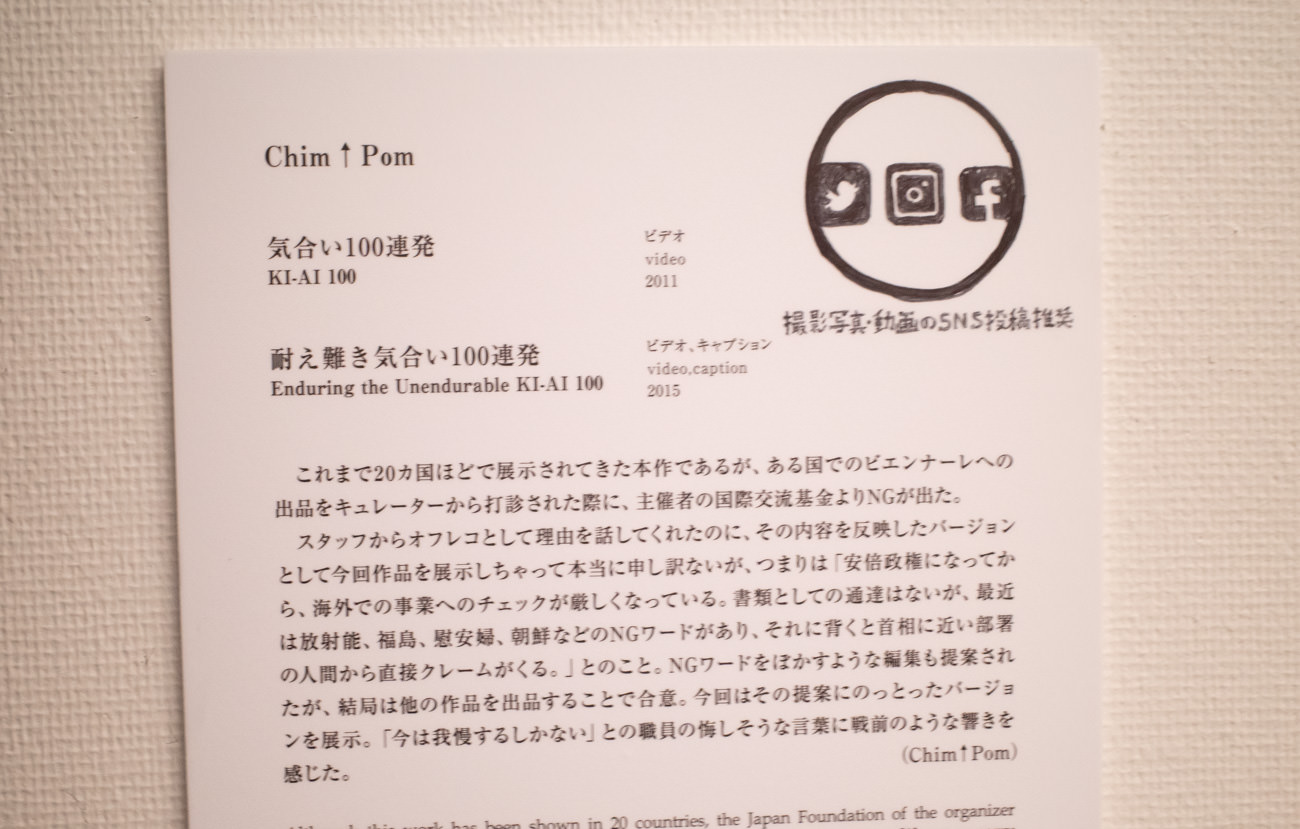
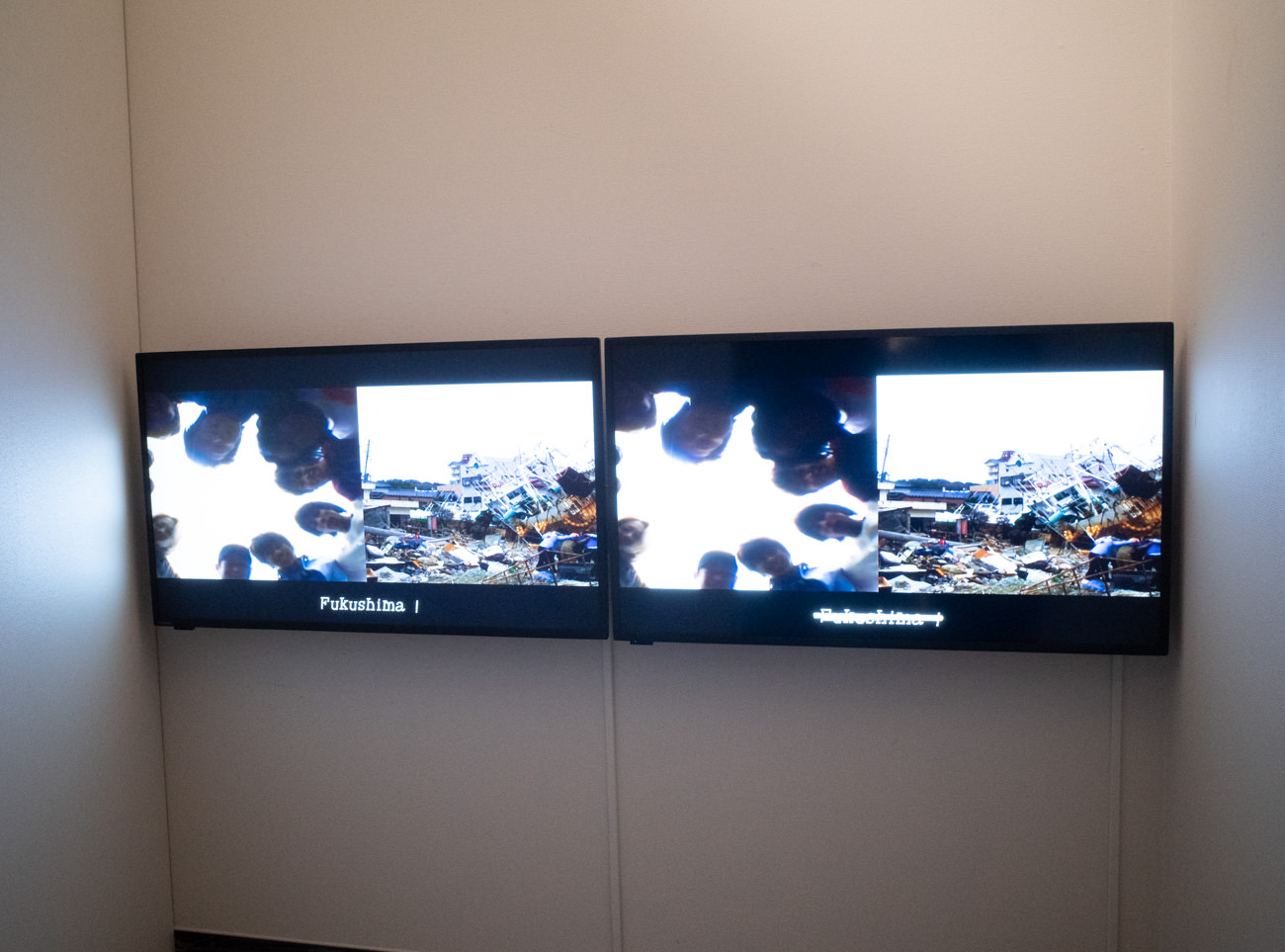
Caption text for the Chim↑Pom exhibit — This work has been exhibited in roughly 20 countries. When a curator invited it to a biennial in a certain country, the co-organizer, the Japan Foundation, rejected it. A staff member told us the reason off the record — we’re truly sorry to display a version incorporating that content, but essentially: “Since the Abe administration, oversight of overseas projects has become stricter. There’s no official directive on paper, but recently ‘radiation,’ ‘Fukushima,’ ‘comfort women,’ ‘Korea’ and other keywords are treated as NGs; violating them draws direct complaints from someone in a department close to the Prime Minister.” An edit that obscured the NG keywords was proposed, but in the end we agreed to show a different work. This exhibition presents the version made in accordance with that proposal. In the staff member’s frustrated words — “For now we can only endure it” — I sensed an echo of the prewar era. (Chim↑Pom)Chim↑Pom “100 Cheers” (2011) / “Unbearable 100 Cheers” (2015)
What ruled the “After ‘Freedom of Expression?'” exhibition room aligned with the overall concept.
It carried a clear curatorial intent — asking the present day about the many histories of suppressed freedom of expression. That exhibition space itself felt like a single work.
I read through the subsequent reporting and the various opinions of art-world figures, but how many of them had actually seen the works on-site and experienced the whole thing?
At the Toyota Municipal Museum of Art, which also served as a satellite venue for the Aichi Triennale, a solo exhibition by Kenjiro Okazaki was underway. In the exhibition release materials, I found the following introduction.
Okazaki insists that this world is by no means monolithic — it consists of plural, disparate worlds each with mutually irreconcilable specificities. And he has consistently held to the idea that when a nowhere-place emerges in which these worlds can circulate while retaining each of their individualities, without being fused into one, rich creativity arises.
Doubting and resisting the tendency for expression to end up representing something; respecting instead the possibilities of what is more peripheral, more small. That Okazaki’s activity has never settled into a single form but has continuously formed and expanded networks with many people and things is, one might say, an expression of this conviction in plural worlds.
From “Kenjiro Okazaki: The Elevation of the Visual”
I found myself wishing I could look at art and society with the kind of perception and imagination Okazaki gestures toward.
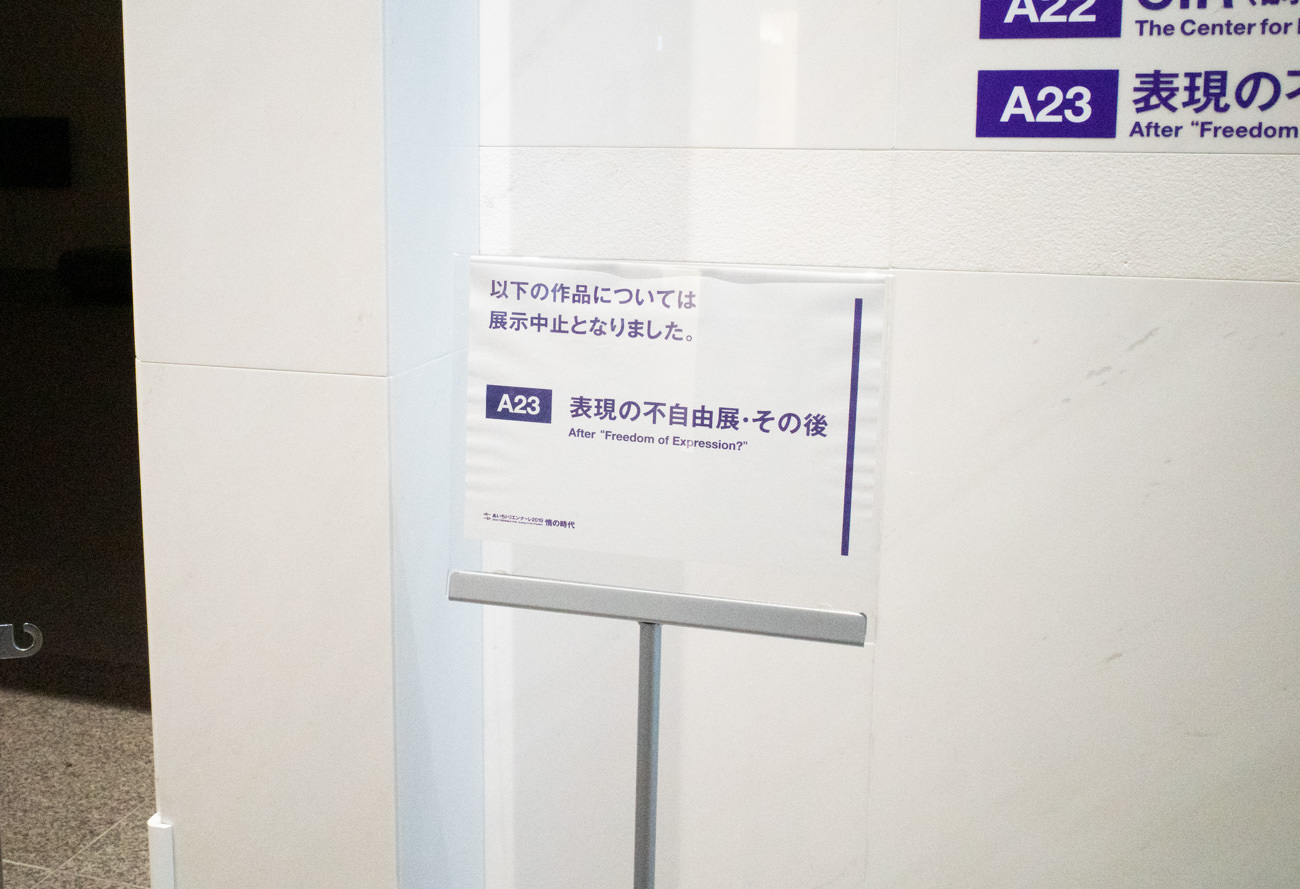
Announcement of the closure of “After ‘Freedom of Expression?'” * Photographed August 10, 2019.
Tadanori Yokoo YOKOO Tadanori 包车电车第五号方案「Tarzan」等 摄影 2011 The fifth proposal of train car decoration “Tarzan”and others, Photos, 2011 暗黑舞踏派Garumera商会 胶印 1965 “A LA MAISON DE M CIVEÇAWA”, Offset printing, 1965Tadanori Yokoo《暗黑舞踏派Garumera商会》1965年・《包车电车第五号方案「Tarzan」等》2011年
제가 방문한 것은 개회 전날인 2019년 7월 31일 열린 프레스 프리뷰, 이후 열린 Sakanaction의 어둠 라이브 타이밍에 맞춰 방문한 2019년 8월 10일, 총 두 차례입니다.
개최로부터 이미 수 개월이 지나 먼 기억이 되어버렸습니다. 그러나 이번 Aichi Triennale 2019는 전체적인 전시 기획 구성과 작품 내용이 훌륭하여 볼거리가 풍부한 내용이었다고 생각합니다. 다양한 정보가 오가기 전에 관람할 수 있었던 것은 어떤 의미에서 다행이었을지도 모릅니다.
본 기획의 감독인 Daisuke Tsuda가 프레스 프리뷰 서두에 남긴 코멘트는 “성공은 틀림없이 확실하며, 전설로 회자될 예술제로 만들고 싶다”였습니다. 결과적으로 이 말은 거짓이 아니었습니다. 성공이 아니라 “전설”이라는 의미로 말이죠.
“성공은 틀림없다, 전설로 만들고 싶다”고 말하는 Daisuke Tsuda 씨 ※2019년 7월 31일 촬영
크게 보도된 「표현의 부자유전・그 후」는 프레스 프리뷰 때 처음 공개되었던 듯합니다. 전시 작품이 밝혀진 후에 열린 당일 저녁 기자회견에서는 질문이 집중되었습니다.
개최 전날의 기자회견〜이때는 “모든 상황을 상정하고 있다, 문제없다”고 단언했습니다.
그러나 Tsuda 씨의 예측은 빗나갔습니다. 상정 이상으로 논란이 일어난 것은 아시는 대로입니다.
이 기자회견 시점에서 제가 느낀 것은 “Twitter에서 해온 방식과 완전히 똑같다”는 것. 센세이셔널한 접근이나 소재로 세간의 주목을 끄는, 웹의 주민으로서의 처신 방식이었습니다.
개최 전날 리셉션 파티〜모 현지사와 모 시장이 나란히 앉아 있네요.
Tsuda 씨의 의도대로, 미디어는 곧바로 보도를 시작했습니다.
전날 밤 NHK 뉴스(아이치)에서
프레스 프리뷰는 어떤 미술전이든 제한된 시간 안에 이루어집니다.
작품을 여유롭게 감상하기가 좀처럼 어렵고, 사진 촬영이나 관계자 인터뷰 등으로 순식간에 시간이 지나갑니다.
Aichi Triennale 2019의 프리뷰도 마찬가지로, 컨베이어 벨트에 실린 듯 각 전시장을 분주하게 이동하는 것이었습니다. 그 바쁜 흐름 속에서 「표현의 부자유전・그 후」 전시를 보게 된 것입니다.
표현의 부자유를 둘러싼 연표〜입구 바로 앞에 게시되어 있었습니다.
입구는 비교적 좁고, 서두에 설치된 연표 코너 역시 여유 있게 볼 수 있는 분위기는 아니었던 것으로 기억합니다.
문제가 된 「평화의 소녀상」은 처음 봤을 때 역시 놀랐습니다. 보도로 존재는 알고 있었지만, 실물을 실제로 보니 “아, 이것이구나…”라는 느낌으로, 예술 작품을 받아들이는 감각과는 달랐습니다. 근처에 있던 작가로 보이는 여성이 미디어의 질문에 즐겁게 답하고 있었습니다. 매우 인상적인 광경으로 눈에 새겨졌습니다.
Kim Seo-kyung/Kim Eun-sung 《평화의 소녀상》 2011년
저의 감상으로는 복잡한 마음이 교차했습니다.
시간을 들여 볼 상황이 아니었다는 점, 그리고 예술 작품으로서는 마음을 움직이는 것이 아니었다는 점. Tadanori Yokoo의 작품에 몰입했던 시간이 길어, 쇼와 천황 관련 작품에 대해서는 솔직히 알아채지 못했습니다.
Tadanori Yokoo YOKOO Tadanori 래핑 전차의 제5호안 「Tarzan」 등 사진 2011 The fifth proposal of train car decoration “Tarzan”and others, Photos, 2011 암흑무답파 가루메라 상회 오프셋 인쇄 1965 “A LA MAISON DE M CIVEÇAWA”, Offset printing, 1965Tadanori Yokoo 《암흑무답파 가루메라 상회》 1965년・《래핑 전차의 제5호안 「Tarzan」 등》 2011년
Chim↑Pom의 작품에까지 영향이 미칠 줄은 예상하지 못했습니다.
폭주하는 여론의 무서움을 느꼈습니다.
Chim↑Pom 전시 작품의 캡션〜 지금까지 약 20개국에서 전시되어 온 이 작품이지만, 어느 나라의 비엔날레 출품을 큐레이터로부터 제안받았을 때, 주최자인 Japan Foundation으로부터 거부되었다. 스태프가 오프더레코드로 이유를 알려주었는데, 그 내용을 반영한 버전으로 이번에 작품을 전시하게 되어 정말 죄송하지만, 요컨대 “아베 정권 이후 해외 사업에 대한 심사가 엄격해지고 있다. 서류상의 통지는 없지만, 최근 방사능, 후쿠시마, 위안부, 조선 등의 NG 워드가 있고, 이를 어기면 총리와 가까운 부서의 인물로부터 직접 컴플레인이 온다.”는 것이었다. NG 워드를 흐리는 편집도 제안되었지만, 결국 다른 작품을 출품하는 것으로 합의되었다. 이번에는 그 제안에 따른 버전을 전시. “지금은 참을 수밖에 없다”는 직원의 안타까운 말에 전전(戰前)과 같은 울림을 느꼈다.(Chim↑Pom)Chim↑Pom 《기합 100연발》 2011년・《견디기 힘든 기합 100연발》 2015년
「표현의 부자유전・그 후」 전시실을 지배하고 있던 것은 전체 콘셉트대로의 것이었습니다.
억압되어 온 표현의 자유를 둘러싼 수많은 역사를 현대에 묻는 기획 의도가 분명히 담겨 있었습니다. 그 전시 공간이 하나의 작품으로 기능하고 있다고 느꼈습니다.
이후의 보도나 다양한 예술 관계자의 의견 등을 대체로 훑어보았지만, 그중 몇 명이 그 자리에서 작품을 감상하고 전체를 체감할 수 있었을까요.
Aichi Triennale의 새틀라이트 회장이기도 한 Toyota Municipal Museum of Art에서는 Kenjiro Okazaki의 개인전이 개최되었습니다. 전시회 배포 자료에서 다음과 같은 소개문을 찾을 수 있었습니다.
Okazaki는 이 세계는 결코 일원적인 것이 아니며, 서로 양립할 수 없는 고유성을 지닌 뿔뿔이 흩어진 복수의 세계로 이루어진다고 말합니다. 그리고 그것들이 하나로 융합되지 않고, 각자의 개성을 유지한 채 교류가 가능해지는 어디에도 없는 장소가 성립할 때, 풍요로운 창조성이 태어난다는 생각을 견지해 왔습니다.
표현이 무언가를 대표해 버리는 것을 의심하고 저항하며, 더 주변적인 것, 작은 것이 가진 가능성을 존중하는 것. Okazaki의 활동이 하나에 머무르지 않고 항상 많은 사람과 사물들과 네트워크를 맺고 확장해 온 것은, 이러한 복수 세계에 대한 확신의 표출이라고 할 수 있습니다.
「Kenjiro Okazaki 시각의 계층」전에서
Okazaki 씨가 언급하는 것과 같은 사물을 바라보는 방식과 상상력을 가지고, 미술과 사회를 바라볼 수 있게 되고 싶다고 생각했습니다.