Art collectors, how do you manage your collection?
In this article, “collection management” doesn’t mean managing the works themselves in a warehouse, but managing work information—that is, a summary article about turning work information into a database.
In the first place, is it necessary to turn purchased works into a database?
As your collected works increase, or as time passes after buying a work, they fade into oblivion.
Which work did you buy, and for how much?
Where is the work currently stored?
What’s the title and year? Did it come with a certificate?
…and so on—there’s a great deal of information attached to collected works, and unless you manage it with text and image information, you won’t be able to retrieve the information you need later.
You’ll want to record information related to collected works early on.
This time, as a collection-management tool, managing with a tool called Notion is what I’d like to recommend.
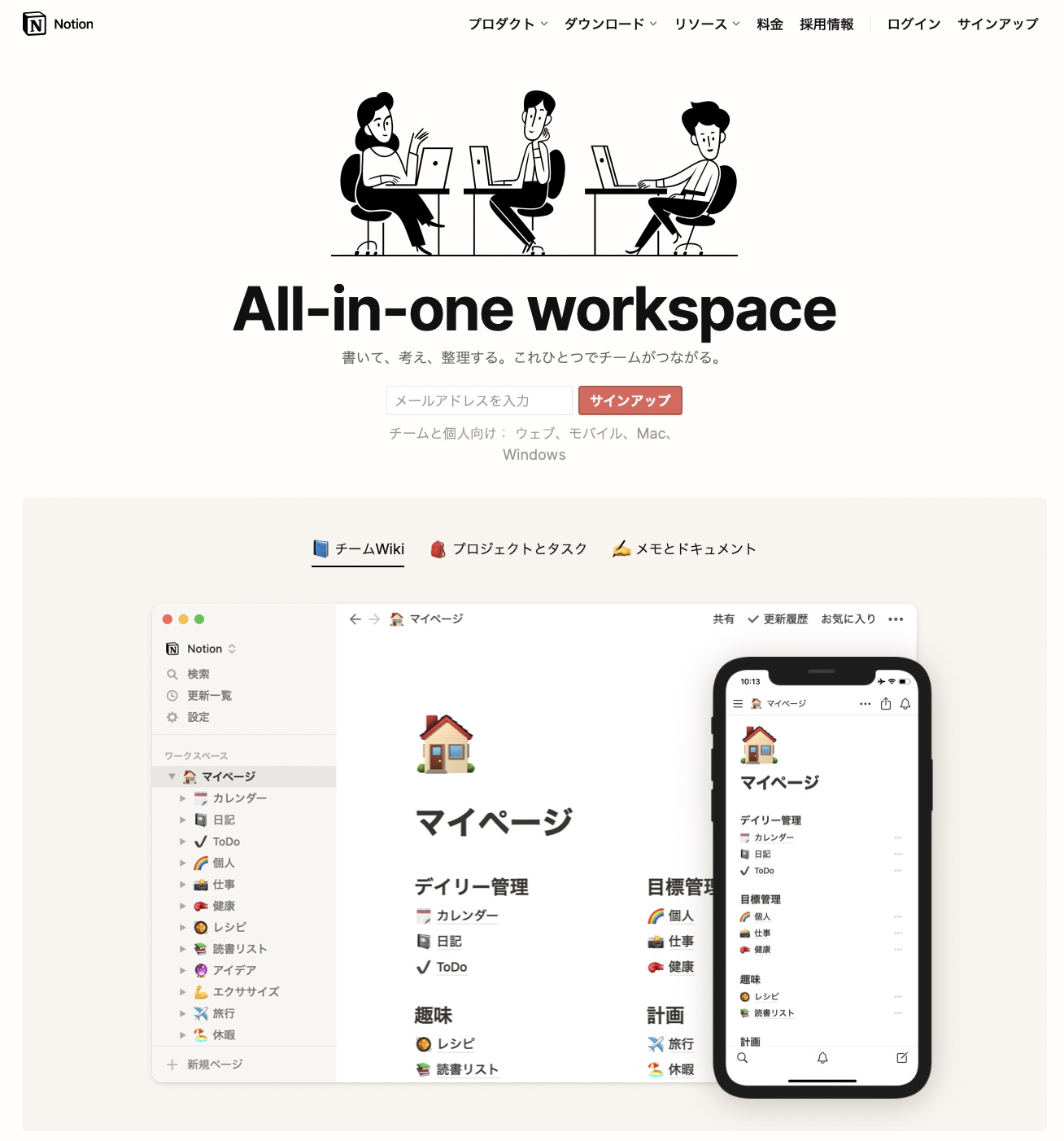
Notion is an all-in-one workspace for note-taking, project management, and task management, developed by Notion Labs Inc, a startup founded in 2016 based in San Francisco.
In a word, isn’t it a “do-anything document tool”?
Also, with the October 2021 update it was made available in Japanese, becoming quite familiar to us.
Until now, I’d been using Evernote to manage information on collected works.
But now that I know Notion, I immediately decided to switch.
The reason is that it’s wonderfully easy to use.
Below, I’ve summarized seven reasons.
Usable for free
Free customization however you like
Already Japanese-compatible; you can input quickly and easily.
Viewable and editable across different devices. Use it anytime, anywhere.
Packed with abundant features—automatic calculation of collection amounts, images can be embedded too
Using the gallery view, it can also be used like a website
A multi-tool usable for work and private life, for everyday use
Note that Notion is updated from time to time and evolves daily.
It’s quite conceivable that even more attractive reasons will be added.
Many ways to use it are posted on YouTube and websites, so please take a look.
“7 reasons” to recommend Notion
Now, I’d like to summarize the “7 reasons” to recommend Notion below.
1) Usable for free
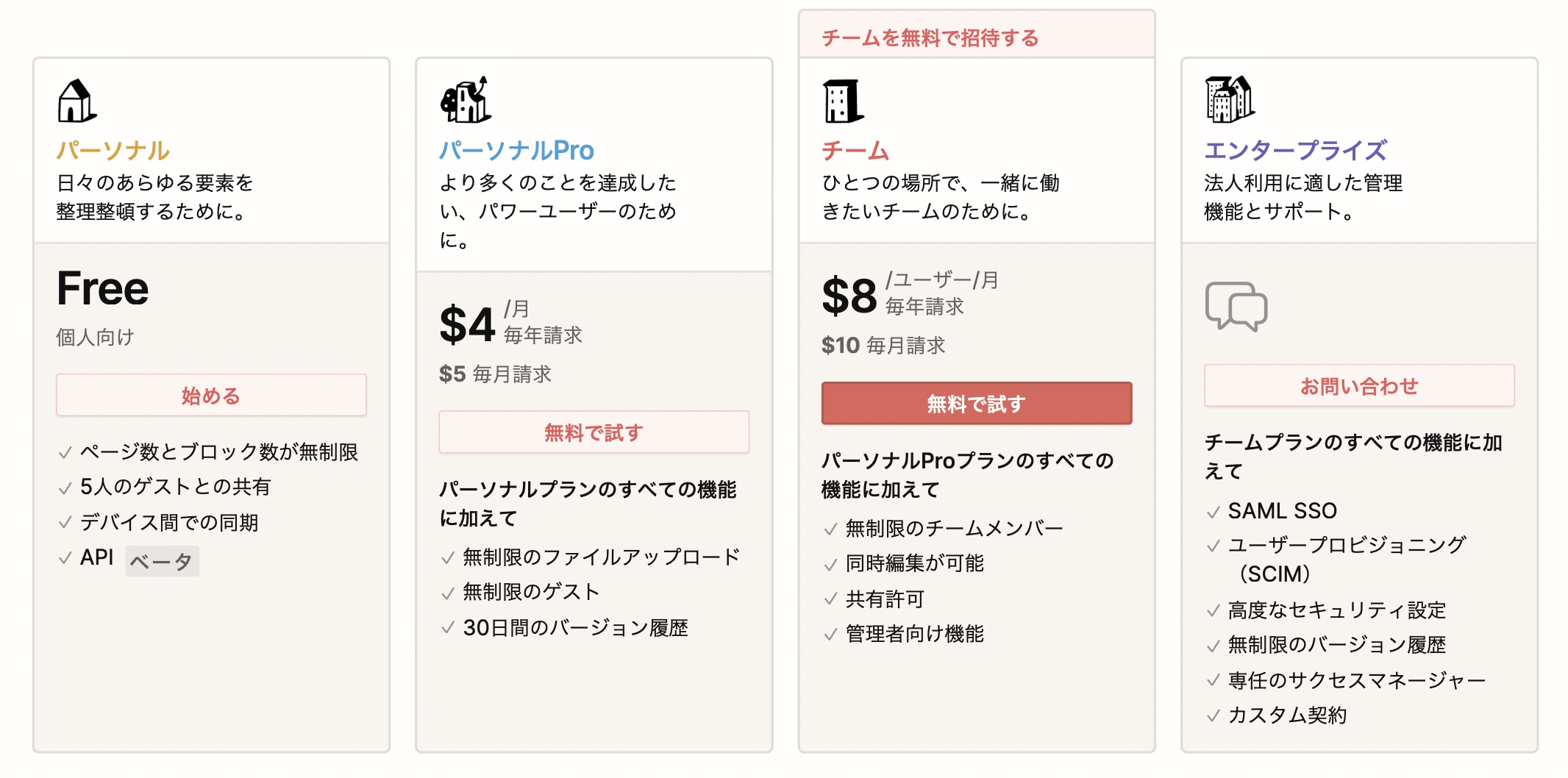
Notion is a free tool. *There are also paid plans.
There are art-specialized online tools from overseas services, but they’re paid and cost quite a bit.
Notion is a completely free, multi-tool that can do memos, calculations, and image storage.
Note that if you exceed a capacity of 5MB, such as with image files, use is restricted. An upgrade to the paid version is required.
These are Notion’s pricing plans.
Those who want to use it for free need to be creative—for example, uploading work images to another place like Instagram and writing the URL link as text data.
2) Free customization however you like
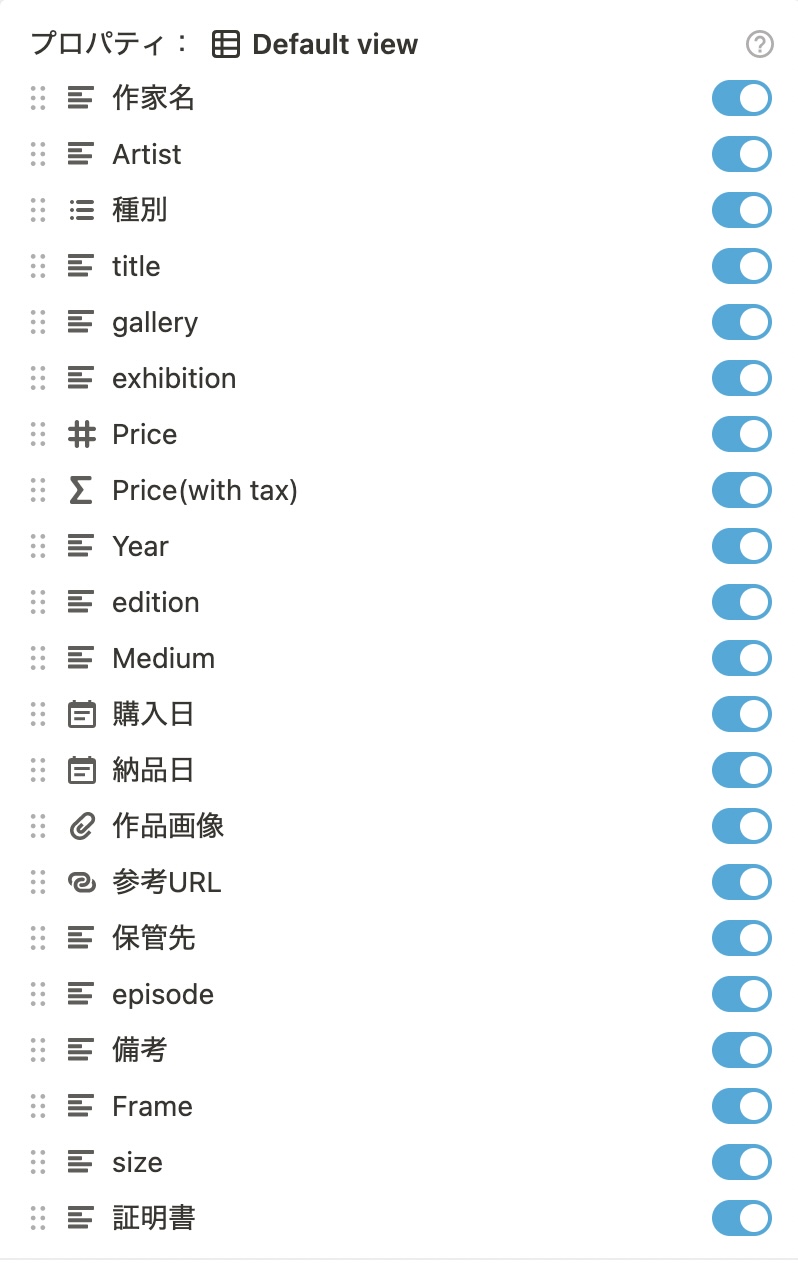
You can input many fields too. Sorting by each field is also easy, so customize it according to your purpose and use scene.
Fields can be set at your discretion.
The mark displayed at the head of each field indicates that the input format differs.
Basically it’s text input (character input), but you can freely set year-month-day as “calendar,” amounts as “number,” images as “file attachment,” and so on.
Data you create can also be exported as CSV. Even if you find Notion’s usability poor, it’s designed to make moving to another service easy.
3) Comfortable operation—input quickly and easily
Although Notion is a cloud service, you can input smoothly and lightly. Because it operates lightly, there’s little stress and input is very comfortable.
The UI is also wonderful; even if it looks complex, once you get used to it, it’s very usable.
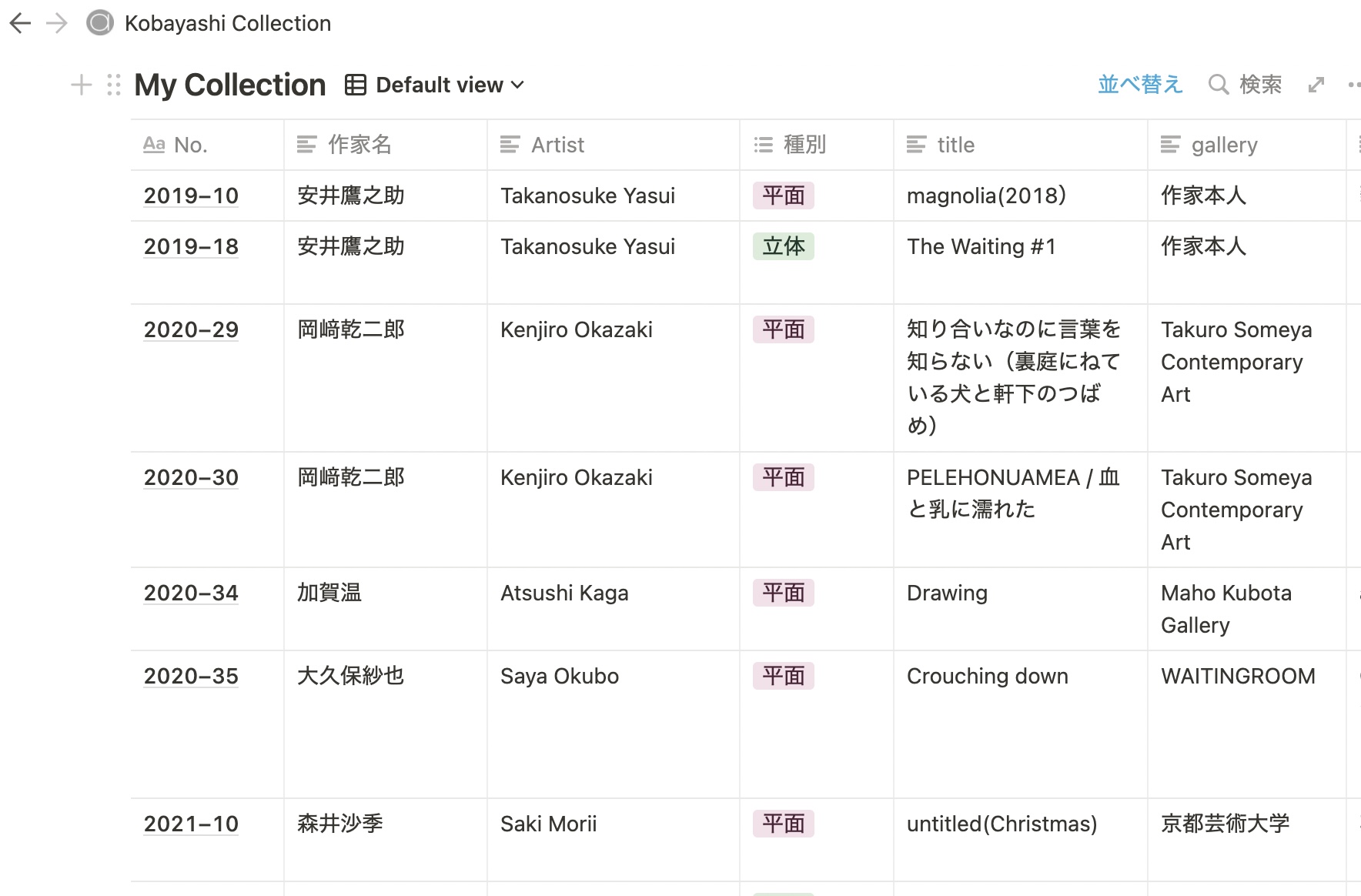
Keep adding more information and images to the fields you’ve created.
4) Viewable and editable across different devices. Use it anytime, anywhere
Notion has web, PC, and app versions, so you can use it according to your use scene.
Inputting information from a PC at home, checking your collection from a smartphone app while out—it doesn’t depend on the device, so it’s very usable. It supports both Windows and Mac OS.
5) Packed with abundant features—automatic calculation of collection amounts, images can be embedded too
Notion is feature-rich and can be used freely for collection management.
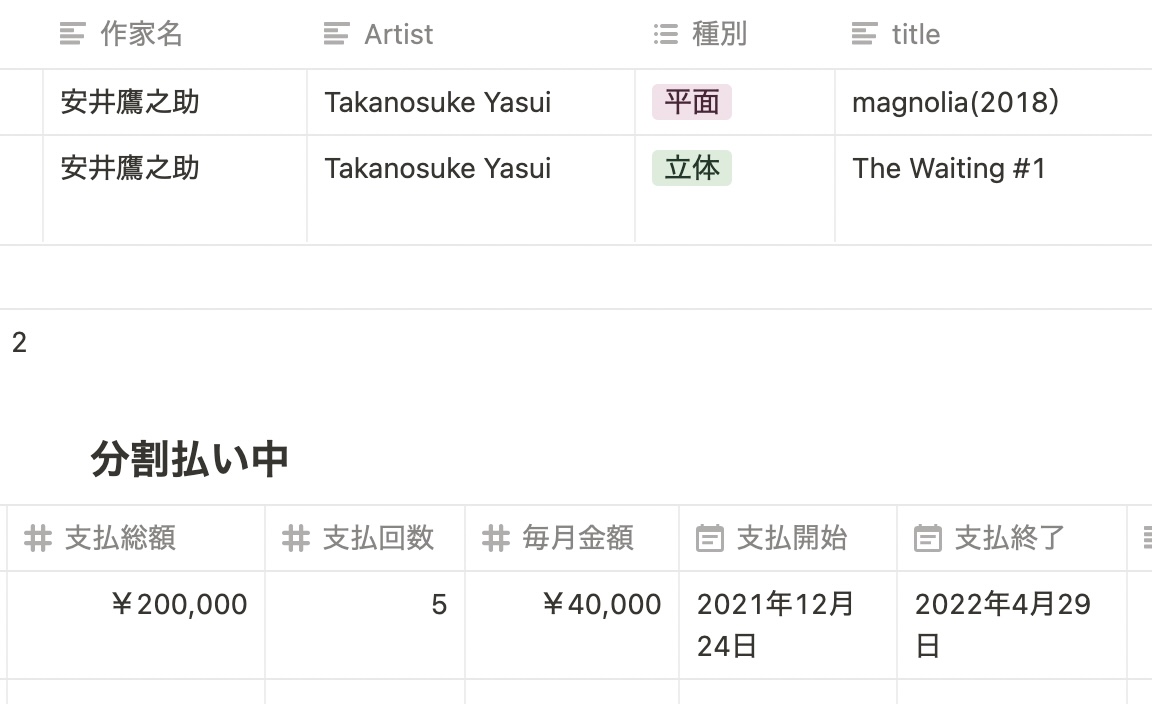
It supports functions like Excel, so the total amount of your collected works is auto-calculated, and using the group feature you can display your collection by artist.
Also, beyond the list of collected works, you can manage on the same screen the status of works you’re paying for in installments, or a list of artists you want to consider in the future.
*The screen is one example—you can create as many fields as you want to manage as a database.
Images can be attached too, and you can also add materials such as PDFs.
6) Using the gallery view, it can also be used like a website
You can also publish your organized collection externally as a single website.
External publishing is possible with a button.
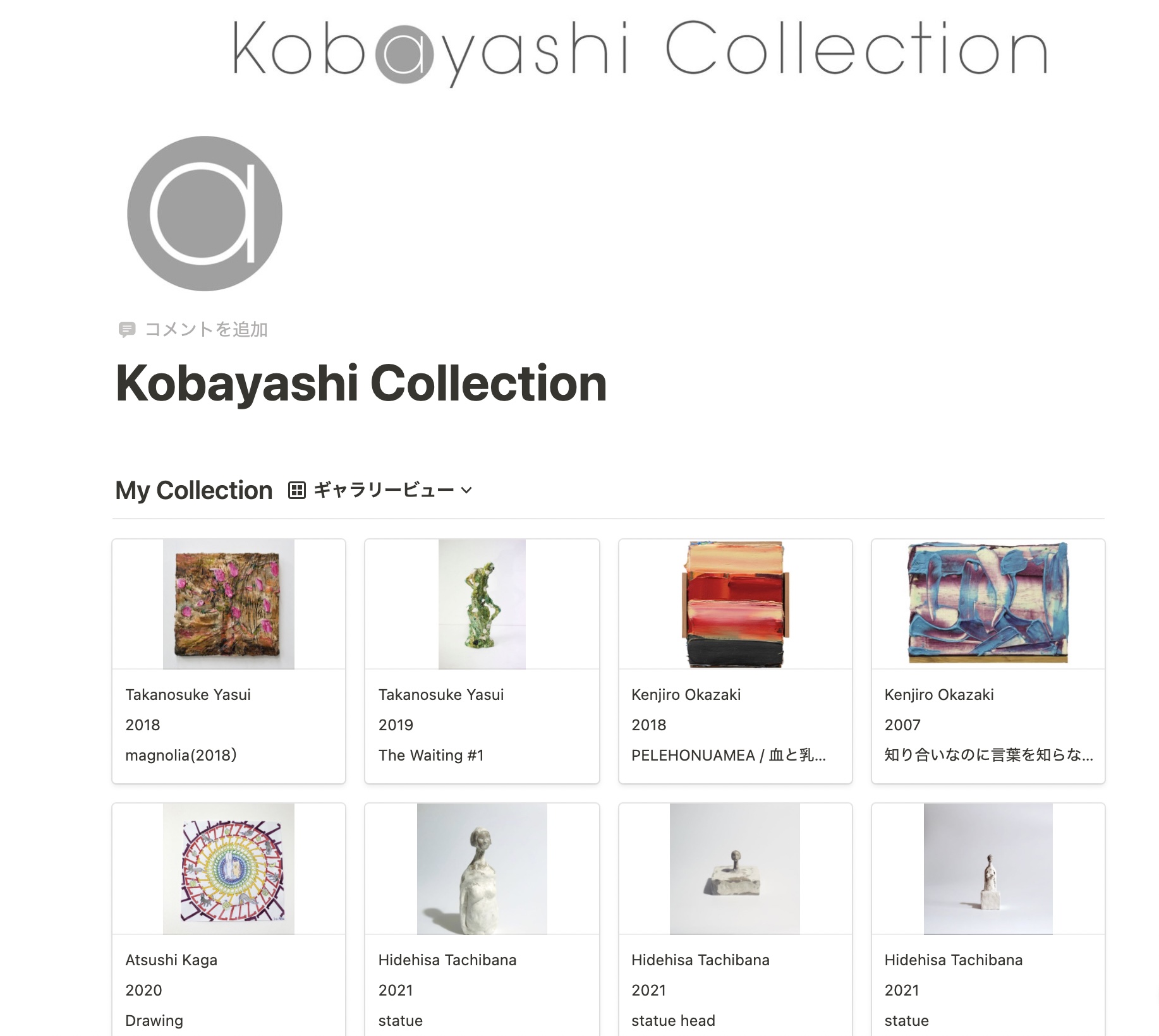
Notion lets you upload images, and view formats are diverse; in the gallery-view selection screen that displays images, a collection-site-like presentation like below is possible. A URL is issued, so external publishing is possible.
Notion screen in “gallery view” mode
It’s a tool not just for managing but for enjoying viewing yourself.
Within the gallery view, you can also sort to group by artist, display chronologically, and so on.
7) A multi-tool usable for work and private life, for everyday use
Notion can be used not only for collection management but also for work and private life.
I switched from Evernote to use it.
Since there are more scenes to use it in both work and daily life, it’s become a tool I use every day.
Managing art news I want to save, or exhibition info I can’t miss—it seems it’ll be a big help beyond collection management too.
You can gather the latest Notion information from the SNS below.
If you’re interested, do check it out.