Kisō no Keifu (Lineage of Eccentrics): The Miracle World of Edo Painting
On Saturday, February 9, 2019, amid falling snow in Ueno, Tokyo, the exhibition “Kisō no Keifu (Lineage of Eccentrics): The Miracle World of Edo Painting” opened at the Tokyo Metropolitan Art Museum.
The exhibition title “Kisō no Keifu” derives from Lineage of Eccentrics, written in 1970—nearly half a century ago—by art historian Nobuo Tsuji.
A recent example of a book title being adopted as an exhibition name is the “Scary Paintings” exhibition, but for an exhibition of Japanese painting this is a first.
Lineage of Eccentrics introduced a wealth of paintings that had never before been presented together in books or exhibitions—works that broke the shell of convention and defied expectation, drawing viewers into extraordinary worlds through free and innovative ideas. Nobuo Tsuji’s achievement in gathering these works under the word “eccentric (kisō)” and making them known to the world deserves the highest praise.
The 2016 “Jakuchu exhibition” became so popular that wait times reached up to 320 minutes.
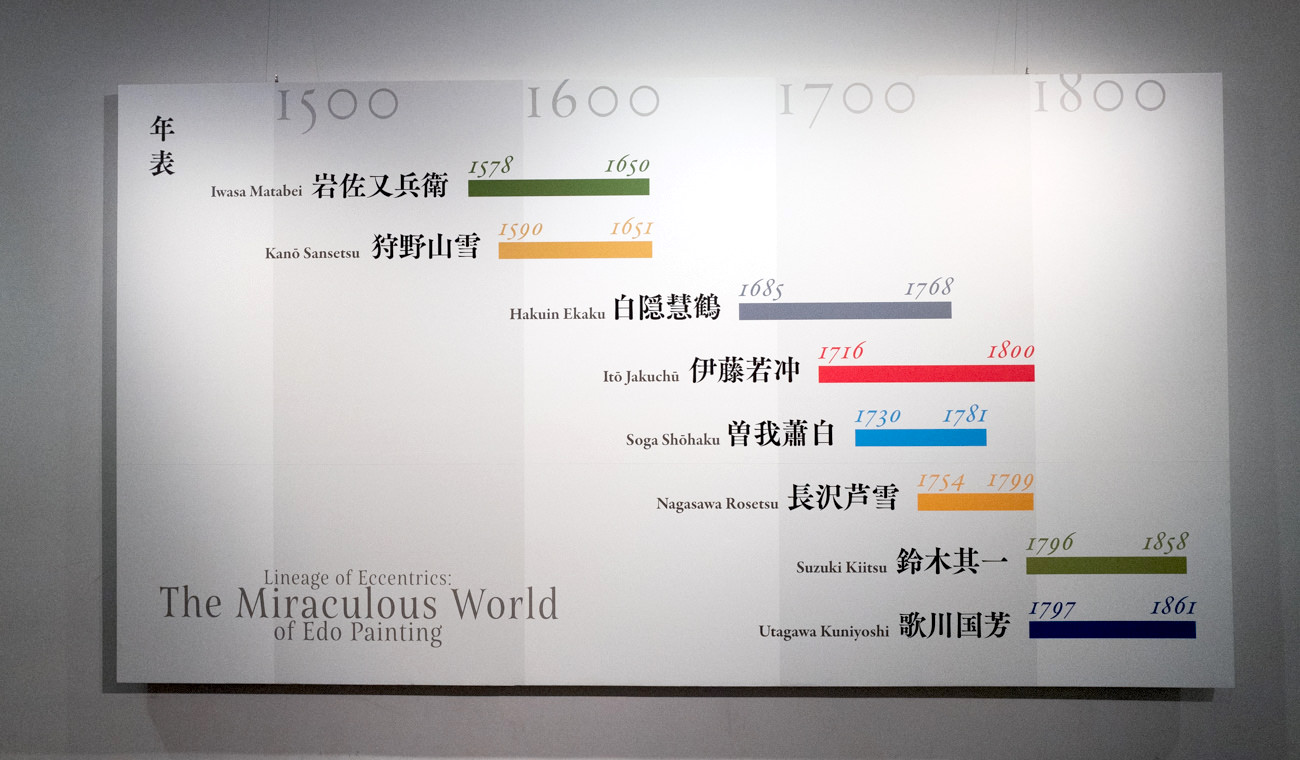
Venue guide map plotting the active periods of the eight artists on a timeline
This exhibition features eight painters in total: the six taken up in Lineage of Eccentrics—Iwasa Matabei, Kano Sansetsu, Ito Jakuchu, Soga Shohaku, Nagasawa Rosetsu, and Utagawa Kuniyoshi—plus two more, Hakuin Ekaku and Suzuki Kiitsu.
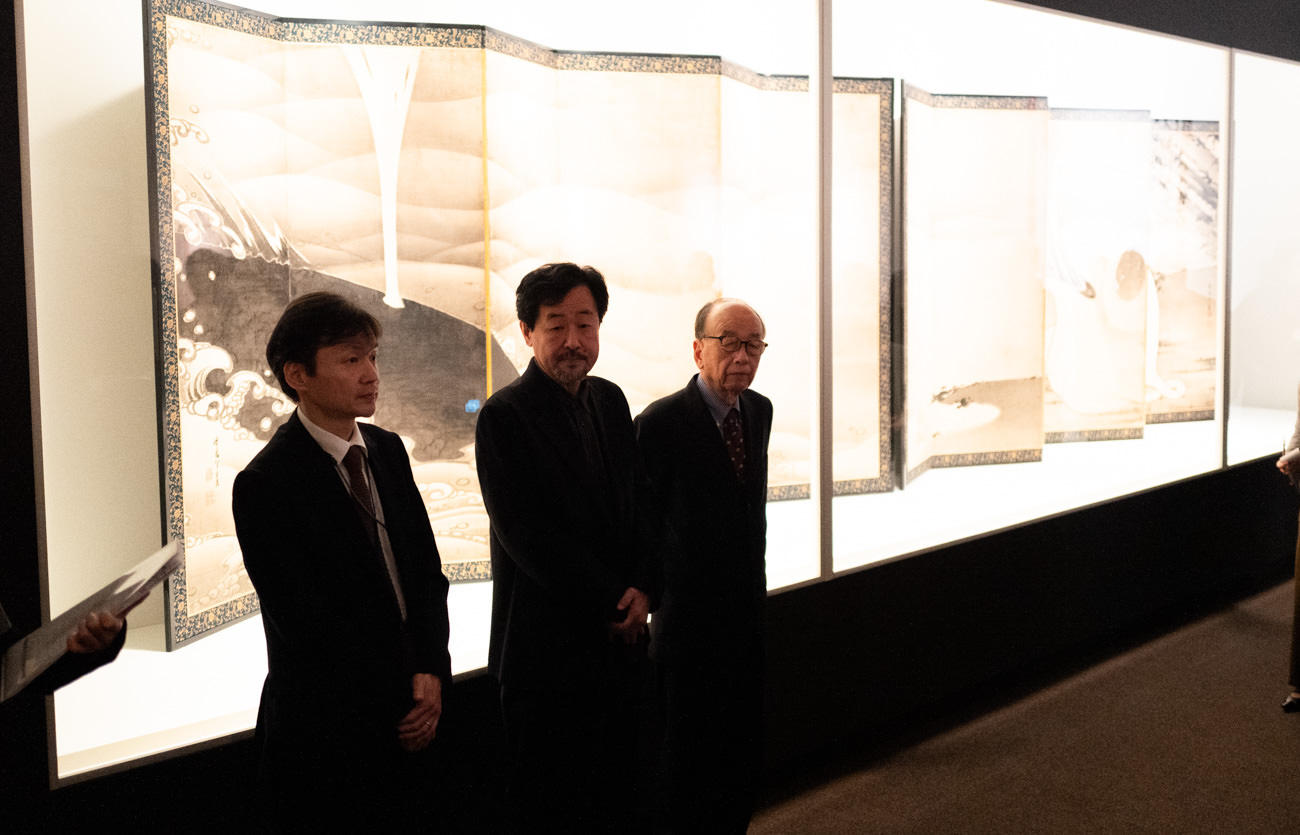
Left: Junko Nakahara (curator); Center: Yuji Yamashita (exhibition supervisor); Right: Nobuo Tsuji (author of Lineage of Eccentrics)
At the press preview, Nobuo Tsuji remarked in his greeting that this was “an exhibition that fills you up.” True to his words—”a lavish all-star billing with content everyone can enjoy”—it is a rich and deeply satisfying exhibition.
Ito Jakuchu
The exhibition is organized artist by artist across the eight painters.
The first gallery is Ito Jakuchu. What supervisor Yamashita calls the “three eccentric crows”—Jakuchu, Shohaku, and Rosetsu—are placed in the first half.
Jakuchu is shown with 18 works in all.
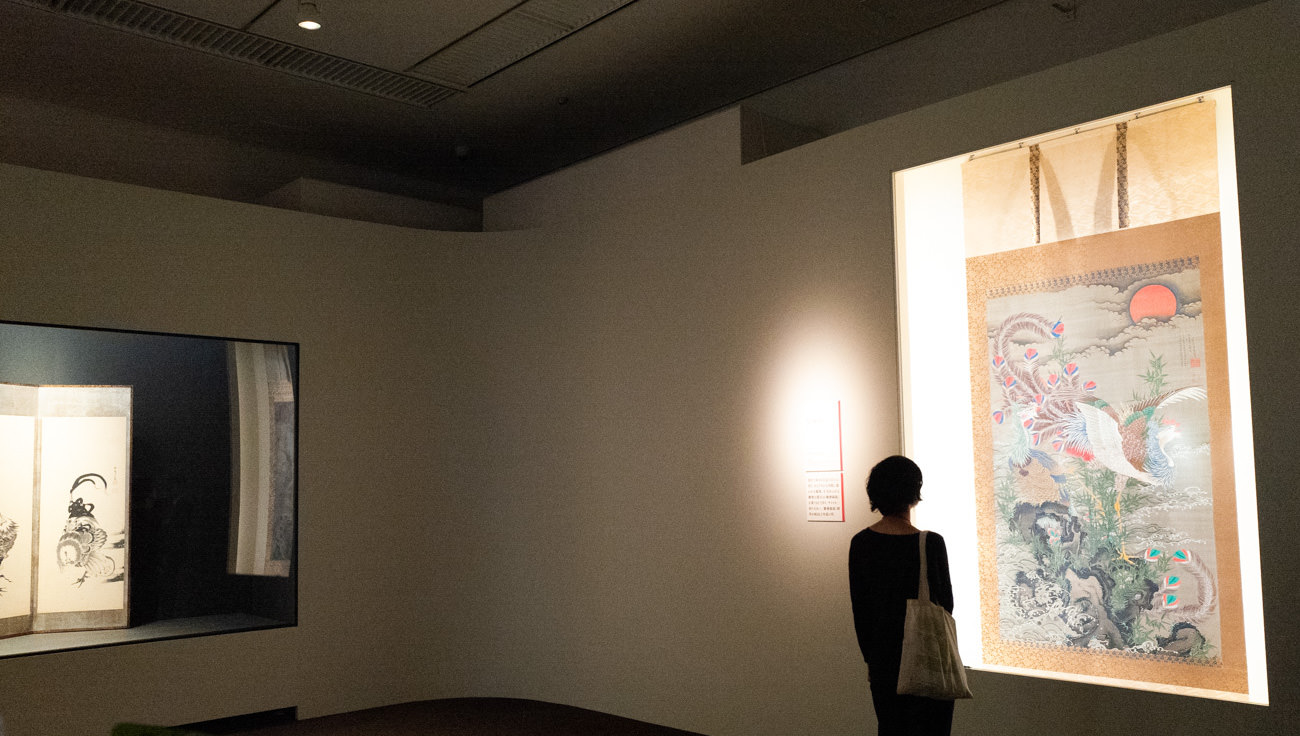
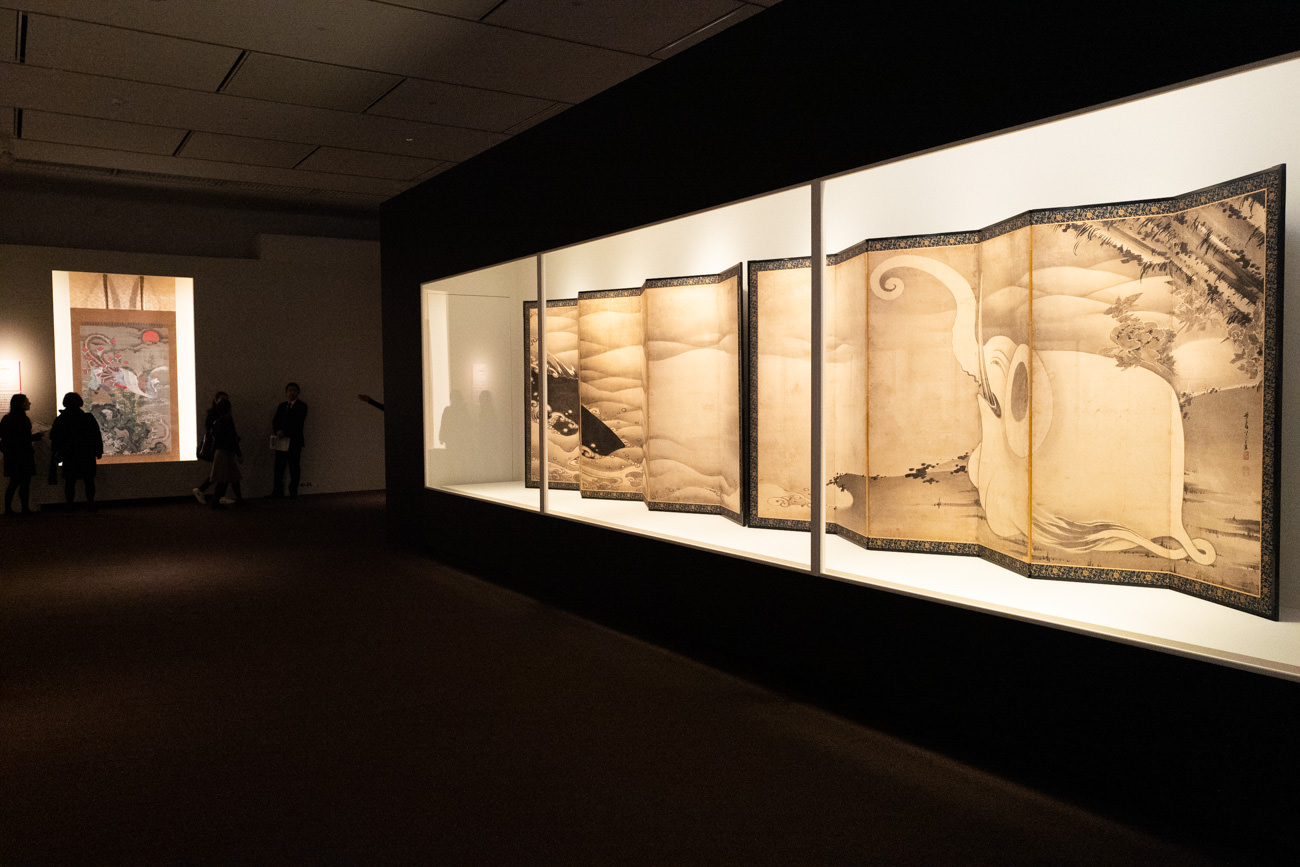
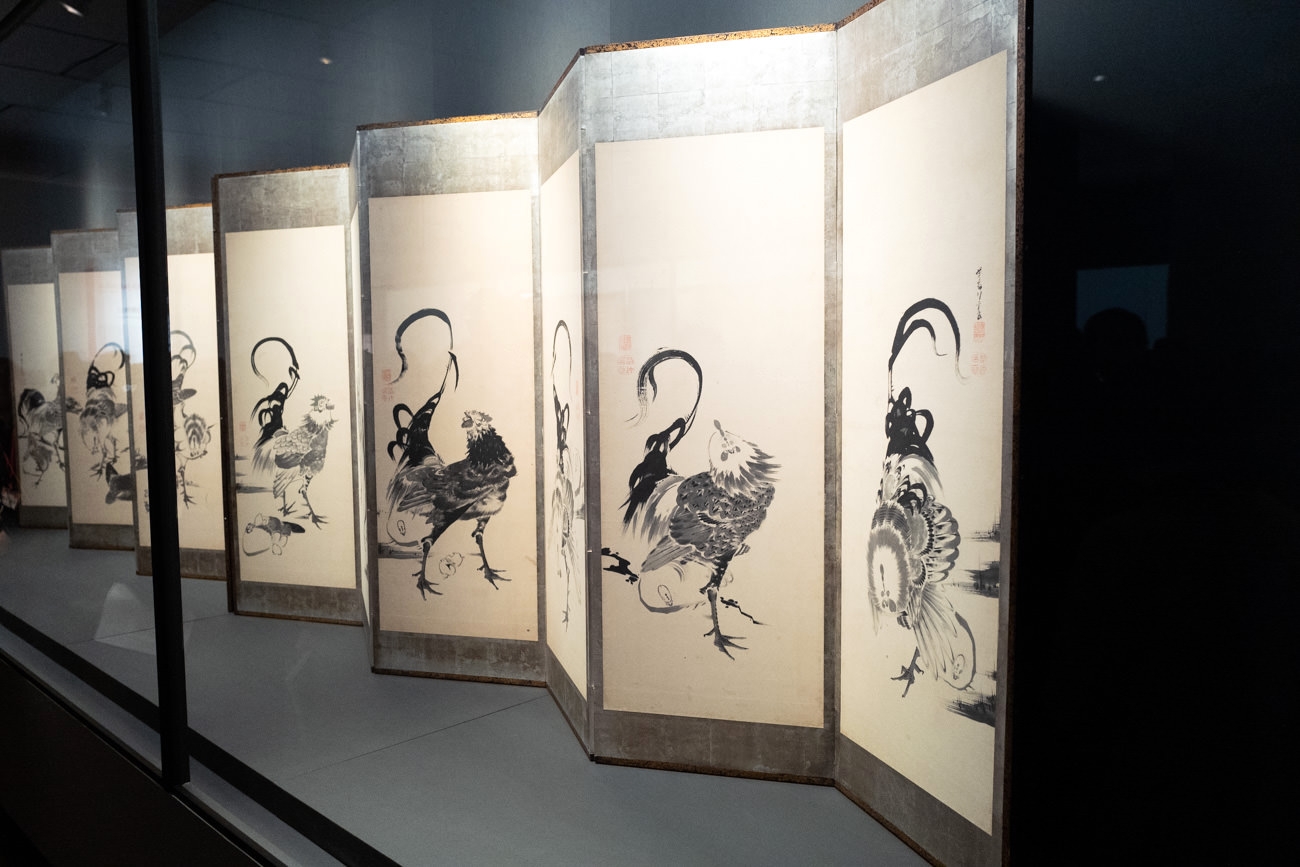
Ito Jakuchu, 《旭日鳳凰図》, Hōreki 5 (1755), Sannomaru Shozokan, Imperial Household Agency [On view: 2/9–3/10]Ito Jakuchu, 《象と鯨図屛風》, ink on paper, pair of six-panel folding screens, 159.4×354.0 cm each, Kansei 9 (1797), MIHO MUSEUM, ShigaIto Jakuchu, 《鶏図押絵貼屏風》, ink on paper, pair of six-panel folding screens, 167.0×348.0 cm each, mid-Edo period (18th c.), private collection
Soga Shohaku
Next comes Soga Shohaku.
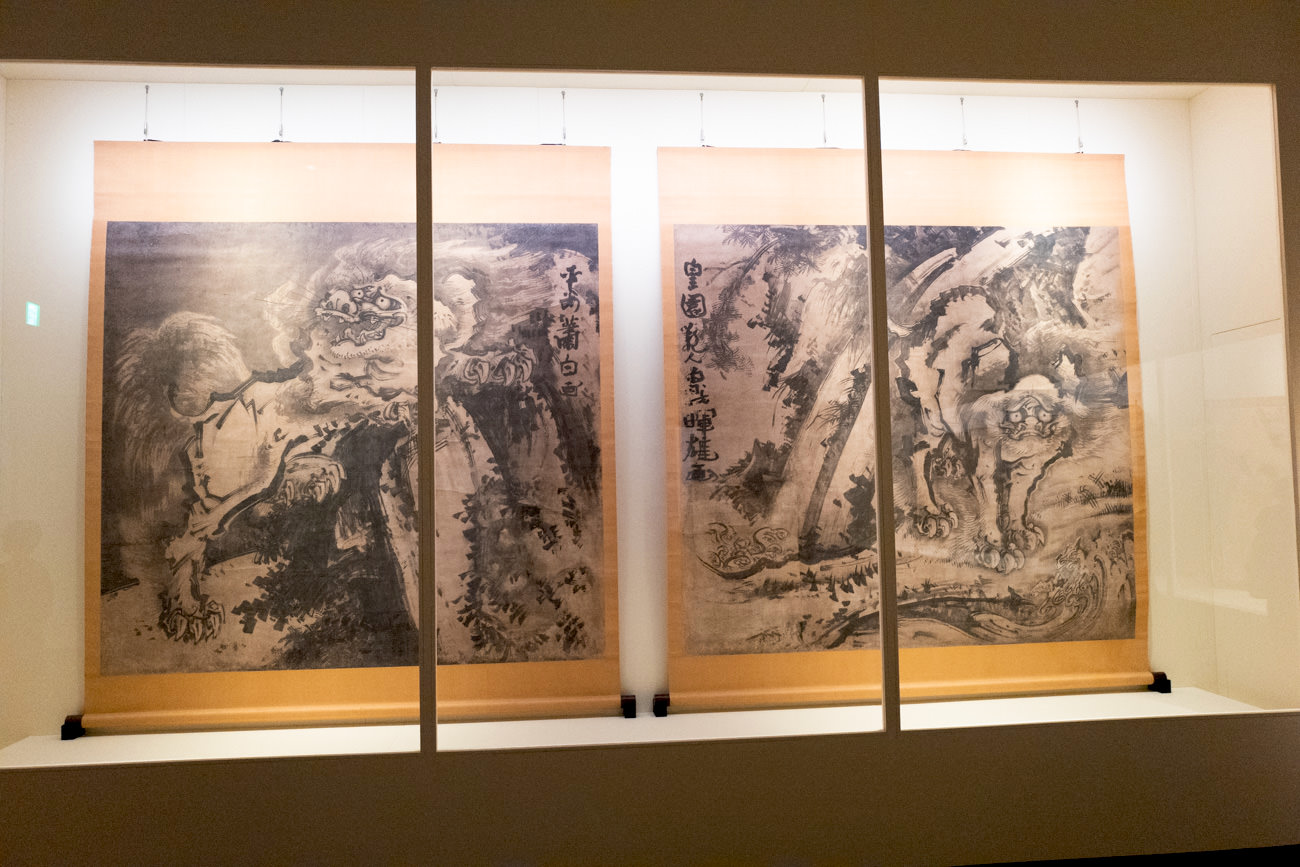
Among the geniuses of the 18th-century Kyoto painting world, Shohaku pursued the most intense expression of all. In his late twenties he claimed to be a direct heir of the Muromachi-period Soga school and took the Soga surname. He studied Chinese-style painting and depicted many traditional tales of Chinese immortals and sages, yet his expression was original and filled with madness—at times grating on the viewer’s nerves and plunging them into a vortex of chaos.
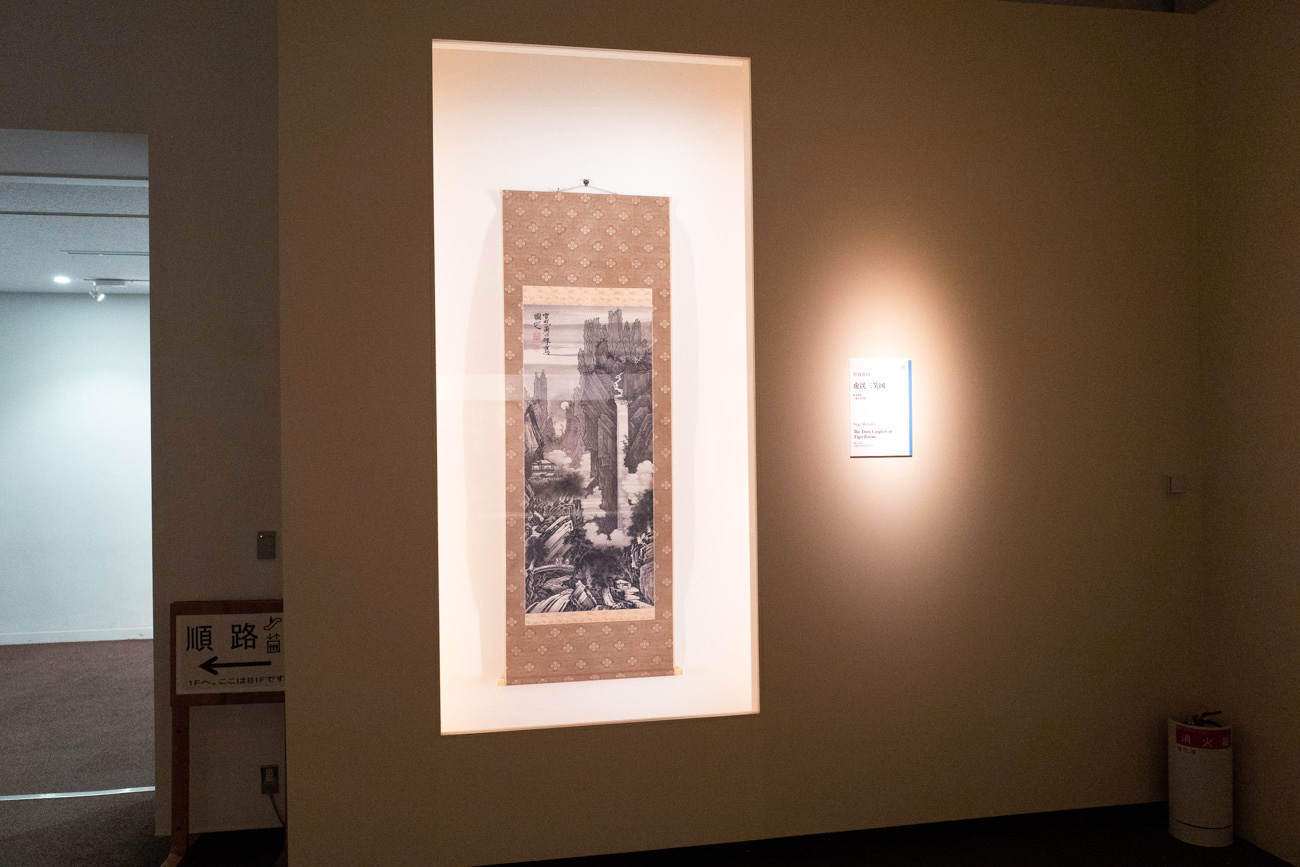
Soga Shohaku, 《雪山童子図》, c. Meiwa 1 (1764), Keishō-ji, MieSoga Shohaku, 《唐獅子図》, ink on paper, pair of hanging scrolls, 224.6×246.0 cm each, c. Meiwa 1 (1764), Chōden-ji, Mie [On view: 2/9–3/10]Soga Shohaku, 《虎渓三笑図》, ink on paper, 132.5×56.3 cm, date unknown, Chiba City Museum of Art
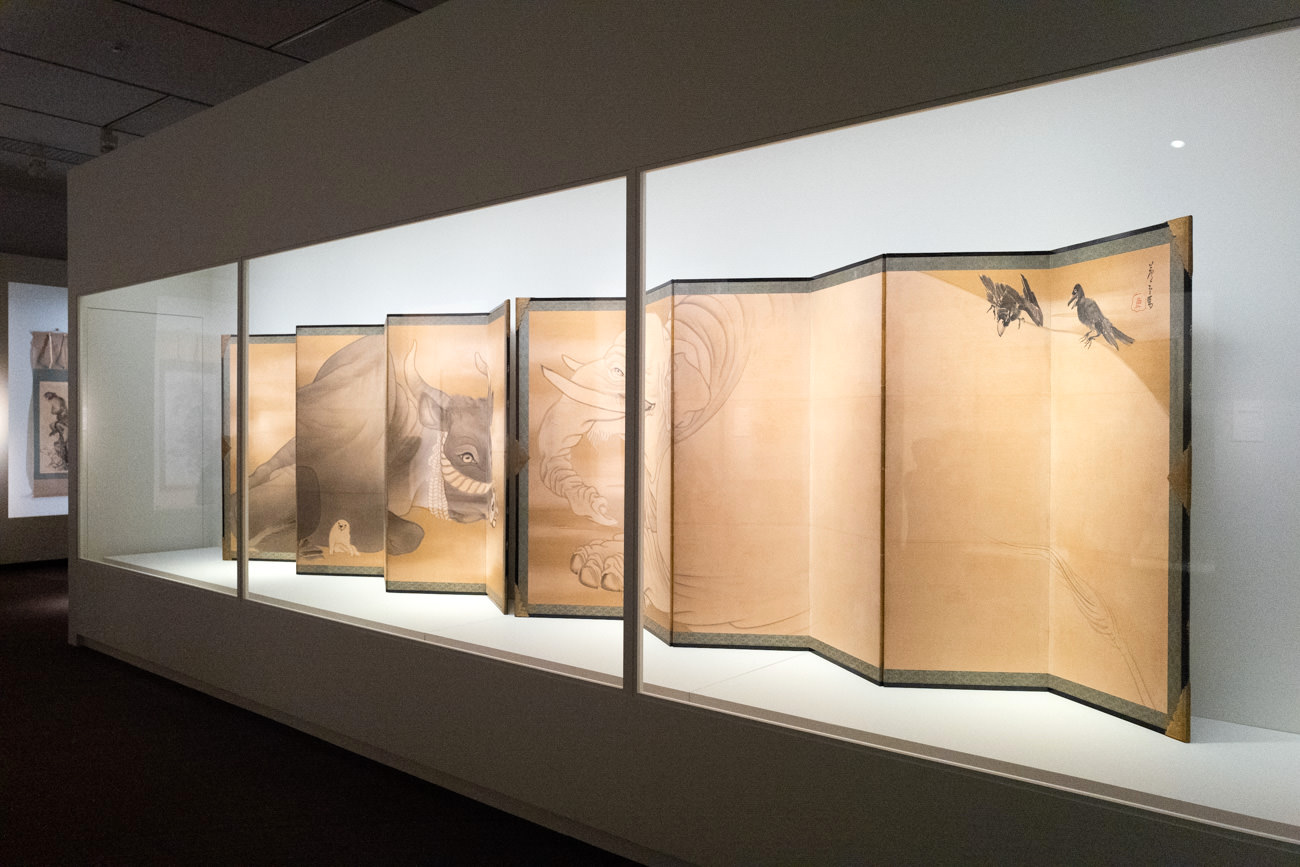
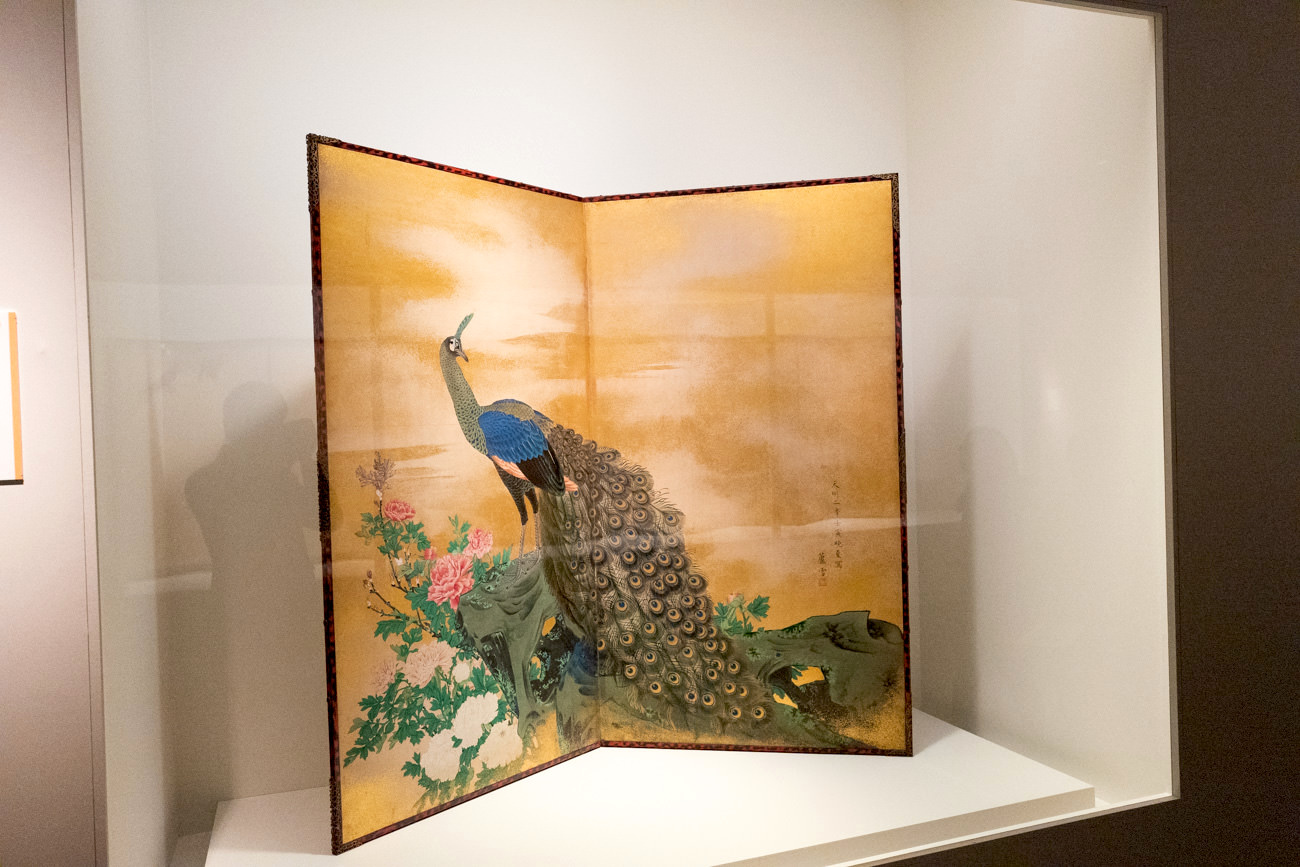
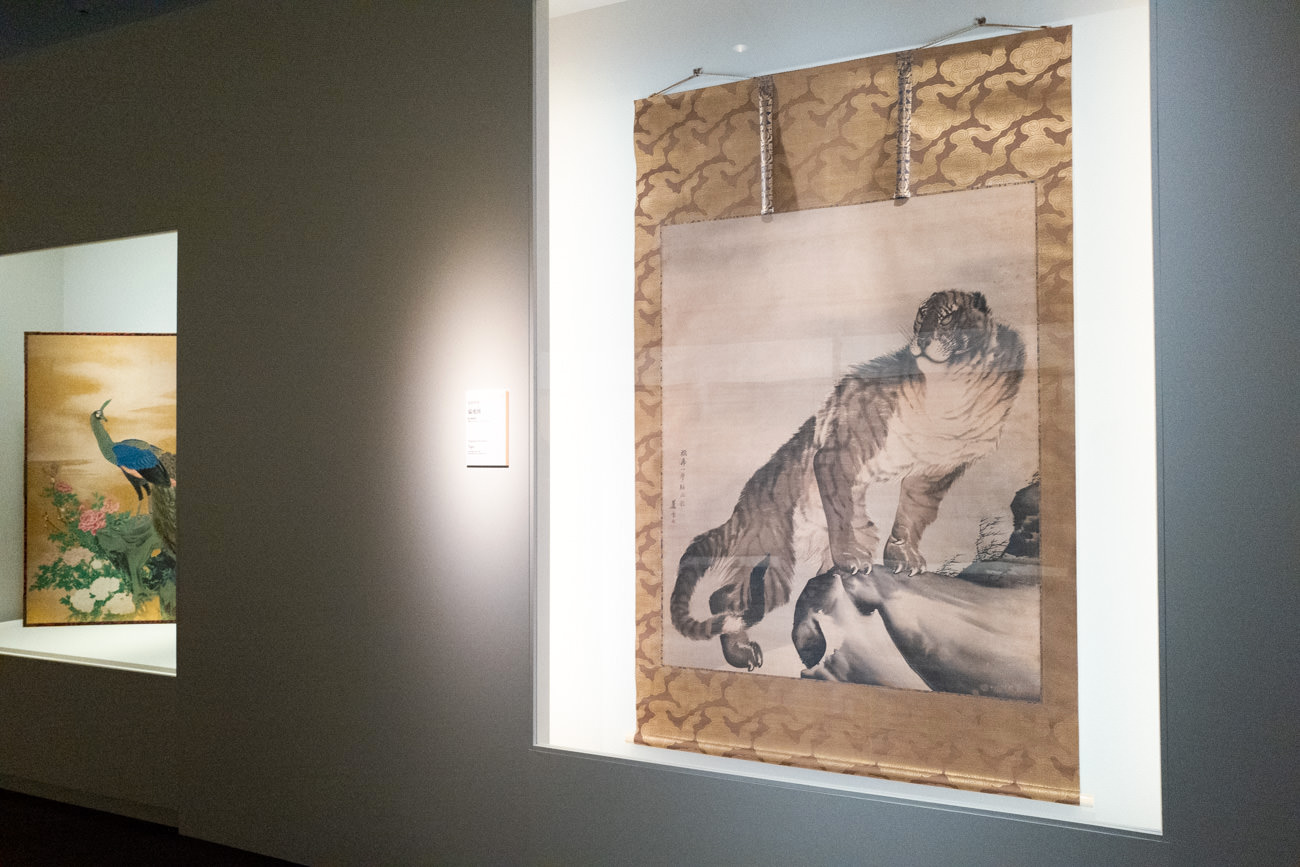
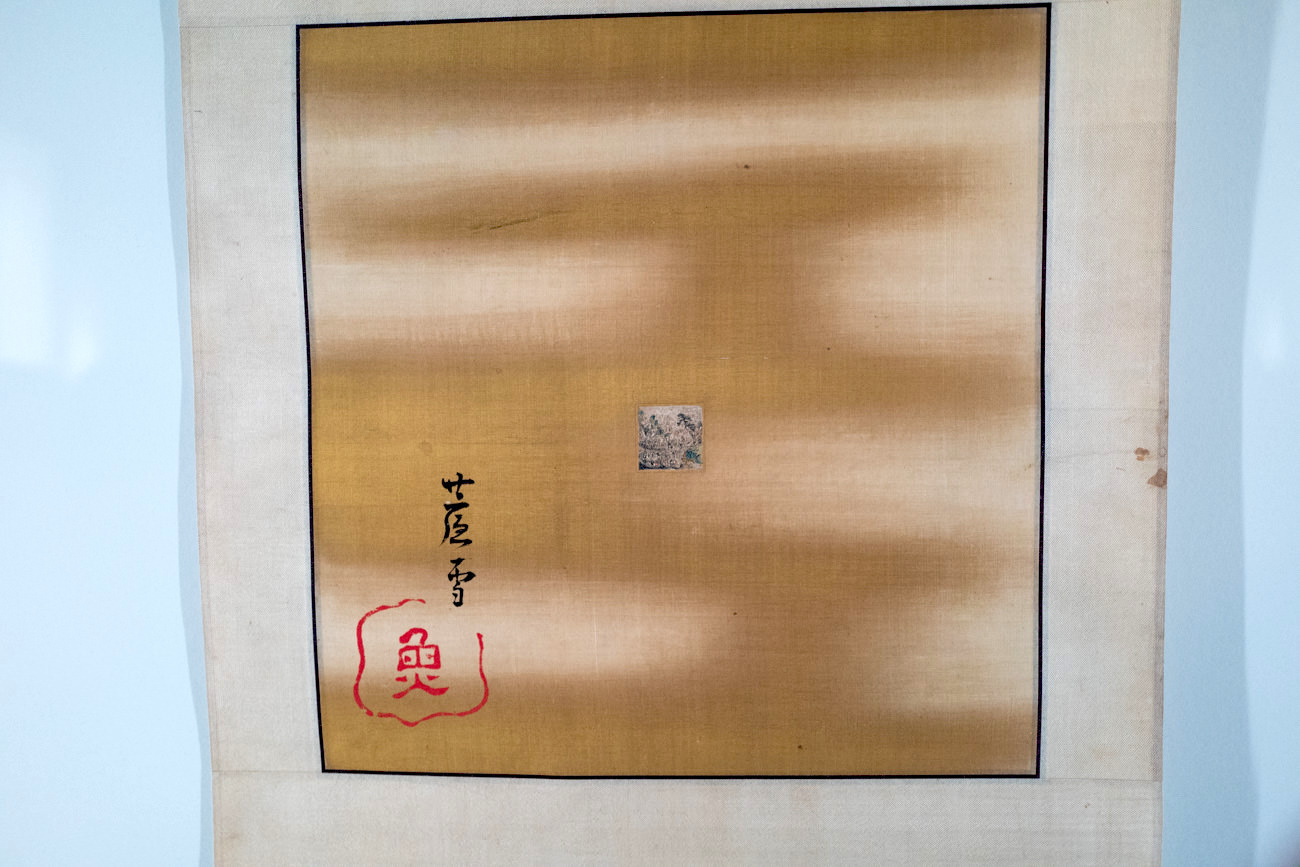
Nagasawa Rosetsu
Born the son of a low-ranking samurai in Sasayama, Kyoto, Rosetsu studied under Maruyama Ōkyo. While most of Ōkyo’s pupils faithfully followed the master’s realistic painting method, Rosetsu opened up his own artistic realm with bold compositions and a free, brilliant brush, leaving many distinctive works full of an entertainer’s playful spirit.
The uniqueness of the tiny 3.1 cm-square work 《方寸五百羅漢図》 drew an involuntary smile.
Nagasawa Rosetsu, 《白象黒牛図屏風》, ink on paper, pair of six-panel folding screens, 155.3×359.0 cm each, mid-Edo period (18th c.), Etsuko & Joe Price Collection, USANagasawa Rosetsu, 《牡丹孔雀図》, color on paper, pair of two-panel folding screens, Tenmei 2, 166.9×184.6 cm, Etsuko & Joe Price Collection, USANagasawa Rosetsu, 《猛虎図》, ink and light color on silk, hanging scroll, 163.5×131.0 cm, Etsuko & Joe Price Collection, USANagasawa Rosetsu, 《方寸五百羅漢図》, ink and light color on silk, hanging scroll, Kansei 10 (1798), 3.1×3.1 cm
Iwasa Matabei
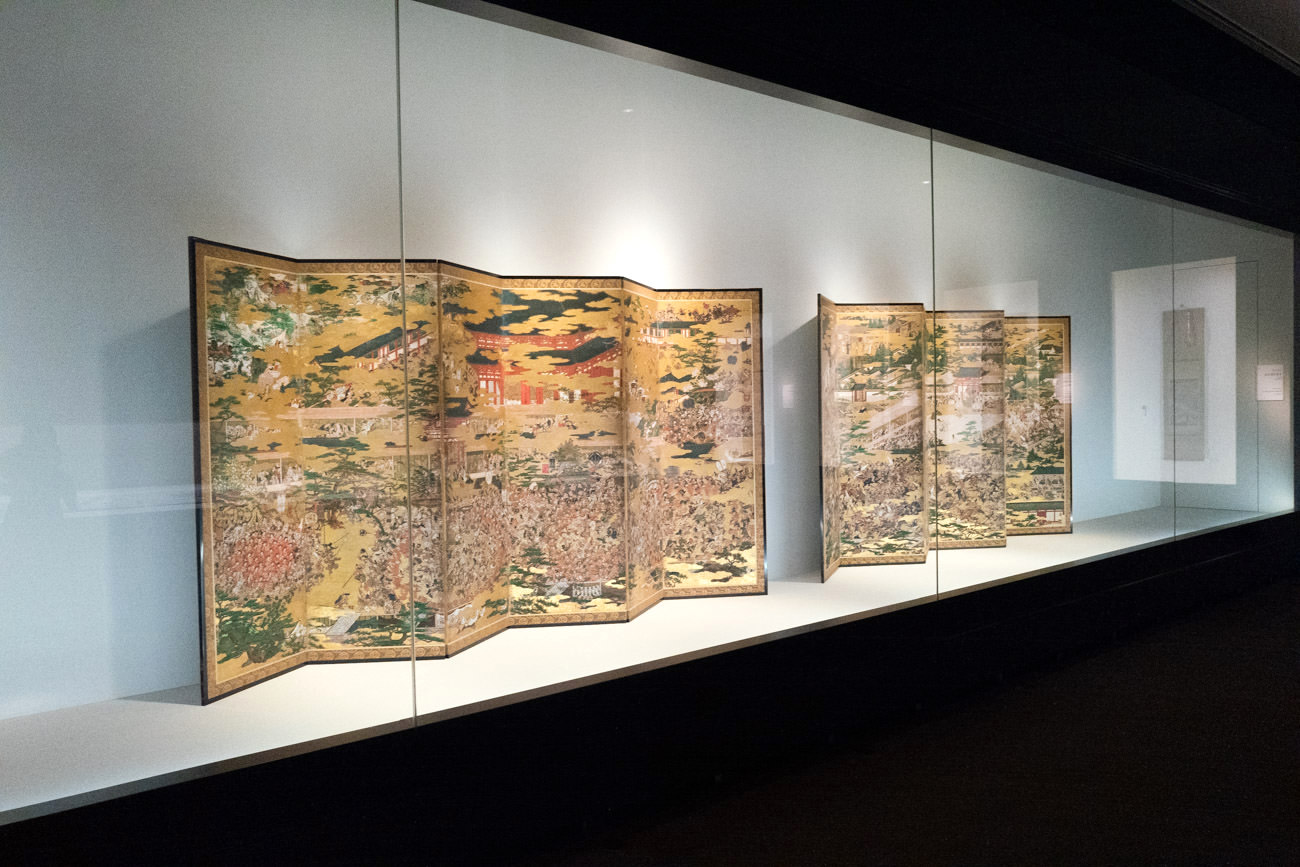
Iwasa Matabei, the subject of Tsuji’s master’s thesis and arguably his life’s work, comes next.
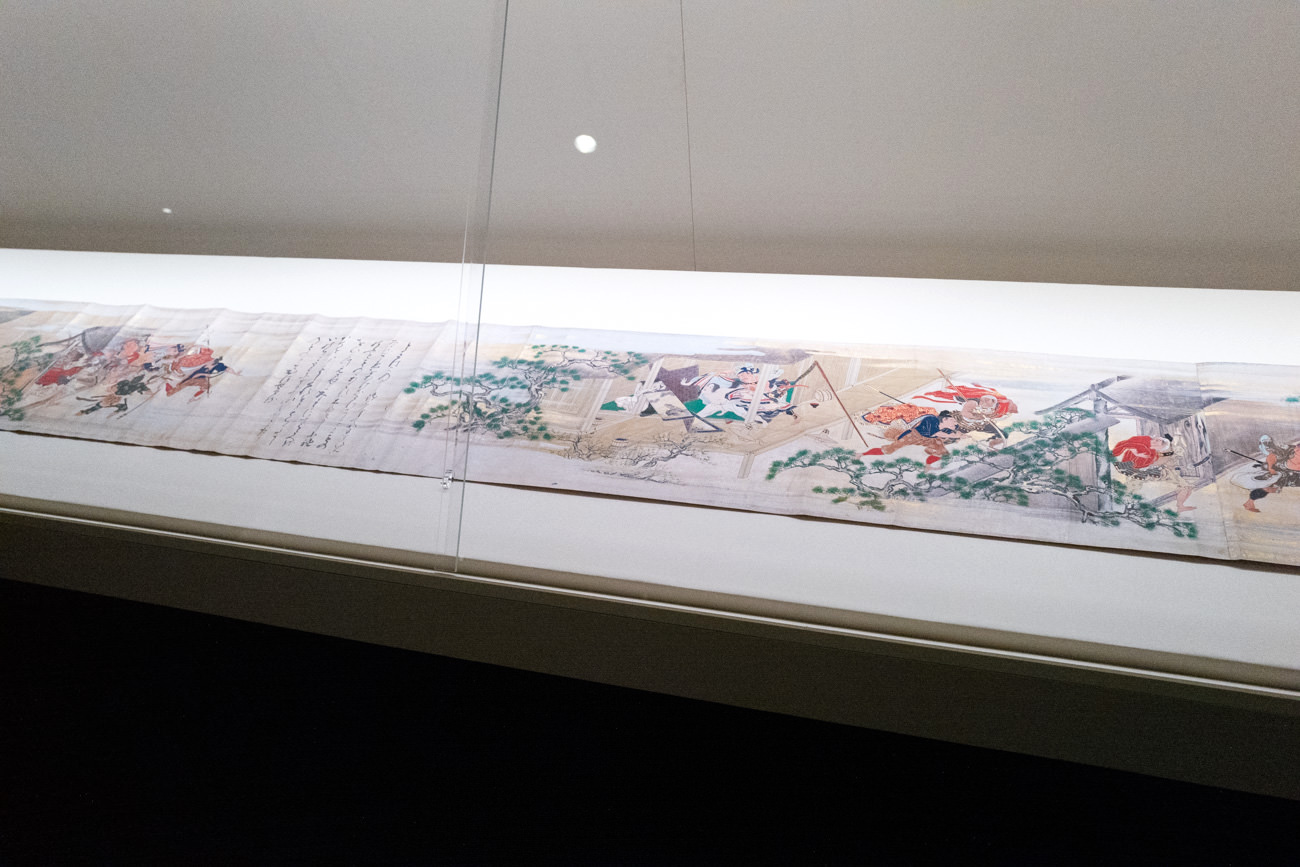
Around 20 works touching on Matabei—called the mysterious ukiyo-e master—can be seen, including a self-portrait and picture scrolls.
The presentation of this zone seems packed with Tsuji’s personal attention: the handscrolls could be viewed up close from above, making them very easy to appreciate.
Iwasa Matabei, 《山中常盤物語絵巻 第四巻(十二巻のうち)》, color on paper, one scroll, 34.1×1259.0 cm early Edo period (first half of 17th c.), MOA Museum of Art, Shizuoka [On view: 2/9–3/10]Iwasa Matabei, 《洛中洛外図(舟木本)》, pair of six-panel folding screens, color on gold-ground paper, 162.7×342.4 cm each, Tokyo National Museum
Kano Sansetsu
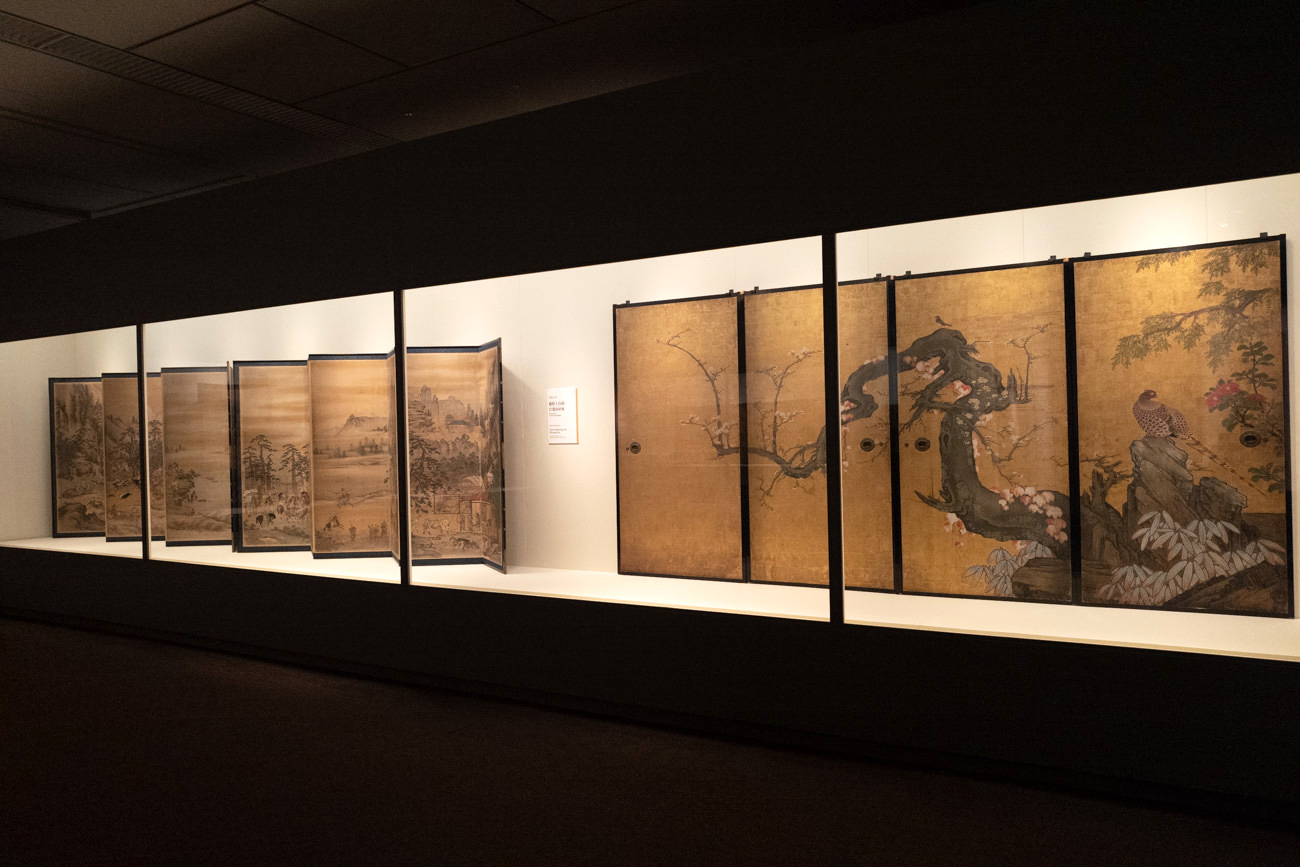
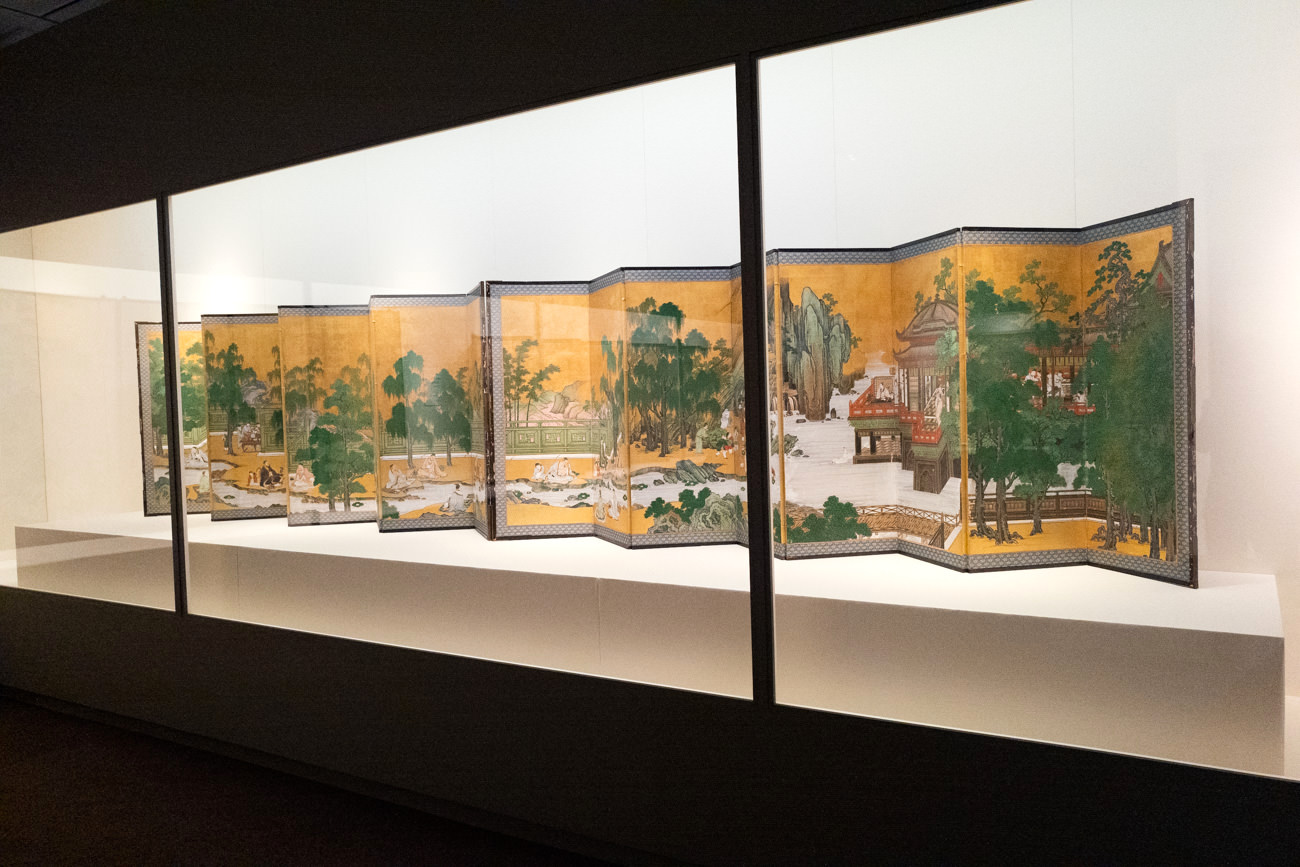
Kano Sansetsu is known for reinterpreting traditional subjects from his own perspective, using intellectual geometric compositions that emphasize verticals, horizontals, and isosceles triangles.
Kano Sansetsu, 《梅花遊禽図襖絵》, color on gold-ground paper, four panels, 184.0×94.0 cm each, Kan’ei 8 (1631), Tenkyū-in, KyotoKano Sansetsu, 《蘭亭曲水図屏風》, pair of eight-panel folding screens, color on gold-ground paper, 107.5×355.2 each, Zuishin-in head temple, Kyoto
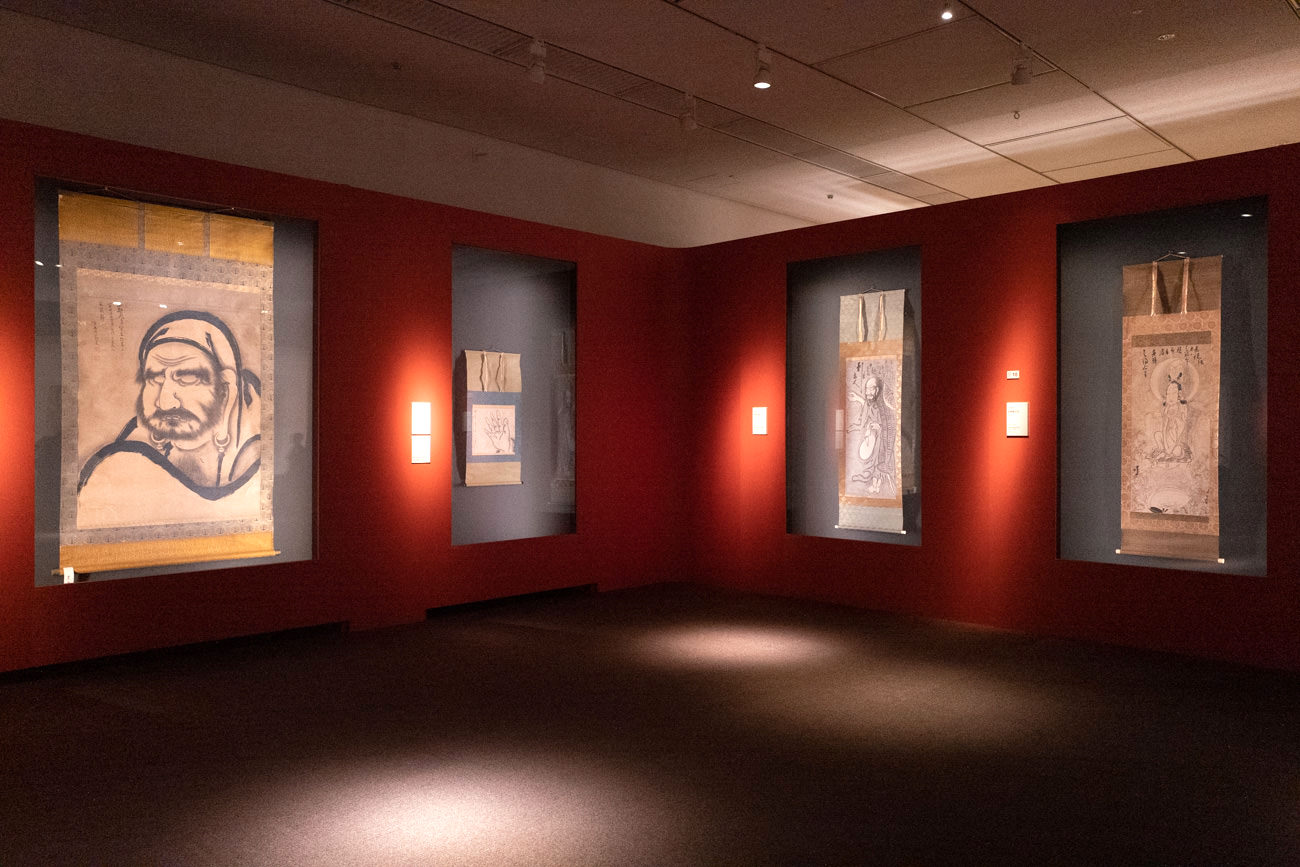
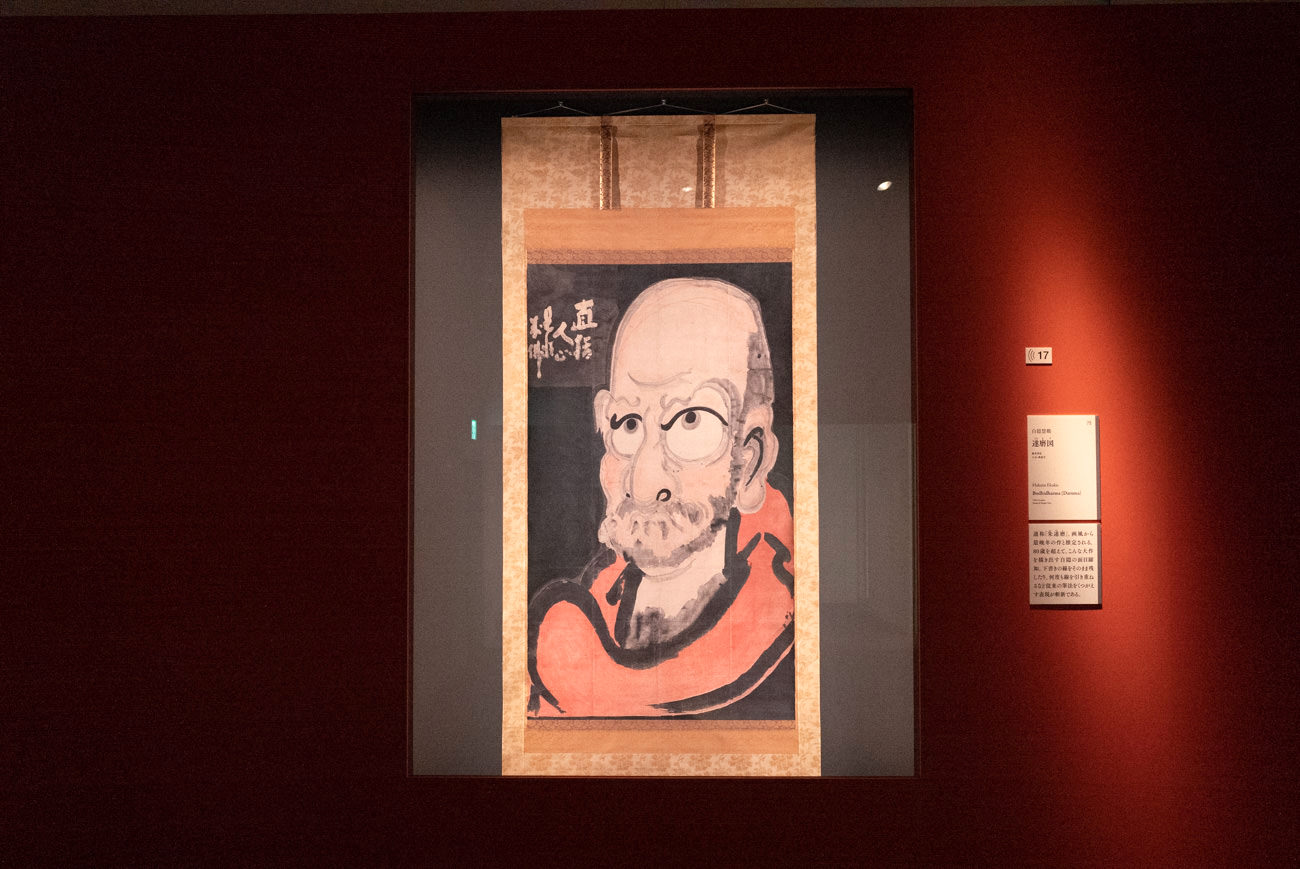
Hakuin Ekaku
A Zen monk called the reviver of the Rinzai sect. Born in Suruga’s Hara-juku (present-day Numazu), he became a monk at 15. In Zen, said to “stand not on words,” Hakuin left an enormous number of Zen paintings and calligraphy.
Not a professional painter, his seemingly humorous, light, yet bold paintings and calligraphy—created as a means to convey the Buddha’s teachings—served as a catalyst for the eccentric painters of the 18th-century Kyoto world such as Shohaku, Rosetsu, and Jakuchu.
From the installation view — Hakuin EkakuHakuin Ekaku, 《半身達磨図》, color on paper, hanging scroll, 192.0×112.0 cm, Edo period (18th c.), Manju-ji, Oita
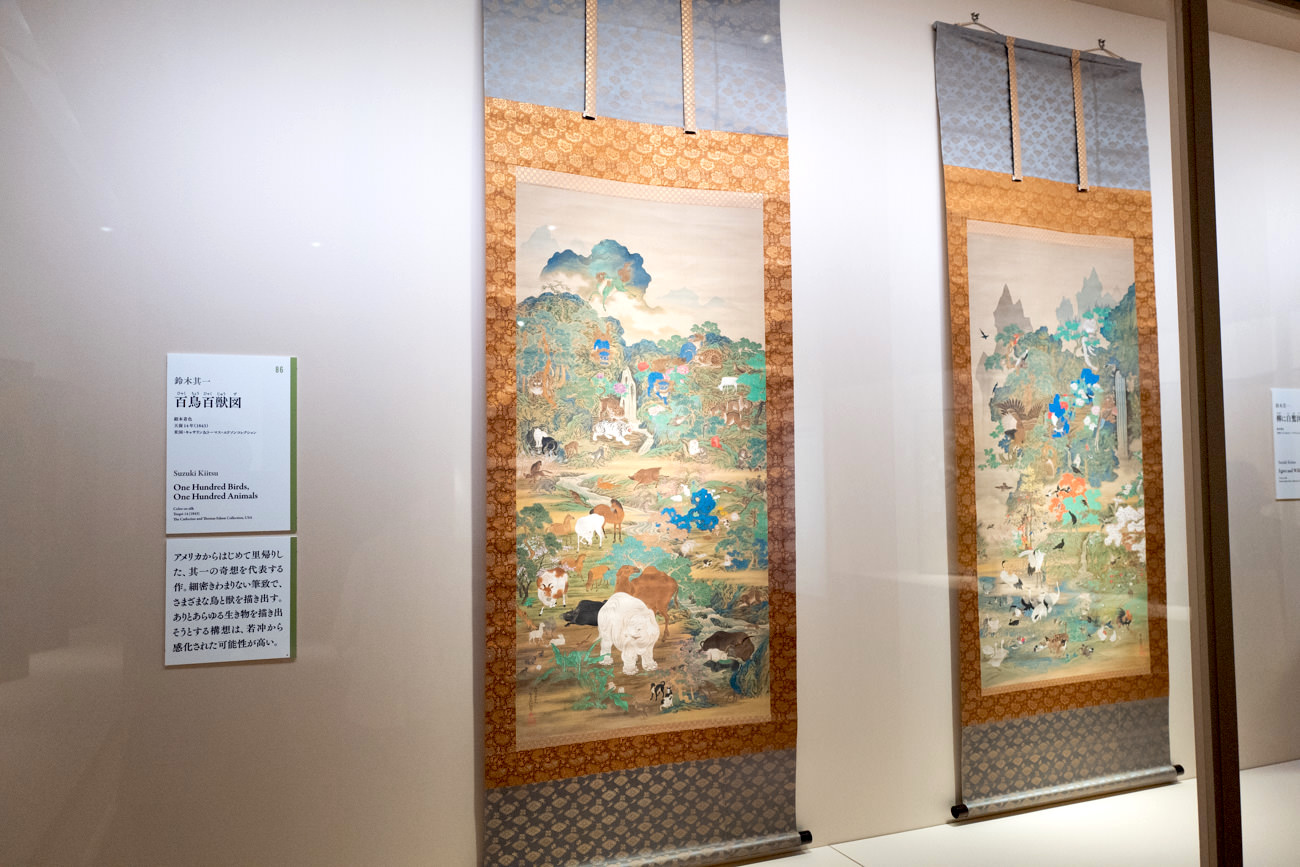
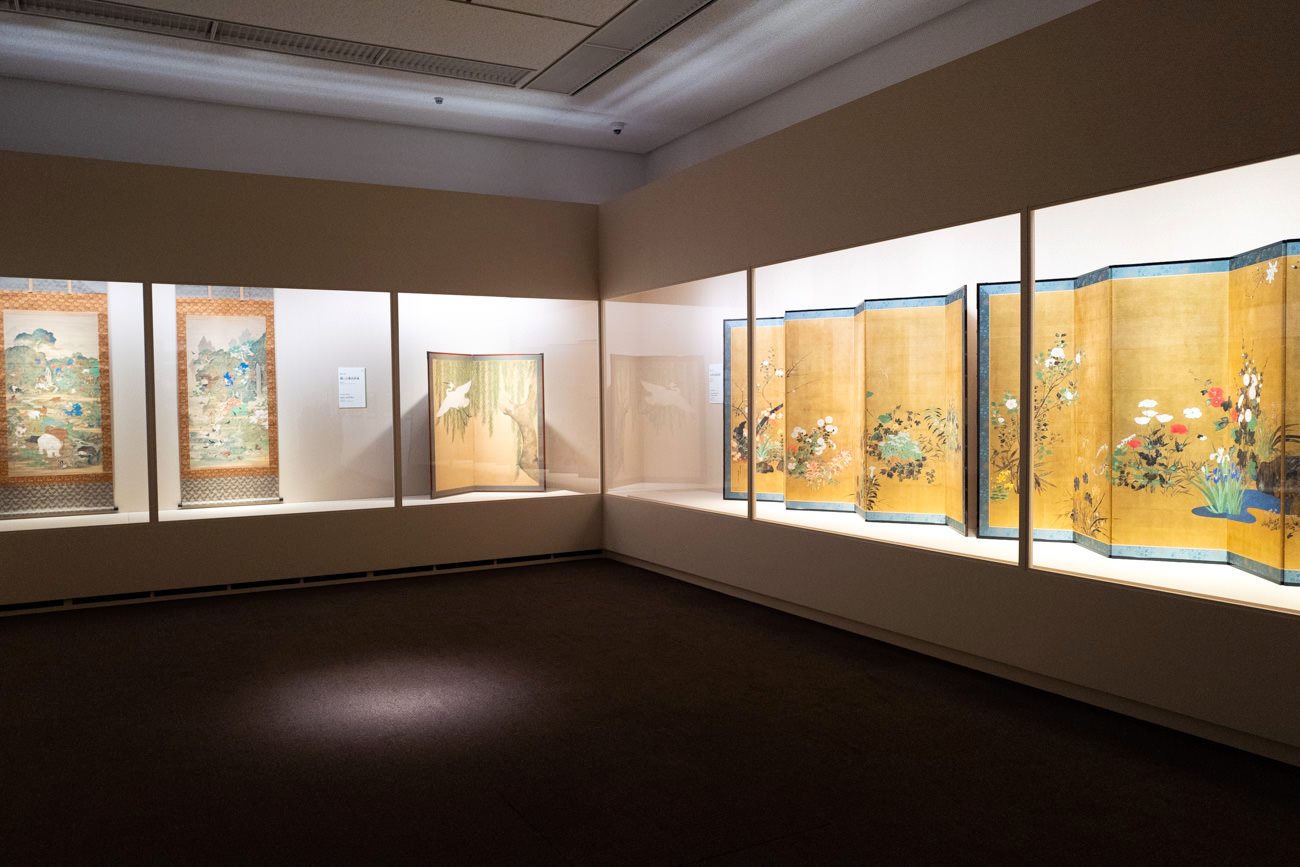
Suzuki Kiitsu
《百鳥百獣図》, returning to Japan from the United States for the first time, is a work representative of Kiitsu’s eccentricity.
With exceedingly fine brushwork, it depicts a variety of birds and beasts. It feels like a work influenced by Jakuchu.
Suzuki Kiitsu, 《百鳥百獣図》, Tenpō 14 (1843), Catherine & Thomas Edson Collection, USAFrom the installation view
Utagawa Kuniyoshi
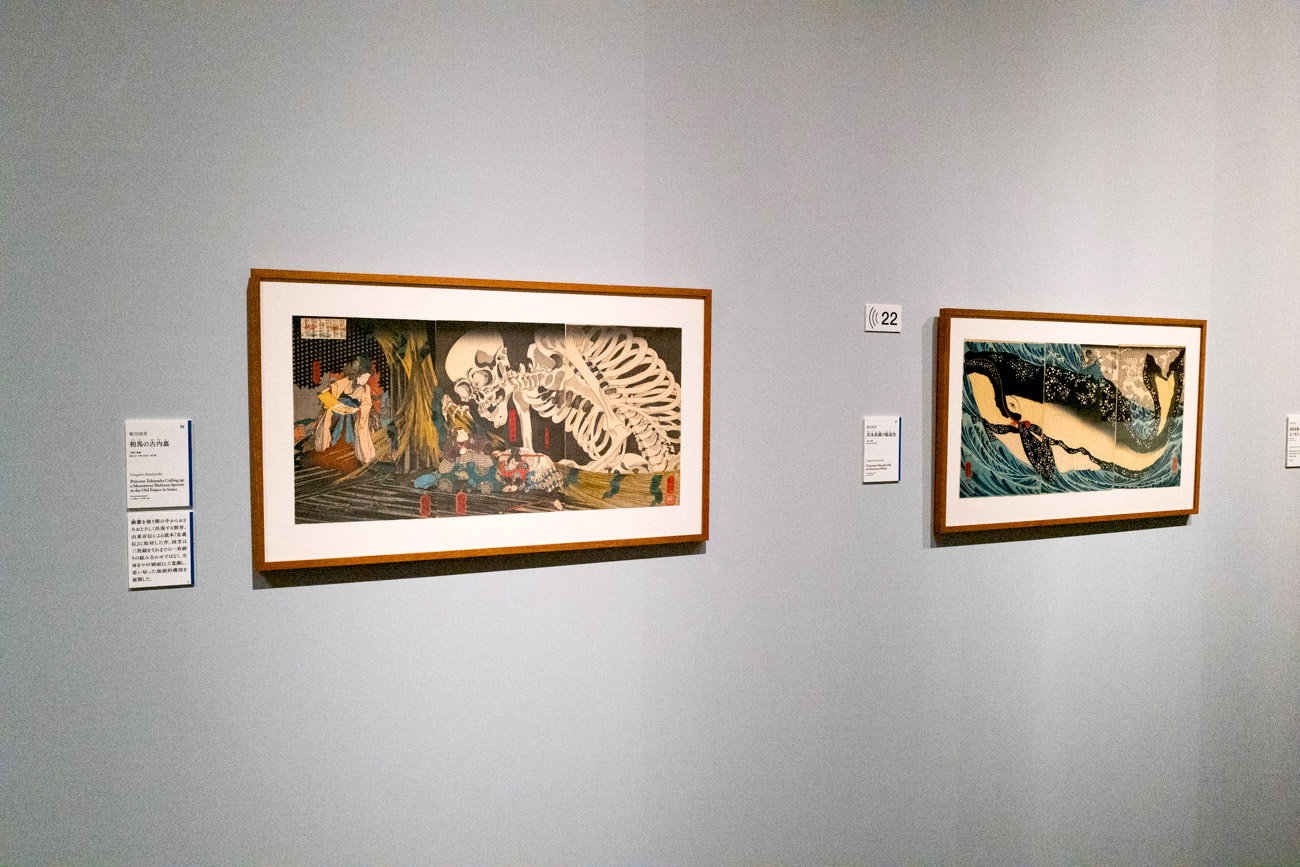
The last of the six eccentrics, Utagawa Kuniyoshi, can be seen at the end of the exhibition.
Alongside Kunisada for actor prints and Hiroshige for landscapes, Kuniyoshi became the leading figure for warrior prints.
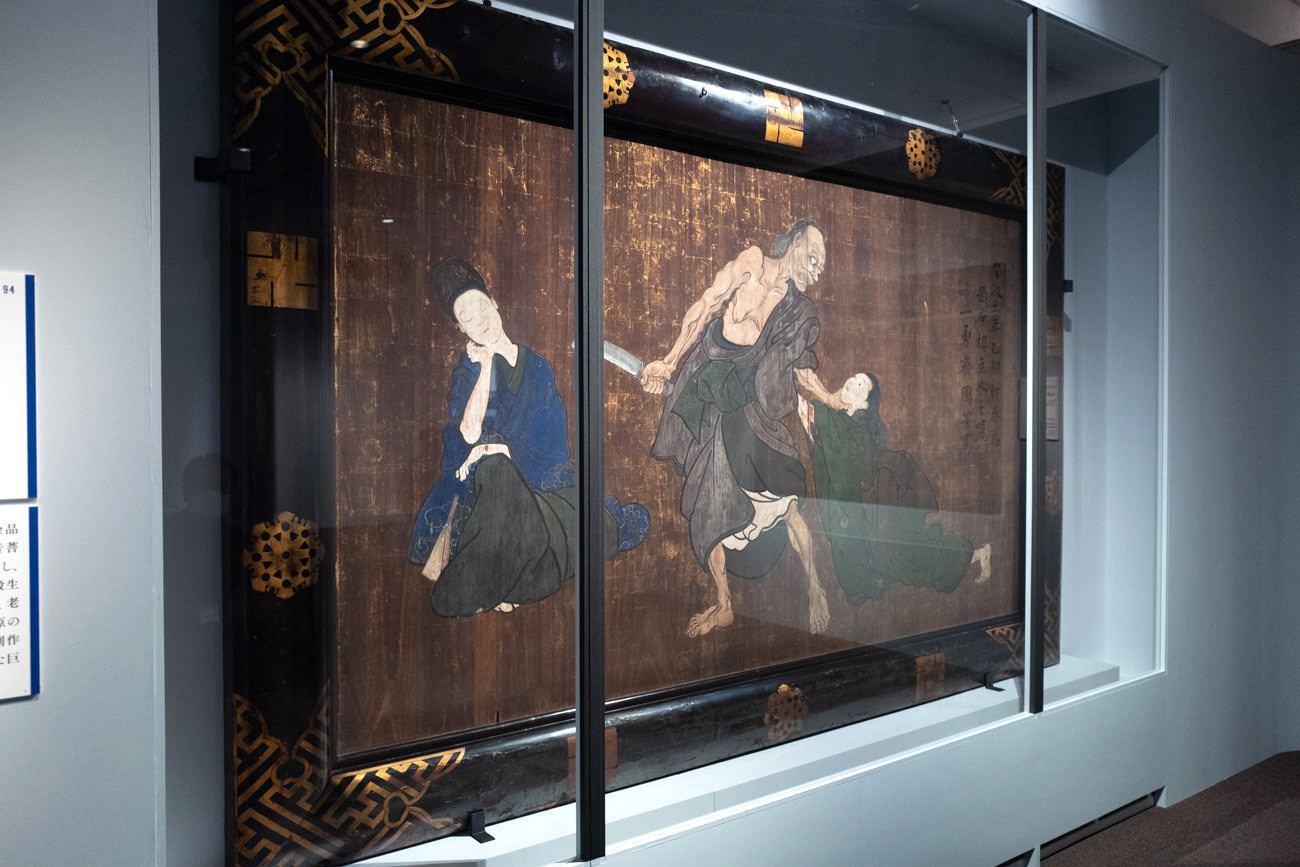
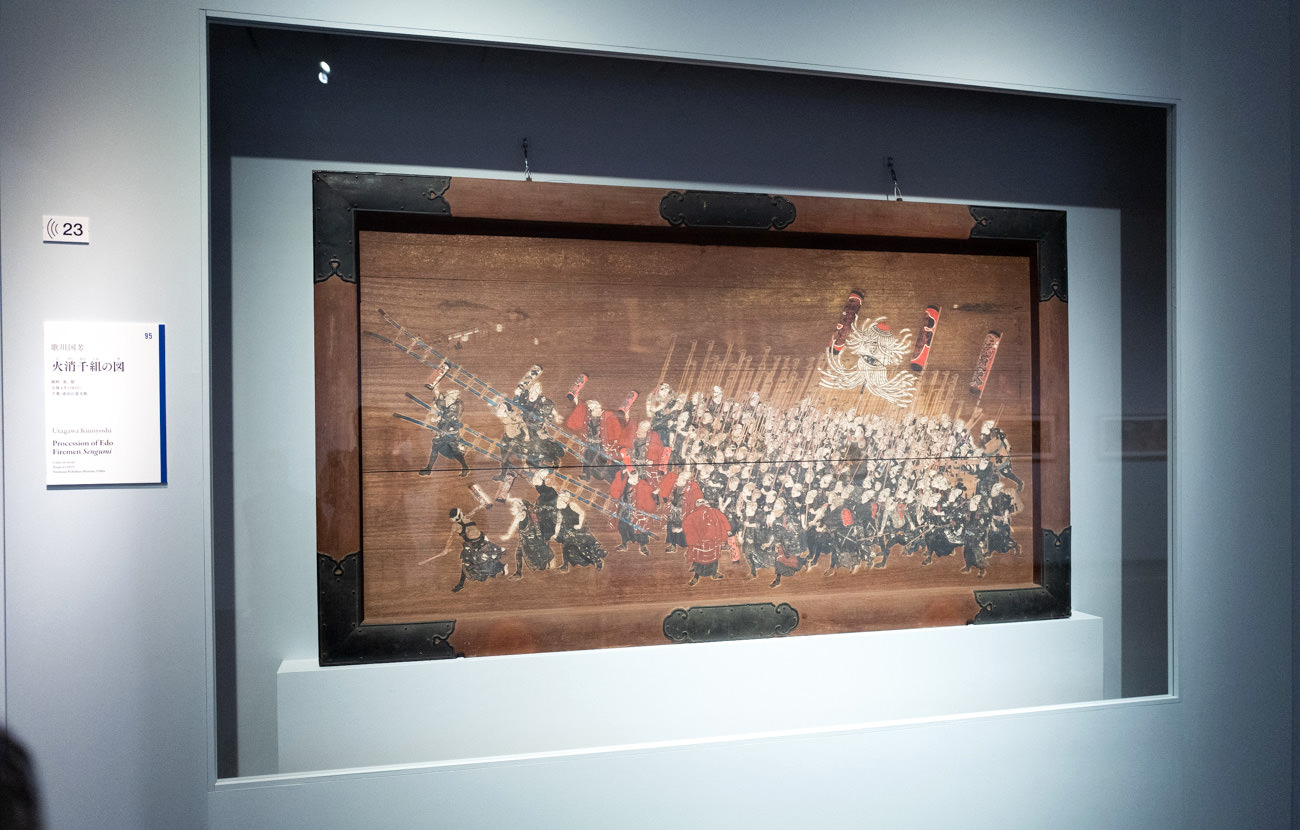
Left: Utagawa Kuniyoshi, 《相馬の古内裏》, ōban nishiki-e triptych, c. Kōka 2–3 (1845–46), private collection Right: Utagawa Kuniyoshi, 《宮本武蔵の鯨退治》, ōban nishiki-e triptych, c. Kōka 4 (1847), private collectionUtagawa Kuniyoshi, 《一ツ家(絵馬)》, pigment on wood, framed, single panel, 228.0×372.0 cm, Ansei 2 (1855), Kinryūzan Sensō-ji, TokyoUtagawa Kuniyoshi, 《火消千組の図》, single panel (Tenpō 4, 1833), Narita-san Reikōkan, Chiba
Special Work
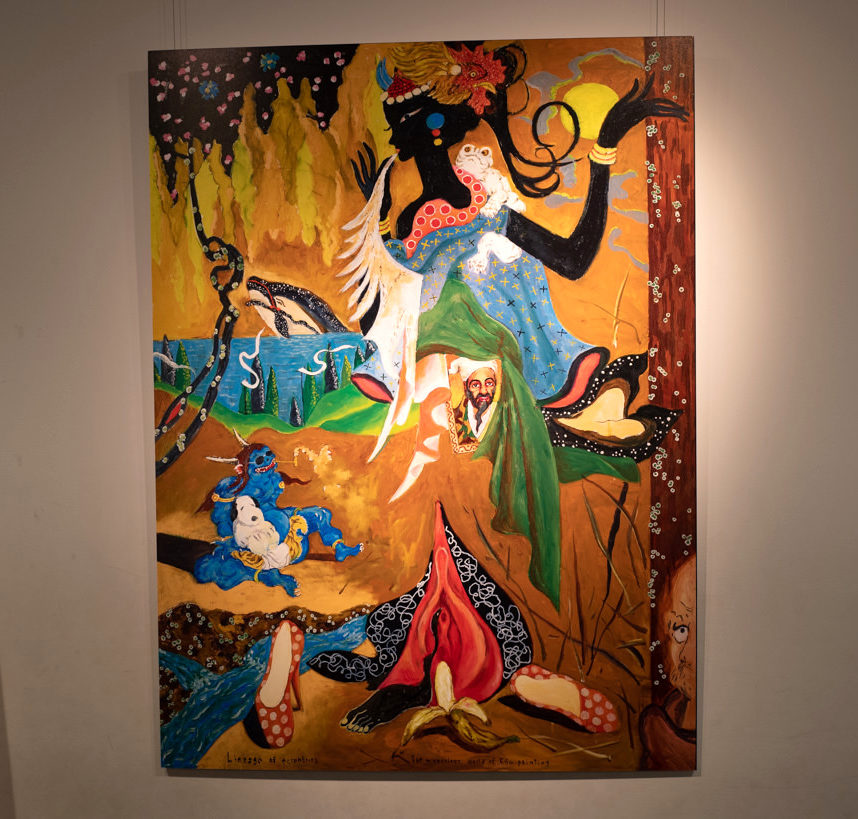
At the very end of the venue, you can see a work specially created for this exhibition by Tadanori Yokoo.
Collaging the imagery of six of the featured artists, Yokoo—citing the work of shōjo painter Chiaki Fujii as a Shōwa-era eccentric answering the Edo lineage—produced his own “eccentric painting.” A magnificent work.
Tadanori Yokoo, special visual work
Summary
The many works by these eight painters gathered under the keyword “eccentric” are all wonderful and richly rewarding to view.
An exhibition where a lavish lineup and superb works come flying into view one after another.
It is sure to be a deeply satisfying show.
Long lines are all but guaranteed for this exhibition too. We recommend going early in the run to avoid the crowds!
2019년 2월 9일(토), 눈 내리는 도쿄 우에노의 도쿄도미술관에서 전람회 「기상의 계보전 에도 회화 미러클 월드」가 개최되었습니다.
본 전시의 제목 「기상의 계보전」은 미술사가 쓰지 노부오 씨가 지금으로부터 반세기 가까이 전인 1970년에 저술한 『기상의 계보』에서 유래합니다.
한 권의 책 제목이 전람회 이름으로 채택된 예는 최근이라면 「무서운 그림전」이 기억에 새롭지만, 일본 회화 전람회에서는 처음 있는 일입니다.
『기상의 계보』에서 소개된 것은 그때까지 책이나 전람회에서 한데 모아 소개된 적이 없던, 인습의 껍질을 깨고 의표를 찌르는, 자유롭고 참신한 발상으로 비일상적 세계로 이끄는 수많은 회화였습니다. 그 작품들을 「기상」이라는 말로 묶어 세상에 알린 쓰지 노부오 씨의 공적은 크게 평가받아 마땅할 것입니다.
2016년의 「자쿠추전」은 최장 320분 대기라는 대인기 전시가 되었습니다.
8명의 활동 시기를 연표로 나타낸 전시장 안내도
본 전시는 『기상의 계보』에서 다뤄진 6명의 화가—이와사 마타베에, 가노 산세쓰, 이토 자쿠추, 소가 쇼하쿠, 나가사와 로세쓰, 우타가와 구니요시—에 하쿠인 에카쿠, 스즈키 기이쓰 2명을 더한 총 8명의 화가에 의한 전람회입니다.
좌: 나카하라 준코(담당 큐레이터) 중: 야마시타 유지(본 전시 감수자) 우: 쓰지 노부오 씨(『기상의 계보』 저자)
쓰지 노부오 씨는 프레스 내람회 인사에서 「배부른 전시」라고 말씀하셨습니다.
「호화로운 스타 총출연으로, 모두가 만족하실 내용」이라는 말 그대로, 충실한 내용으로 만족감 높은 전람회가 되었다고 생각합니다.
이토 자쿠추
본 전시는 8명의 작품별로 구성되어 있습니다.
첫 전시실은 이토 자쿠추. 본 전시 감수자 야마시타 씨가 말하는 「기상 삼우」—자쿠추, 쇼하쿠, 로세쓰—를 전반부에 배치한 흐름입니다.
자쿠추는 총 18작품의 전시입니다.
이토 자쿠추 《旭日鳳凰図》 호레키 5년(1755) 궁내청 산노마루 쇼조칸 【전시 기간: 2/9~3/10】이토 자쿠추 《象と鯨図屛風》 지본묵화 6곡1쌍 각 159.4×354.0cm 간세이 9년(1797) 시가·MIHO MUSEUM이토 자쿠추 《鶏図押絵貼屏風》 지본묵화 6곡1쌍 각 167.0×348.0cm 에도 시대 중기(18세기) 개인 소장
소가 쇼하쿠
이어지는 전시는 소가 쇼하쿠입니다.
18세기 교토 화단의 귀재들 중에서도 가장 격렬한 표현을 지향한 쇼하쿠. 20대 후반에는 무로마치 시대 소가파의 직계에 해당한다고 자칭하며 소가 성을 사용했습니다. 한화를 배워 중국의 선인이나 성인 같은 전통적 고사를 많이 그렸지만, 그 표현은 독창적이고 광기로 가득하여 때로 보는 이의 신경을 거스르며 혼돈의 소용돌이로 빠뜨립니다.
교토·사사야마의 하급 무사의 아들로 태어나 마루야마 오쿄에게 사사. 오쿄가 창안한 사생 화법을 충실히 따르는 제자가 대부분을 차지하는 가운데, 대담한 구도와 재기 넘치는 분방한 필법으로 독자적인 화경을 열어, 엔터테이너적인 놀이 정신이 담긴 개성적인 작품을 다수 남겼습니다.
3.1cm 사방의 작은 작품 《方寸五百羅漢図》의 독특함에 나도 모르게 미소가 흘렀습니다.
나가사와 로세쓰 《白象黒牛図屏風》 지본묵화 6곡1쌍 각 155.3×359.0cm 에도 시대 중기(18세기) 미국·에쓰코 & 조 프라이스 컬렉션나가사와 로세쓰 《牡丹孔雀図》 지본착색 2곡1쌍 덴메이 2년 166.9×184.6cm 미국·에쓰코 & 조 프라이스 컬렉션나가사와 로세쓰 《猛虎図》 견본묵화담채 1폭 163.5×131.0cm 미국·에쓰코 & 조 프라이스 컬렉션나가사와 로세쓰 《方寸五百羅漢図》 견본묵화담채 1폭 간세이 10년(1798년) 3.1×3.1cm
이와사 마타베에
쓰지 노부오 씨의 석사 논문으로도 다뤄졌으며 그의 필생의 작업이라 할 수 있는 것이 이와사 마타베에입니다.
수수께끼의 우키요에 화가로 불리는 마타베에를 다룬 작품은 자화상과 그림두루마리를 포함해 약 20점 볼 수 있습니다.
이 구역의 연출은 쓰지 씨의 고집이 담긴 듯, 그림두루마리를 위에서 가까이 감상할 수 있어 매우 보기 편했습니다.
이와사 마타베에 《山中常盤物語絵巻 第四巻(十二巻のうち)》 지본착색 1권 34.1×1259.0cm 에도 시대 초기(17세기 전반) 시즈오카·MOA미술관 【전시 기간】 2/9〜3/10이와사 마타베에 《洛中洛外図(舟木本)》 6곡1쌍 지본금지착색 각 162.7×342.4cm 도쿄국립박물관
가노 산세쓰
가노 산세쓰는 전통적 화제를 독자적 시점으로 재해석하여, 수직·수평·이등변삼각형을 강조한 이지적 기하 구도로 알려져 있습니다.
가노 산세쓰 《梅花遊禽図襖絵》 지본금지착색 4면 각 184.0×94.0cm 간에이 8년(1631) 교토·덴큐인가노 산세쓰 《蘭亭曲水図屏風》 8곡2쌍 지본금지착색 각 107.5×355.2 교토·대본산 즈이신인
하쿠인 에카쿠
임제종 중흥의 조로 불리는 선승. 슨슈 하라주쿠(현 누마즈시)에서 태어나 15세에 출가. 「불립문자(말에 의존하지 말라)」라 하는 선종에서, 하쿠인은 엄청난 수의 선화와 묵적을 남겼습니다.
직업 화가가 아닌, 부처의 가르침을 전하는 수단으로 그려진 언뜻 유머러스하고 경묘하면서도 대담한 서화는, 쇼하쿠·로세쓰·자쿠추 등 18세기 교토 화단·기상 화가들의 기폭제가 되었습니다.
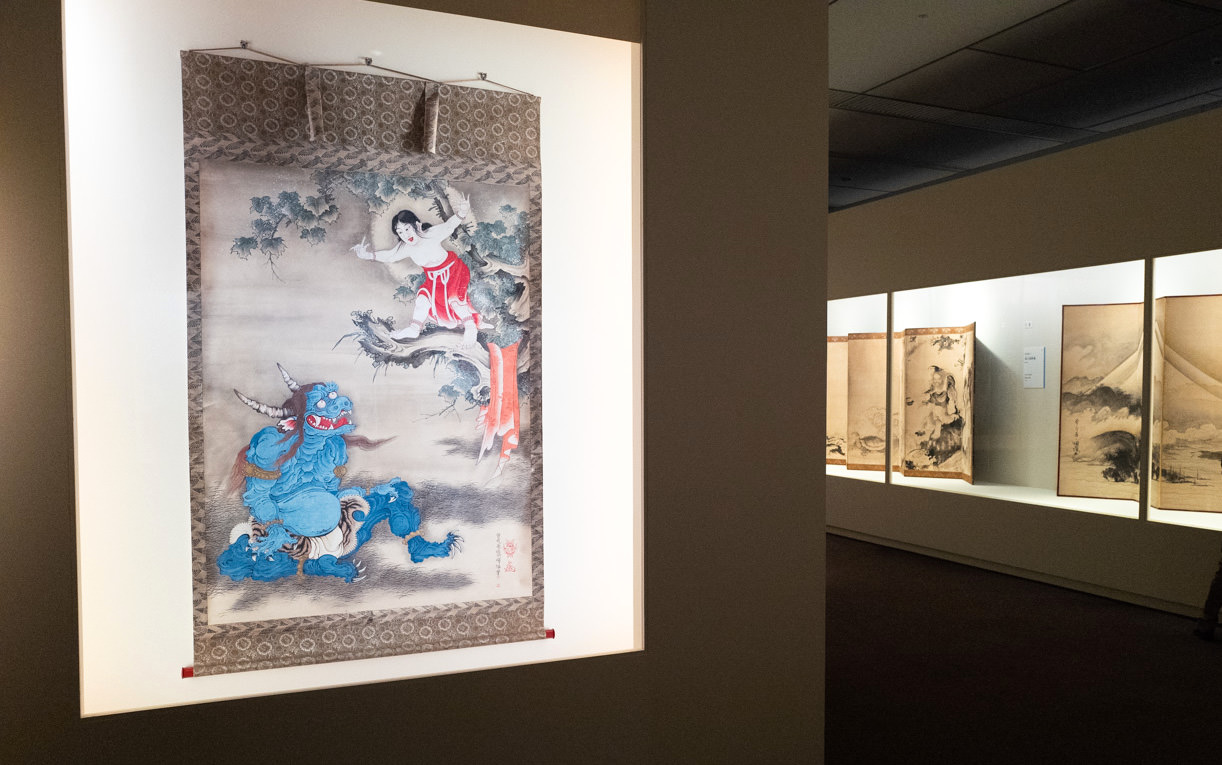
전시 풍경에서—하쿠인 에카쿠하쿠인 에카쿠 《半身達磨図》 지본착색 1폭 192.0×112.0cm 에도 시대(18세기) 오이타·만주지
스즈키 기이쓰
《百鳥百獣図》는 미국에서 처음으로 귀향하는, 기이쓰의 기상을 대표하는 작품입니다.
극도로 정밀한 필치로 다양한 새와 짐승을 그려냈습니다. 자쿠추에게 영향받은 듯한 작품이네요.
스즈키 기이쓰 《百鳥百獣図》 덴포 14년(1843년) 미국·캐서린 & 토머스 에디슨 컬렉션전시 풍경에서
우타가와 구니요시
기상 6인 중 마지막 한 사람, 우타가와 구니요시는 전시의 마지막에 볼 수 있습니다.
배우 그림의 구니사다, 풍경화의 히로시게와 나란히, 무사 그림의 구니요시로서 제일인자가 되었습니다.
좌: 우타가와 구니요시 《相馬の古内裏》 오반 니시키에 3매 연속 고카 2-3년(1845-46)경 개인 소장 우: 우타가와 구니요시 《宮本武蔵の鯨退治》 오반 니시키에 3매 연속 고카 4년(1847)경 개인 소장우타가와 구니요시 《一ツ家(絵馬)》 안료·판, 액자 1면 228.0×372.0cm 안세이 2년(1855) 도쿄·긴류잔 센소지우타가와 구니요시 《火消千組の図》 1면(덴포 4년·1833년) 지바 나리타산 레이코칸
특별 작품
전시장 마지막에는 본 전시를 위해 특별 제작된 요코오 다다노리 씨의 작품을 볼 수 있습니다.
이는 출품 작가 중 6작가의 도상 부분을 콜라주한 뒤, 에도의 계보 화가에 대해 쇼와의 기상 화가로서 소녀화 화가 후지이 지아키의 그림을 인용한 요코오 씨 나름의 「기상화」. 훌륭한 작품이네요.
요코오 다다노리 스페셜 비주얼 작품
정리
「기상」이라는 키워드로 묶인 8명 화가의 수많은 작품은 하나같이 훌륭하여 감상할 보람이 있는 작품들입니다.
호화로운 면면과 훌륭한 작품이 잇달아 눈에 날아드는 전람회.
만족감 높은 전람회가 되지 않을까요.

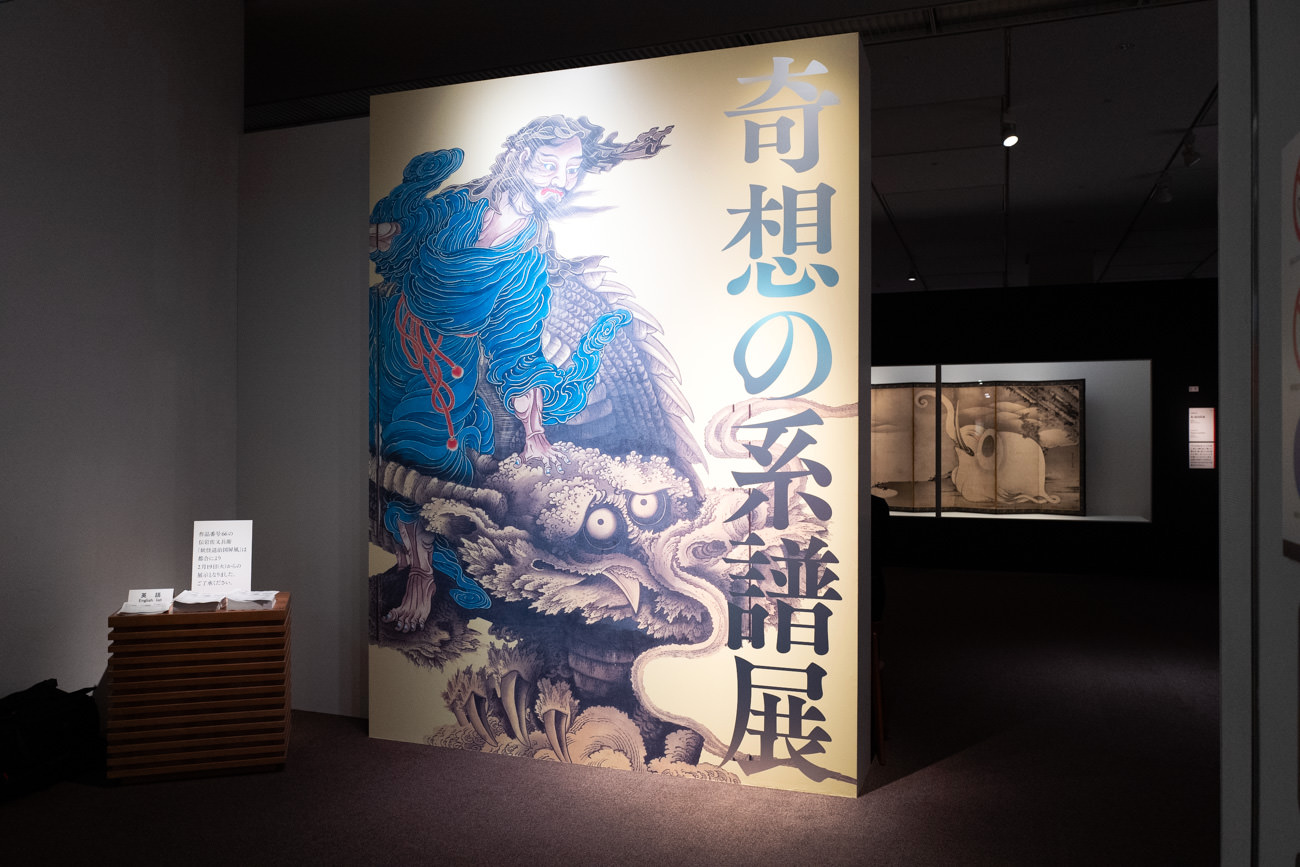 本展のタイトル「奇想の系譜展」は、美術史家・辻惟雄氏が、今から半世紀近く前の1970年に著した『奇想の系譜』から来ております。