なお、本展のタイトル「終わりのむこうへ : 廃墟の美術史」ですが、担当学芸員の話によれば、最初に決まった「廃墟の美術史」を深める言葉を探していた中、2010年に群馬県立近代美術館で行われた野又穫さんの個展図録の章題「After the Future」からインスピレーションを得て、“終わりのむこうへ”と付けられたそうです。
“Beyond the End: An Art History of Ruins”, currently on view at The Shoto Museum of Art, is approaching the end of its run.
I attended Minoru Nomata’s artist talk held during the exhibition period.
The talk took place on January 19, 2019. Because the content was so valuable, I would like to leave a record of it here as a special report.
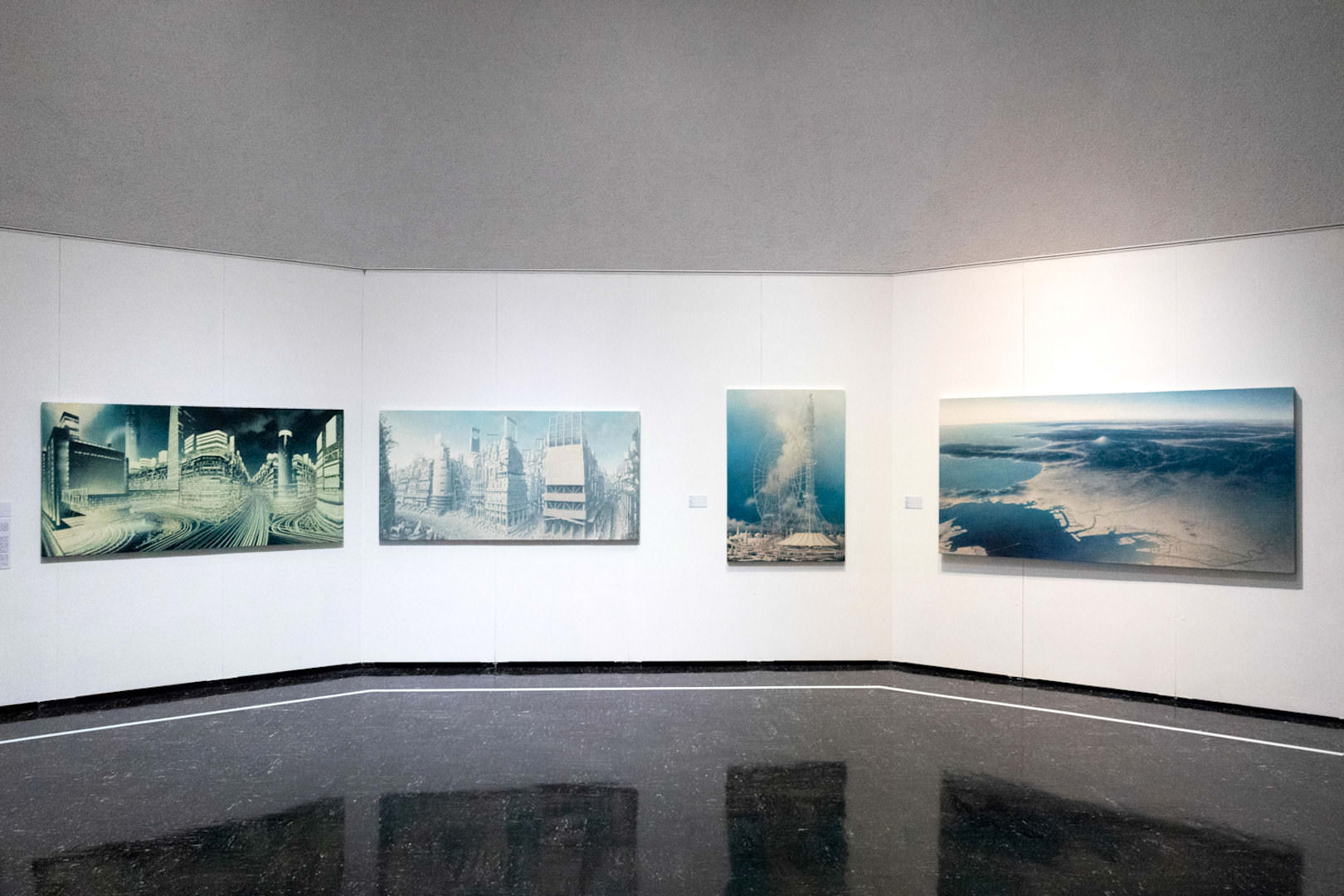
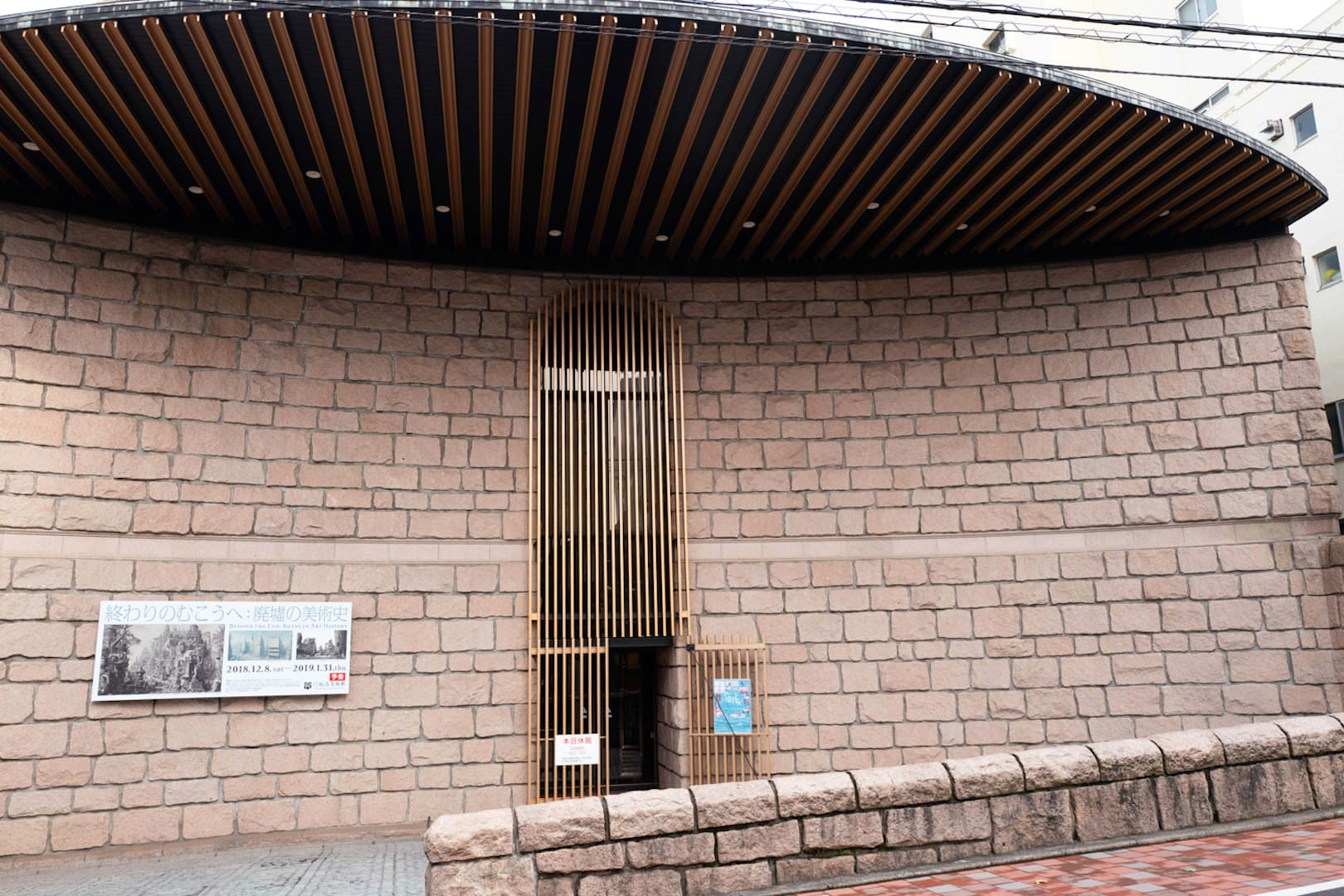
Installation view of “Beyond the End: An Art History of Ruins”
Minoru Nomata
Minoru Nomata has developed a body of work around motifs of imaginary architecture that he himself has envisioned.
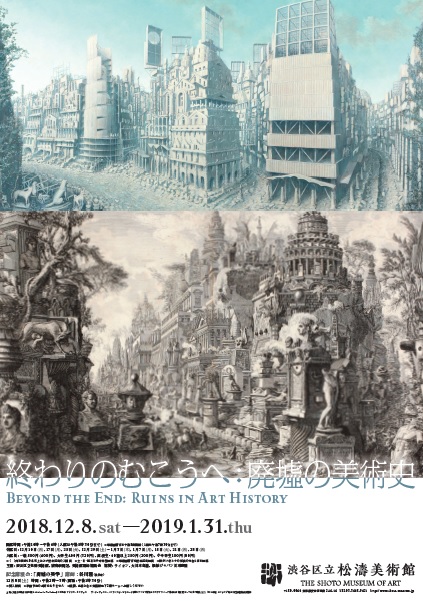
His work was chosen as the main visual for “Beyond the End: An Art History of Ruins”, and the overwhelming worldview of his art continues to captivate viewers.
Poster visual for “Beyond the End: An Art History of Ruins” Top: Minoru Nomata, “While Waiting at the Crossing”
On the day of the artist talk, distribution of numbered admission tickets began 30 minutes before the start time. A crowd of hopeful attendees had already lined up, and all the tickets were gone in a matter of moments – a testament to Nomata’s popularity.
Artist Talk “Imagine”
The talk took the form of a self-narrated presentation, unfolding as a chronological look back at Nomata’s career from childhood on.
Minoru Nomata’s family home is in the Higashiyama area of Meguro Ward, not far from Shibuya where the ruins exhibition is being held. Growing up there, he has witnessed the changes of the urban landscape firsthand throughout his life.
He passed his childhood and youth in the middle of the high-growth era, in a city that was always full of energy, with almost no opportunity to touch nature.
“In my mind there is no such word as ‘ruin’ – past, present, and future intersect at once.”
Perhaps this is the perspective on the city cultivated by someone who grew up in one of Tokyo’s core urban-planning zones.
New buildings are always going up; construction is repeated over and over in different parts of the city.
Minoru Nomata, “While Waiting at the Crossing”, 2013, acrylic on canvas, collection of the artist Photo by Keizo Kioku (C)Minoru Nomata
“My family ran a dyeing shop, so I was constantly surrounded by color. Because I grew up in a very Japanese world, I longed for Western-style spaces.”
After graduating from Tokyo University of the Arts, Nomata joined the advertising agency McCann Erickson. While working as a designer in the corporate world, he continued making his own art. He would come home from work and paint until three in the morning, night after night.
Minoru Nomata, “Wave Flower”, 2013, acrylic on canvas, collection of the artist Photo by Keizo Kioku (C)Minoru Nomata
Nomata’s paintings unfold into imaginary structures and worlds that do not exist in reality.
“My motifs are things I cannot reach – the things I long for or want.”
After he left the company, filling a scrapbook edge-to-edge with clippings became his source of ideas.
By stuffing the pages without any particular meaning or connection, he came to realize that past, present, and future were all contained there together.
Minoru Nomata, “Imagine-1”, 2018, acrylic on canvas, collection of the artist Photo by Keizo Kioku (C)Minoru Nomata
“There are devices embedded inside my paintings. One is time; the other is presence. They give the work a roundabout quality, so that it may look like architecture, or like a ruin.”
The scrapbook practice that he still keeps up settles into a kind of notebook when the clippings are pasted in; after some time passes, looking back at them lets him notice things he had not before.
“Friends often ask me about this, but I’ve never drawn people. Since there are buildings in the paintings, it wouldn’t be strange for people to be there too.”
He consciously avoids including any human figures among the clippings he pastes into the scrapbook. He says that if a figure enters, it feels like an impurity has been mixed in and gets in the way.
“I interpret time as depth. In painting, creating depth is what gives birth to time, and to the traces and presences it leaves behind. I am very conscious of ‘time plus presence.'”
By including this indirect quality in his work, he says he infuses the paintings with a scent.
Minoru Nomata, “Imagine-2”, 2018, acrylic on canvas, collection of the artist Photo by Keizo Kioku (C)Minoru Nomata
The Q&A brought a wide range of questions from the audience, showing just how much interest there is in Nomata’s work.
“There are no tricks in the making. I draw the underdrawings in pencil and revise them over and over, working steadily. Well – it’s hard work. There’s no secret. (laughs)”
Looking at the works again after the talk, I felt an even stronger awareness of presence and time – a shivering sensation almost stirred up from within. I felt once more the sheer strength of Minoru Nomata as an artist.
As for the exhibition title, “Beyond the End: An Art History of Ruins”, the curator in charge said that after “An Art History of Ruins” was set first, they were searching for words that would deepen it, and drew inspiration from “After the Future” – the chapter title of the catalogue for Minoru Nomata’s 2010 solo exhibition at The Museum of Modern Art, Gunma – which led to “Beyond the End”.
The exhibition runs through January 31, 2019. I highly recommend a visit.
Overview
“Beyond the End: An Art History of Ruins”
Venue: The Shoto Museum of Art
Dates: Saturday, December 8, 2018 – Thursday, January 31, 2019
Admission: General 500 (400) yen, University students 400 (320) yen,
High school students and those aged 60 and over 250 (200) yen, Elementary and junior high school students 100 (80) yen
* Figures in ( ) are for groups of 10 or more and for Shibuya Ward residents
* Elementary and junior high school students free on Saturdays, Sundays, holidays, and during summer vacation
* Free for Shibuya Ward residents every Friday
* Free for visitors with disabilities and one accompanying person
Closed days: December 10 (Mon), 17 (Mon), 25 (Tue), December 29 (Sat) – January 3 (Thu), January 7 (Mon), 15 (Tue), 21 (Mon), 28 (Mon)
(Some works will be rotated during the exhibition period)
Organizers: The Shoto Museum of Art, The Yomiuri Shimbun, The Japanese Association of Museums
Sponsors: Lion, DNP Dai Nippon Printing, Sompo Japan Nipponkoa
Artist Talk
Saturday, January 19
Minoru Nomata (participating artist, professor at Joshibi University of Art and Design)
“Imagine”
15:00-16:00 (doors open at 14:30), capacity 80
* Numbered admission tickets distributed at the 1F lobby from 14:30
Beyond the End: An Art History of Ruins
在The Shoto Museum of Art举办的”Beyond the End: An Art History of Ruins”展即将闭幕。
关于本展的标题“Beyond the End: An Art History of Ruins”,据负责策展人所说,”An Art History of Ruins”先确定,之后在寻找可以将其加深的词语时,从2010年在The Museum of Modern Art, Gunma举办的Minoru Nomata个展图录的章节标题”After the Future”中获得灵感,于是命名为”Beyond the End”。
本展会期至2019年1月31日为止,衷心推荐前来观展。
概览
“Beyond the End: An Art History of Ruins”
会场:The Shoto Museum of Art
会期:2018年12月8日(周六)~2019年1月31日(周四)
入馆费 一般500(400)日元,大学生400(320)日元,
高中生·60岁以上250(200)日元,中小学生100(80)日元
※( )内为10人以上团体及涩谷区居民入馆费
※周六、周日、法定假日及暑假期间中小学生免费
※每周五涩谷区居民免费
※残障人士及一名陪同者免费
休馆日 12月10日(周一)、17日(周一)、25日(周二)、12月29日(周六)~1月3日(周四)、1月7日(周一)、15日(周二)、21日(周一)、28日(周一)
(会期中部分作品会更换)
主办 The Shoto Museum of Art、读卖新闻社、美术馆联络协议会
赞助 狮王、大日本印刷、损保日本兴亚
The Shoto Museum of Art에서 개최 중인 “Beyond the End: An Art History of Ruins”전이 종료를 앞두고 있습니다.
회기 중에 열린 Minoru Nomata의 아티스트 토크에 참가했습니다.
아티스트 토크는 2019년 1월 19일에 진행되었습니다. 귀중한 내용이었기에 특별편으로 기사로 남겨두려 합니다.
“Beyond the End: An Art History of Ruins”전시 광경
Minoru Nomata
독자적으로 구상한 공상 건축을 모티프로 삼아 수많은 작품을 발표해 온 Minoru Nomata.
그의 작품은 “Beyond the End: An Art History of Ruins”전의 메인 비주얼로도 채택되었으며, 그 압도적인 세계관으로 관람자를 매료시키는 작가입니다.
“Beyond the End: An Art History of Ruins” 포스터 비주얼 상단: Minoru Nomata 《While Waiting at the Crossing》
아티스트 토크 당일, 시작 시간 30분 전부터 진행된 정리권 배부에는 개시 전부터 청중 희망자들이 줄지어 몰려들어 순식간에 정원분이 모두 배부되었고, Minoru Nomata의 높은 인기를 실감할 수 있었습니다.
아티스트 토크 ‘Imagine’
아티스트 토크는 셀프 토크 형식으로, 어린 시절부터의 작가 경력을 되짚듯 이야기가 전개되었습니다.
Minoru Nomata는 폐허의 미술사展이 열리고 있는 시부야에서 그리 멀지 않은 메구로구 히가시야마 지역에 본가가 있어, 어린 시절부터 살아가며 도시 거리의 변천을 눈앞에서 지켜봐 왔다고 합니다.
거리는 늘 활기가 넘쳤고, 자연에 접할 기회는 거의 없었던 고도성장기의 한복판에서 유년기를 보냈다고 합니다.
“제 안에는 ‘폐허’라는 말은 없고, 현재, 과거, 미래가 교차하고 있습니다.”
도쿄 중에서도 도시계획의 중심지에서 자란 환경이기에 갖게 되는, 도시를 향한 시선일지도 모릅니다.
거리는 언제나 새로운 것들이 건설 중이고, 공사는 여러 곳에서 반복적으로 이루어집니다.
질의응답 시간에는 참가자들로부터 다양한 질문이 오갔고, Minoru Nomata의 작품에 대한 관심이 얼마나 높은지를 실감할 수 있었습니다.
“작품 제작에는 아무런 트릭도 없습니다. 밑그림은 연필로 그리고, 몇 번이고 수정을 거듭하며 성실하게 제작하고 있습니다. 뭐, 힘들어요, 비밀은 없습니다(웃음).”
아티스트 토크 후에 다시 작품을 감상하니, 기척과 시간이 한층 강하게 의식되어 오싹한 감각이 되살아나는 듯한 느낌이 들었습니다. 새삼 Minoru Nomata의 역량을 절감하게 되었습니다.
또한 본 전시의 타이틀 “Beyond the End: An Art History of Ruins”는, 담당 큐레이터의 말에 따르면 먼저 정해진 “An Art History of Ruins”를 심화시킬 문구를 찾던 중, 2010년 The Museum of Modern Art, Gunma에서 열린 Minoru Nomata의 개인전 도록의 장 제목 “After the Future”로부터 영감을 얻어, “Beyond the End”라는 이름이 붙여졌다고 합니다.
본 전시의 회기는 2019년 1월 31일까지. 꼭 관람해 보시기를 권합니다.
개요
“Beyond the End: An Art History of Ruins”
회장: The Shoto Museum of Art
회기: 2018년 12월 8일(토) ~ 2019년 1월 31일(목)
입장료 일반 500(400)엔, 대학생 400(320)엔,
고등학생·60세 이상 250(200)엔, 초·중학생 100(80)엔
※( ) 안은 10명 이상 단체 및 시부야구 주민 입장료
※토·일요일, 공휴일 및 여름방학 기간에는 초·중학생 무료
※매주 금요일은 시부야구 주민 무료
※장애인 및 동반자 1명 무료
휴관일 12월 10일(월), 17일(월), 25일(화), 12월 29일(토) ~ 1월 3일(목), 1월 7일(월), 15일(화), 21일(월), 28일(월)
(회기 중 일부 전시 교체 있음)
주최 The Shoto Museum of Art, 요미우리신문사, 미술관연락협의회
협찬 라이온, 다이닛폰인쇄, 손보재팬닛폰코아
토크쇼
1월 19일(토)
Minoru Nomata (참여 작가, 조시비 미술대학 교수)
‘Imagine’
오후 3시 ~ 4시 (개장: 오후 2시 30분) 정원 80명
*오후 2시 30분부터 1층 로비에서 정리권 배부

《交差点で待つ間に》-2013-年-アクリル、カンヴァス -撮影:木奥恵三-cMinoru-Nomata .jpg)
《波の花》 2013-年 .jpg)
《イマジン-1》 2018年.jpg)
《イマジン-2》.jpg)
《交差点で待つ間に》-2013-年-アクリル、カンヴァス -撮影:木奥恵三-cMinoru-Nomata .jpg)
《イマジン-1》 2018年.jpg)
《イマジン-2》.jpg)