At the press conference where the media gathered, there was a moment when Chiharu Shiota herself spoke about the recurrence of her cancer.
Perhaps overwhelmed with emotion, she was momentarily at a loss for words, and the room fell silent for a while.
After a brief pause, curator Mami Kataoka’s exquisite response changed the atmosphere, and it seemed to bring not only Shiota but also this writer’s consciousness back into focus, providing a sense of relief.
Sitting in the press seats where Shiota’s face was clearly visible, I felt a glimpse of the severity of her battle with illness while witnessing this scene and the atmosphere.
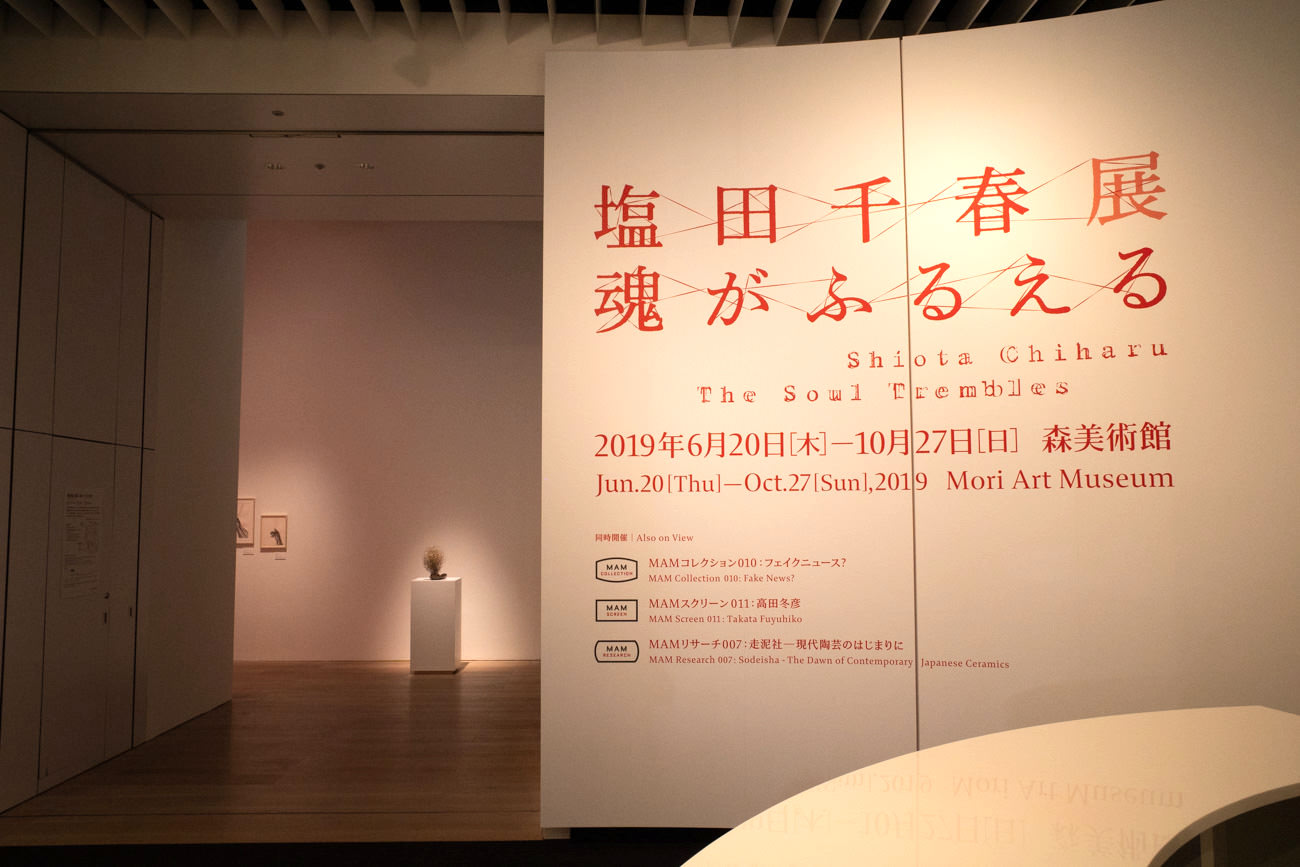
Near the entrance of Chiharu Shiota “The Soul Trembles”
Until now, I loved exhibitions — they were my sole reason for living, and I created works for them.
My works are the manifestation of inner conflicts that can’t be resolved, feelings that can’t be conveyed in words, and my inexplicable existence.
Two years ago, the cancer I had 12 years ago recurred, but I thought perhaps the difficult treatment of living alongside death might be a trial to make better works.
This exhibition presents 25 years of my work.
Please see the dialogue with my bare soul.
Chiharu Shiota
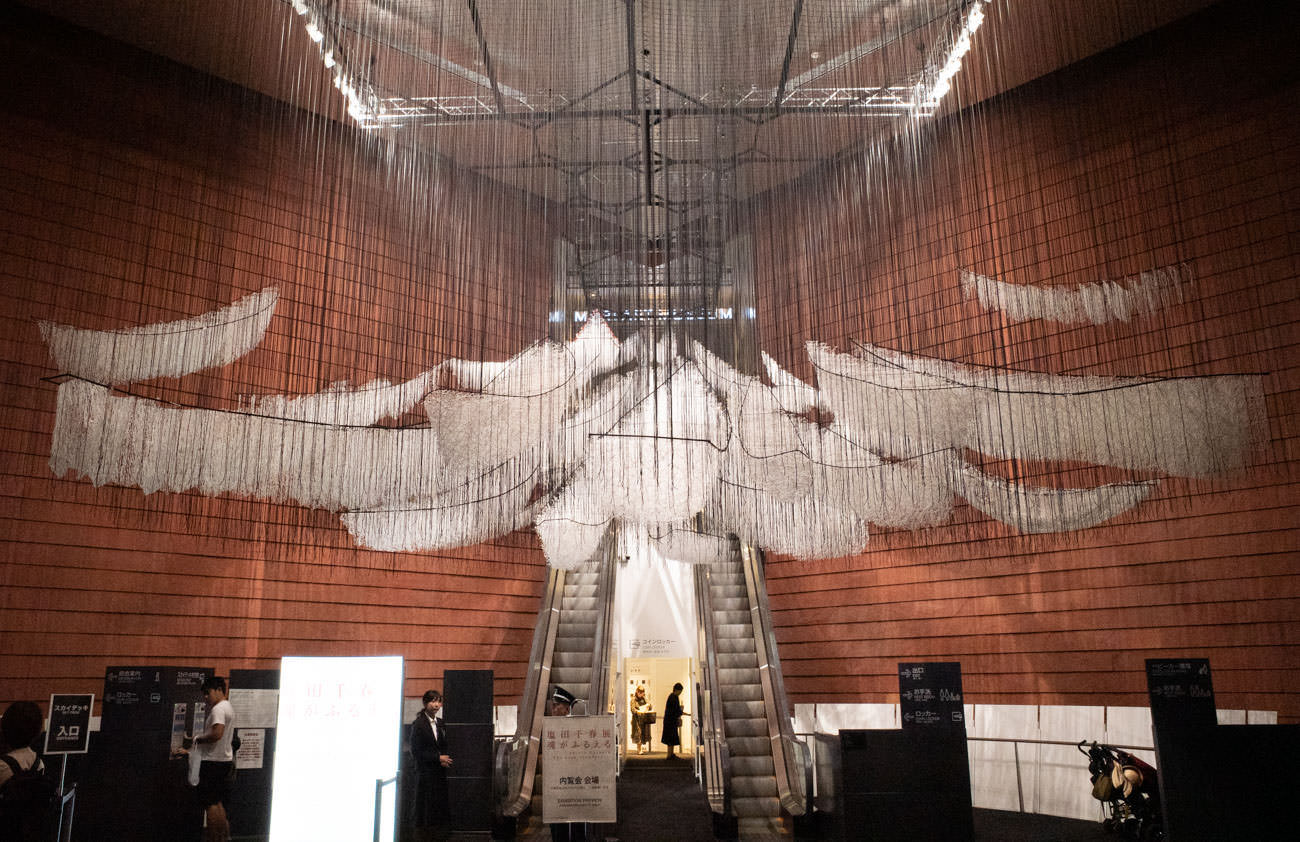
Visitors begin their viewing with the work “Where Are We Going?” in the open atrium space with escalators leading to the venue.
Sixty-five boats suspended from an 11-meter-high ceiling greet visitors at the museum entrance, inviting them on a journey through the exhibition.
Chiharu Shiota, “Where Are We Going?” 2019
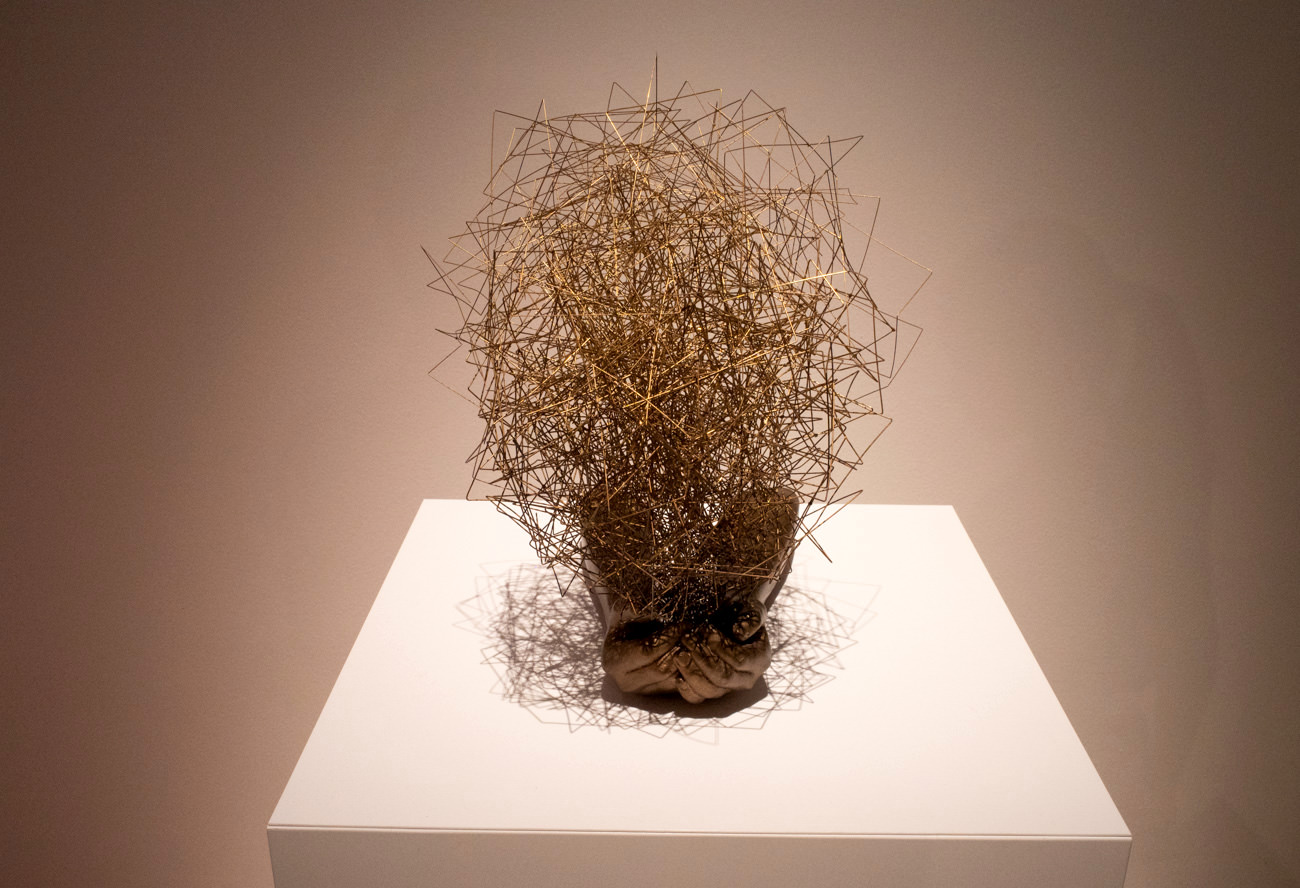
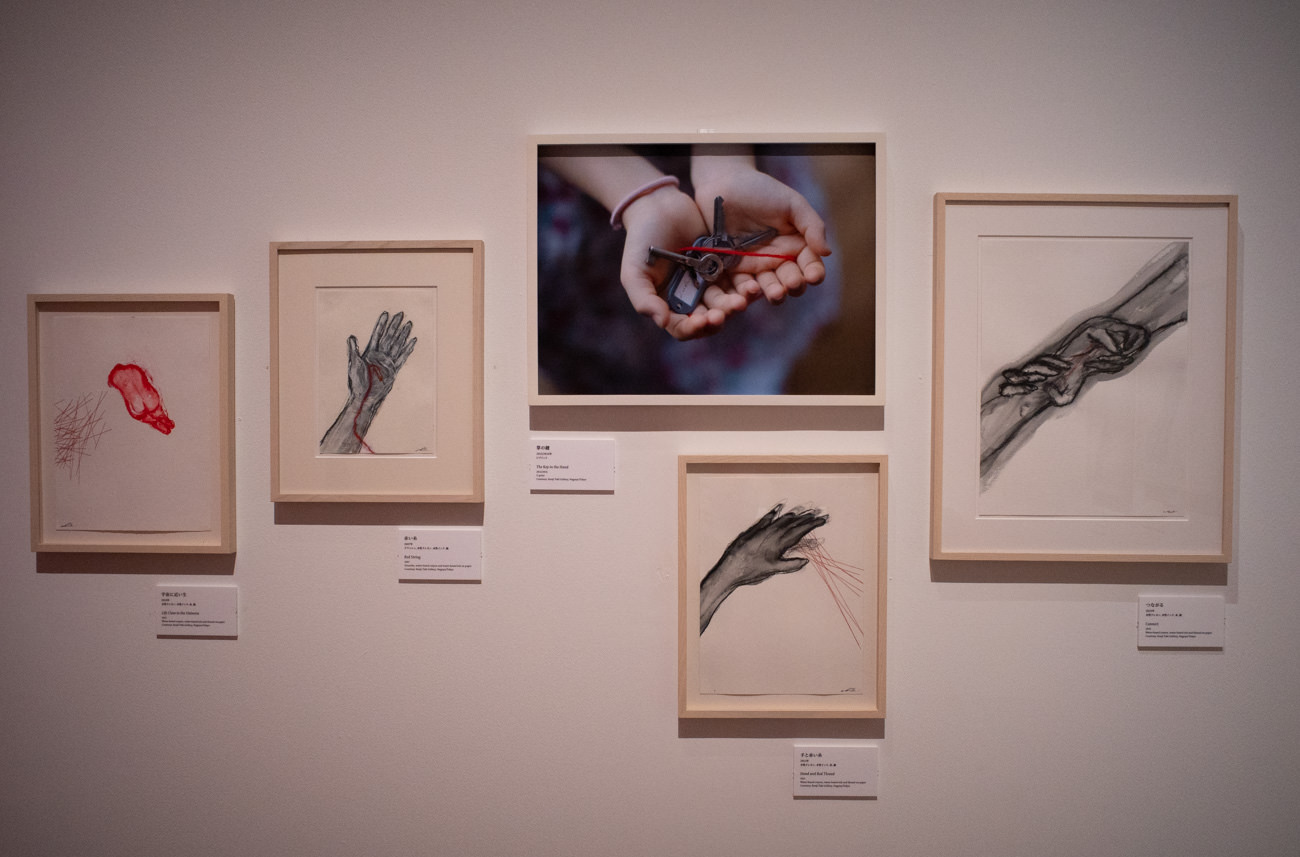
“In the Hand”
A fragile object seemingly on the verge of breaking is cradled in a child’s hands. Through her thread installations that cover galleries, Shiota has visualized invisible presences hidden in space, and this abstract motif quietly nestled in the palms seems to represent the life or soul within her body, evoking the exhibition’s subtitle “The Trembling Soul.”
Chiharu Shiota, “In the Hand,” 2017, bronze, brass, key, wire, lacquer, 38×31×42 cm
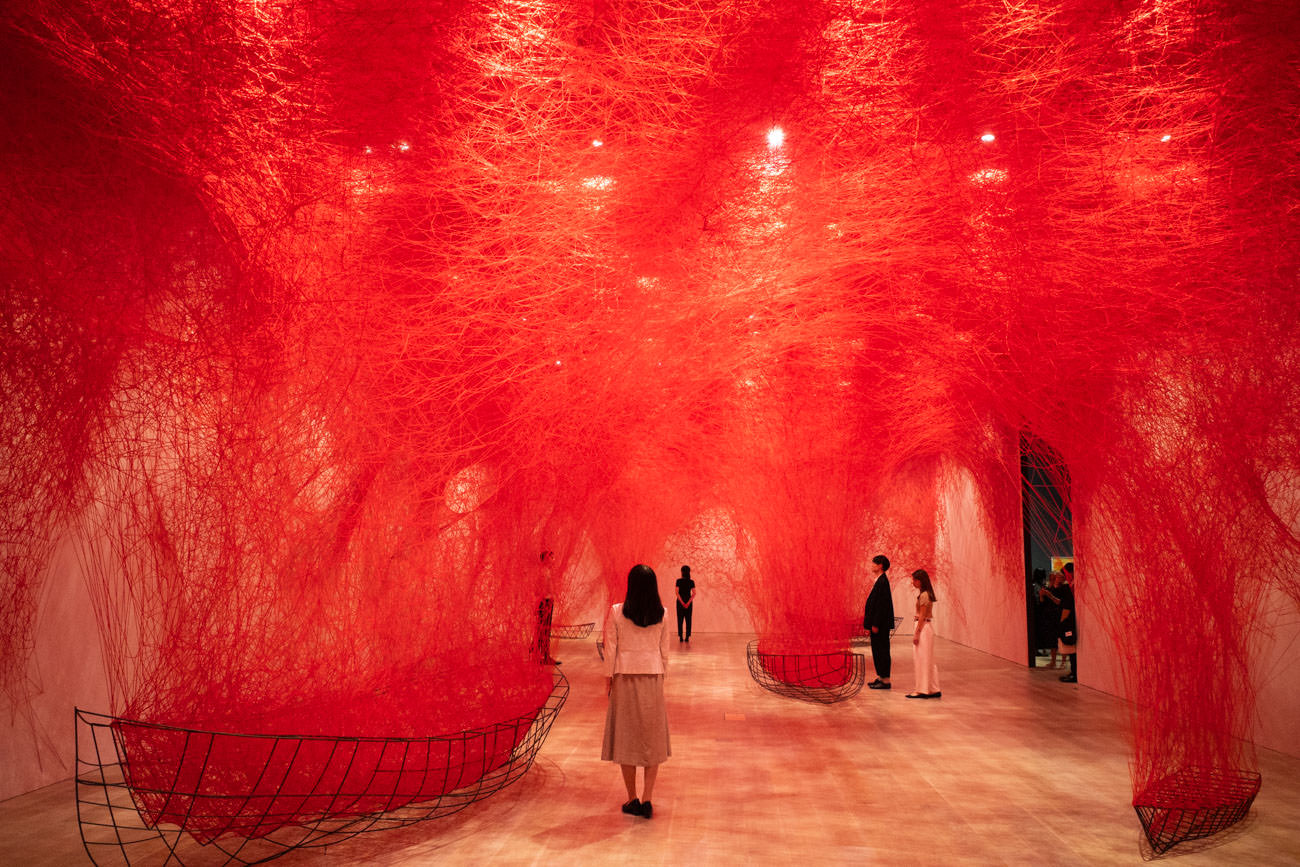
“Uncertain Journey”
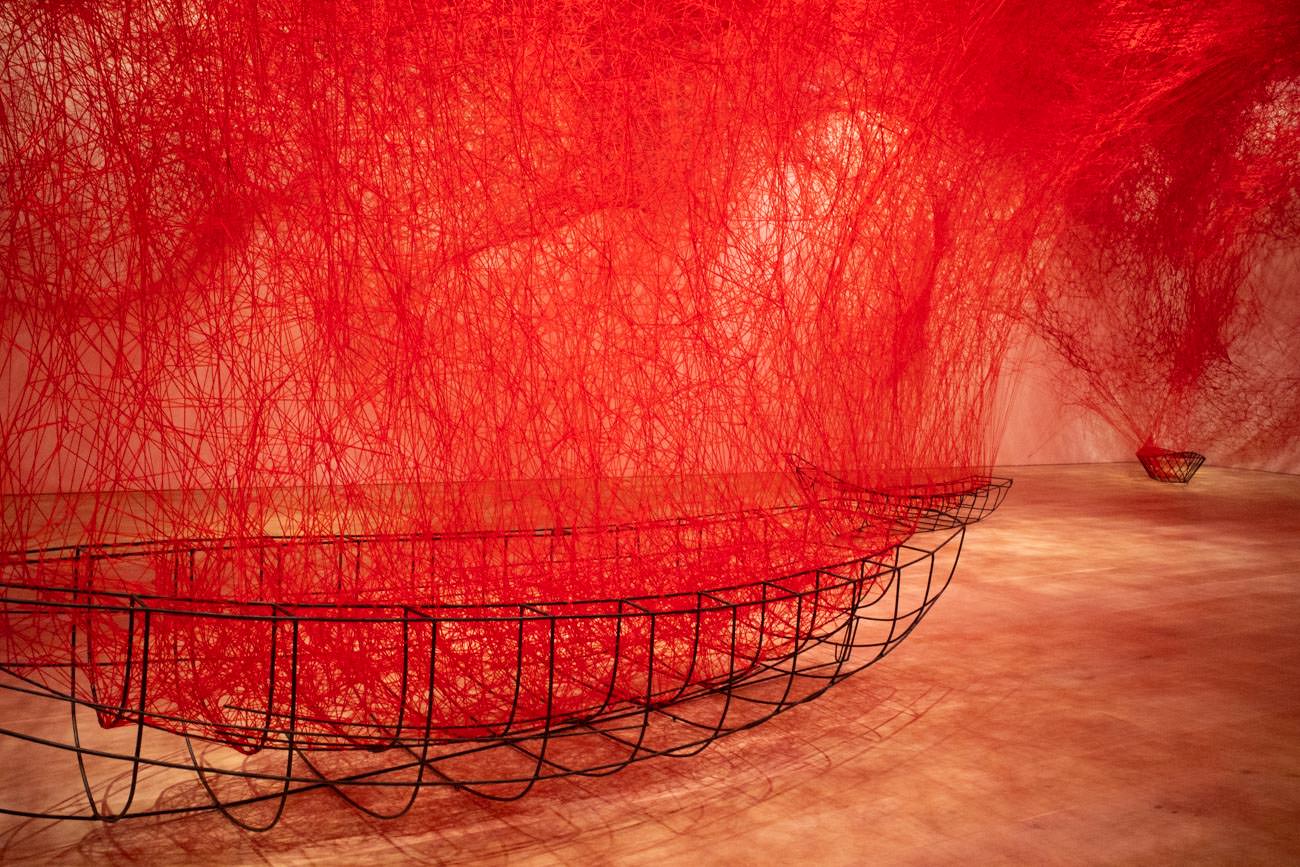
The first installation upon entering the venue is a space covered in bright red thread, with boats made only of frames. In the 2015 Venice Biennale Japan Pavilion display, an enormous number of keys were suspended above traditional old Venetian boats, but in “Uncertain Journey,” the boats are more abstract, and the space filled with red thread seems to suggest the many encounters that lie beyond the uncertain journey.
Chiharu Shiota, “Uncertain Journey,” 2016, iron frame, red woolChiharu Shiota, “Uncertain Journey,” 2016, iron frame, red wool
“In Silence”
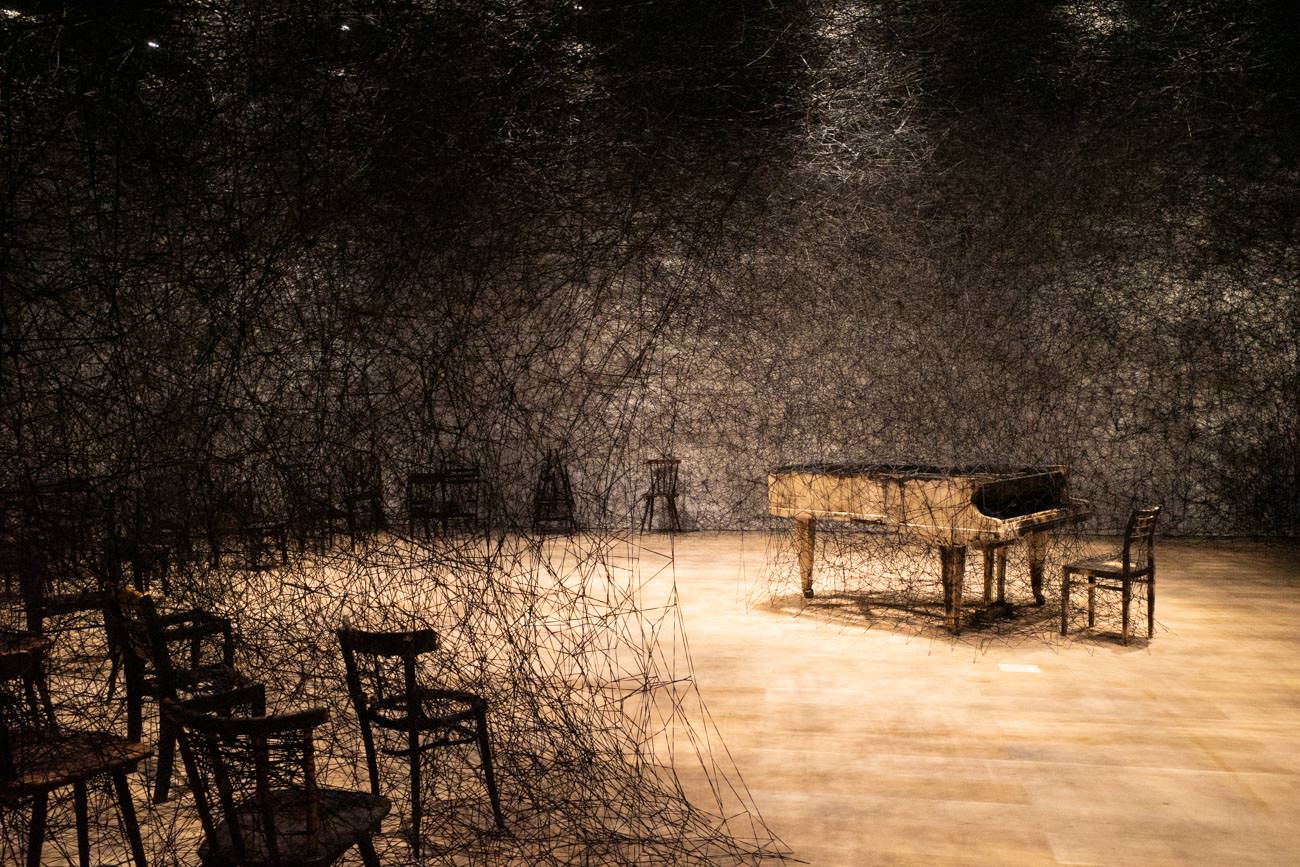
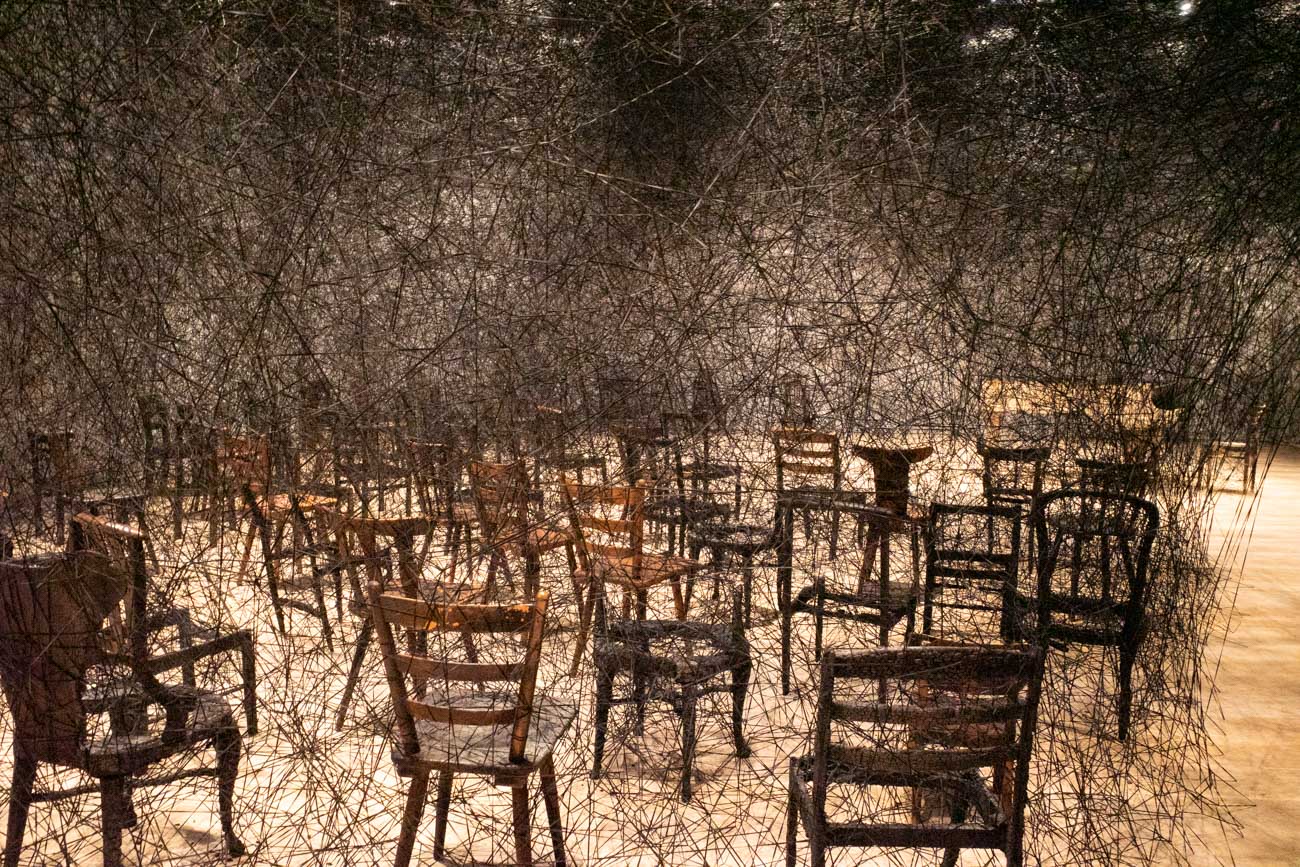
This installation was created from Shiota’s childhood memory of a neighboring house burning down in the night. A burnt grand piano and audience chairs are entirely filled with black thread throughout the space. The soundless piano symbolizes silence while playing a visual music.
“Reflection of Space and Time”
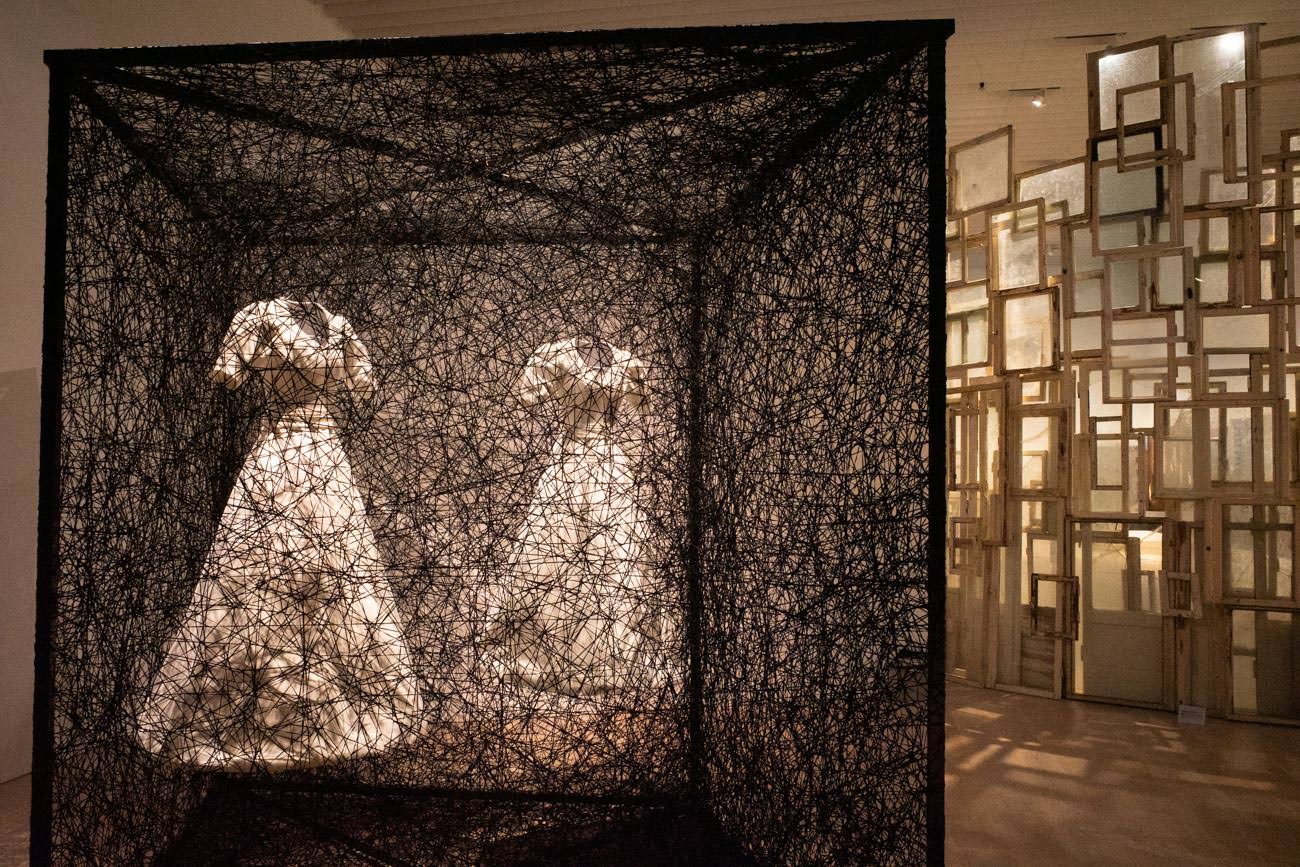
Like skin covering the body, a dress symbolizes the boundary between one’s interior and exterior. By suspending these dresses in a space filled with black thread, they evoke the presence of absence. Furthermore, with dresses hung on both sides of a mirror that divides the space enclosed by iron frames in half, the reflected dresses in the mirror and the actual dresses on the opposite side mix together in the viewer’s consciousness.
Chiharu Shiota, “Reflection of Space and Time,” 2018, white dress, mirror, iron frame, black Alcantara thread
“Inside – Outside”
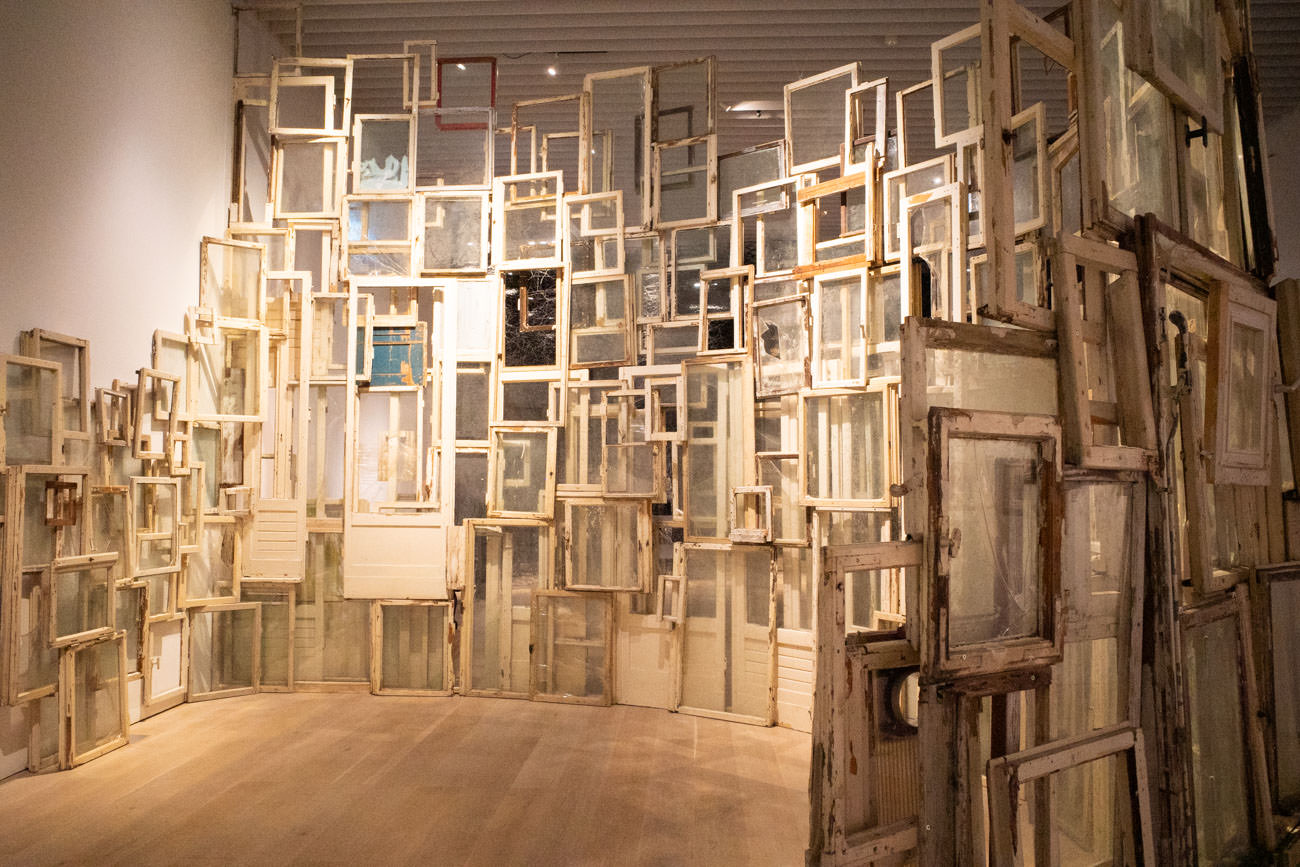
Shiota moved to Germany in 1996 and is currently based in Berlin. Around 2004, fifteen years after the fall of the Berlin Wall, she began creating works using windows. At that time, as redevelopment progressed in Berlin and many buildings were being demolished, Shiota walked around collecting discarded window frames. Windows exist as boundaries between the interior and exterior of private spaces, but they also evoke the wall that divided East and West Germany. “Inside – Outside” has been produced since 2009 with several versions, and this exhibition displays a work using approximately 230 window frames.
Chiharu Shiota, “Inside – Outside,” 2009, old wooden windows, chair
“Accumulation – Searching for the Destination”
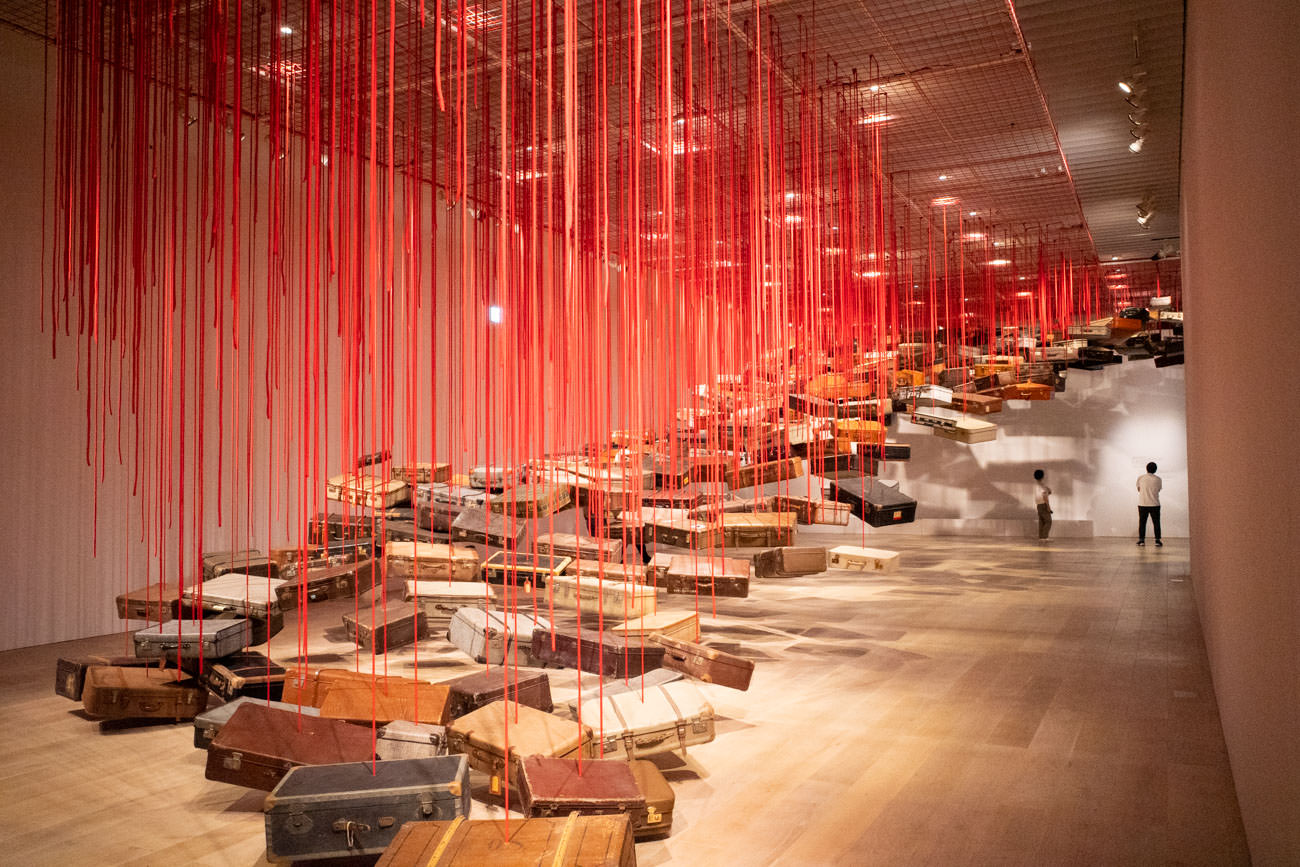
This work, in which approximately 430 suitcases continuously vibrate, was created after Shiota found an old newspaper inside a suitcase discovered at a Berlin flea market. All objects contain their own memories, but here the suitcases seem to suggest the memories of strangers, movements and migrations, or the journey of refugees seeking a place to settle — the very journey of life itself.
Chiharu Shiota, “Accumulation – Searching for the Destination,” 2016
“Where to Go, What to Be”
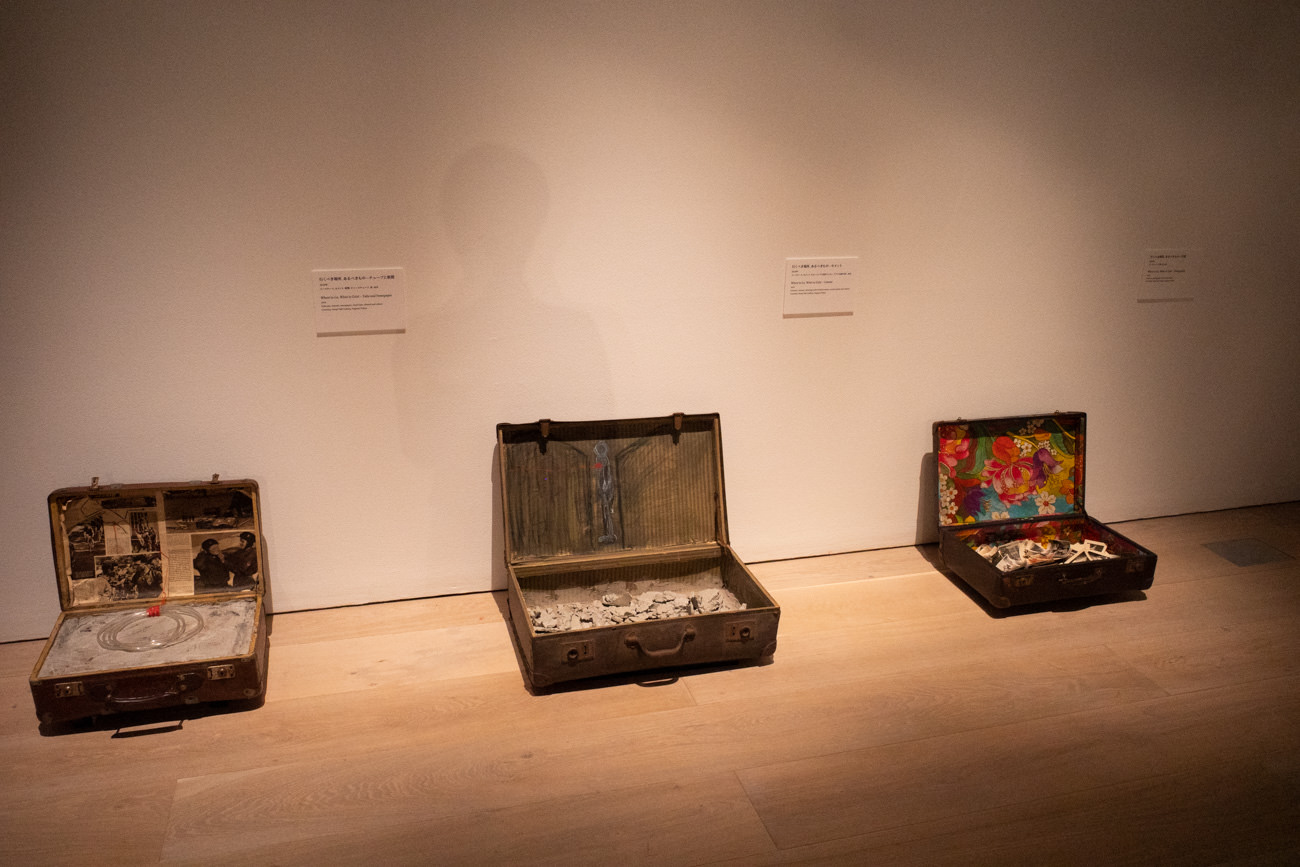
Personal photos gathered from somewhere, newspaper clippings, building rubble, and other objects suggesting a lost past are packed into old suitcases. Carrying someone’s keepsakes and mementos toward a future with no promises, the suitcases seem to embody the yearnings of people seeking the certainty of existence while living in an uncertain world.
Chiharu Shiota, “Where to Go, What to Be — Photograph,” 2010, suitcase, photograph, thread, etc.
“Out of My Body” * New work
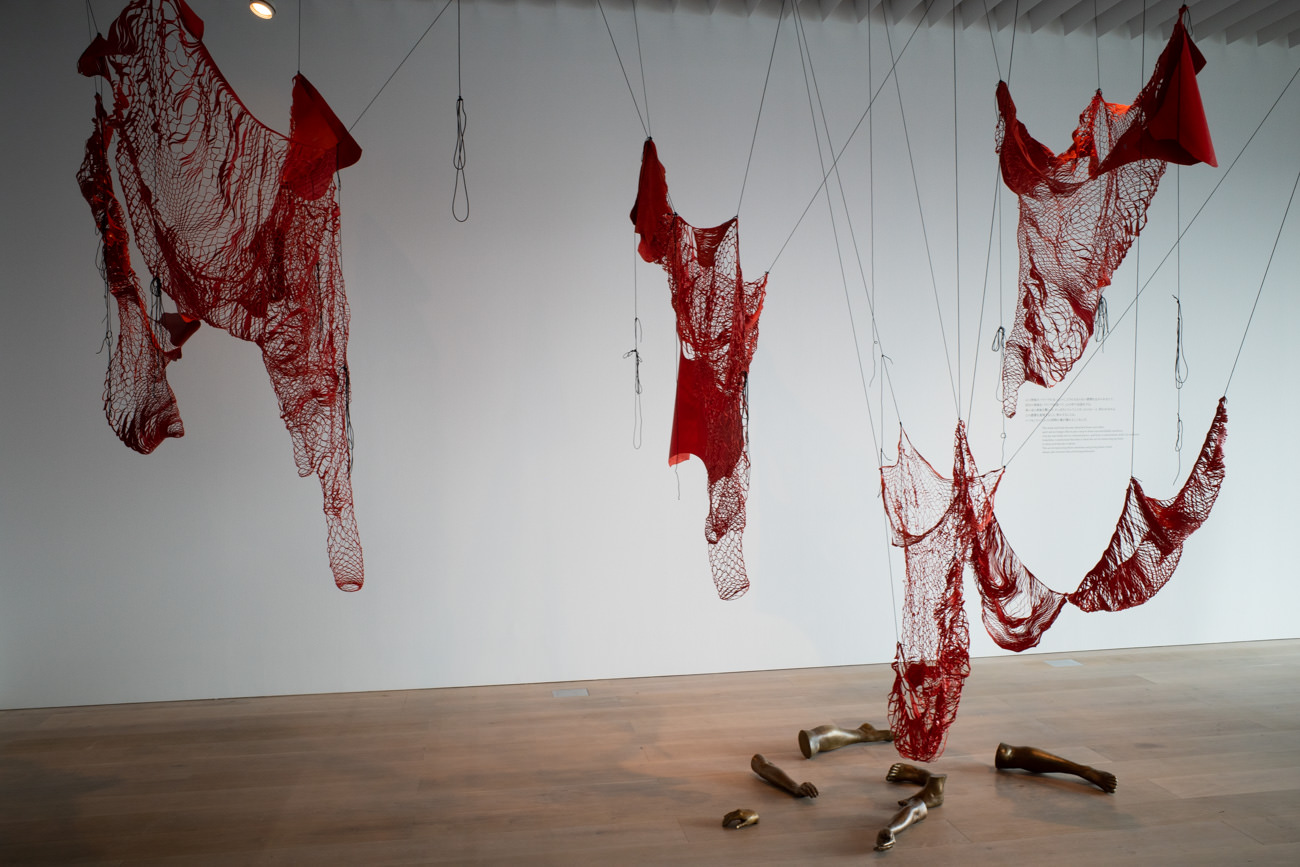
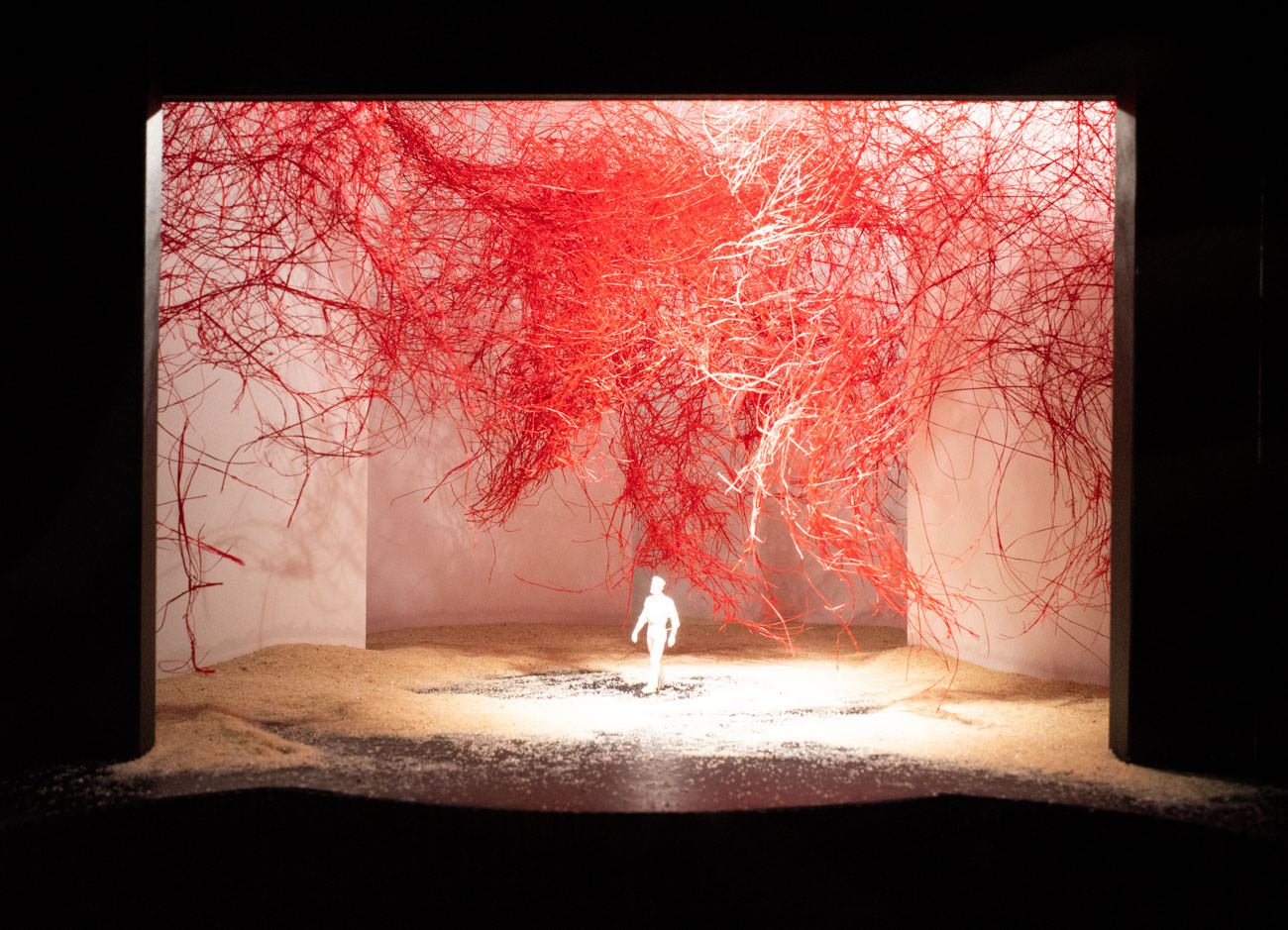
Since the recurrence of her cancer and treatment in 2017, body parts have become part of Shiota’s work. Behind this is her experience of feeling that her soul was left behind as body parts were removed, as if on a conveyor belt during treatment, and while receiving chemotherapy. For Shiota, who has felt the presence of life within absence, using the body in her work may be a way of imagining that absence.
Chiharu Shiota, “Out of My Body” (partial), 2019Two-dimensional works were also on display.Shiota’s stage design work
Summary
The day after this exhibition was confirmed, she discovered her cancer had recurred, and the two years leading up to the opening began with the question: “How should I live?” The time spent contemplating life and death appears to have significantly influenced her new works.
Mami Kataoka’s response to Shiota when she was at a loss for words at the opening was the question: “How did it turn out?”
The Mori Art Museum allows photography, so many people will likely see this exhibition through photos shared on SNS. However, the atmosphere Shiota created in her installations cannot be conveyed through images.
Shiota did not directly comment on how the exhibition turned out, saying only, “It hasn’t quite sunk in yet.”
However, standing in the vast space of this museum, one will be overwhelmed by the power of the works. And it will lead to an experience where one’s own heart trembles, where the soul truly quivers.
Chiharu Shiota’s bared soul is here.
Please make your way to the museum.
在开头一幕中语塞的Shiota,Mami Kataoka巧妙地插入的问题是”效果如何?”
Mori Art Museum允许拍摄,因此通过社交媒体看到这次展览面貌的机会想必也很多。但是Shiota创作的装置作品中的氛围恐怕难以传达。
Shiota没有直接谈及展览效果,只是说”目前还没有真实感”。
但是,只要站在这美术馆的巨大空间中,就会被作品的力量所折服。并且,会通向内心震颤、正如魂灵震动般的体验。
Chiharu Shiota袒露的灵魂,就在这里。
希望大家一定前往美术馆感受。
Chiharu Shiota “영혼의 떨림”
언론이 모인 기자회견 자리에서, Chiharu Shiota 본인이 직접 암의 재발을 언급하는 장면이 있었습니다.
감정이 북받쳤는지 그녀 자신도 말문이 막혀 잠시 회장이 정적에 휩싸였습니다.
잠깐의 침묵 후, 큐레이터 Mami Kataoka가 분위기를 바꾸는 절묘한 대응을 했고, Shiota뿐 아니라 필자의 의식도 되돌려진 듯 안도감을 느낄 수 있었습니다.
Shiota의 얼굴이 잘 보이는 기자석에 앉아 있던 필자는 그 장면과 공기를 접하며 투병의 혹독함의 일단을 느낄 수 있었습니다.
Chiharu Shiota “영혼의 떨림” 회장 입구 부근
지금까지 저는 전시회를 좋아해서 그것만이 삶의 보람이었고, 작품을 만들어 왔습니다.
어찌할 수 없는 마음의 갈등이나 말로는 전할 수 없는 감정, 설명할 수 없는 저의 존재, 그런 마음이 형태가 된 것이 저의 작품입니다.
재작년 12년 전의 암이 재발했지만, 죽음과 함께하는 괴로운 치료도 좋은 작품을 만들기 위한 시련일지도 모른다고 생각했습니다.
이번 전시에서는 지난 25년간의 작품을 발표합니다.
벌거벗은 저의 영혼과의 대화를 보아 주십시오.
Chiharu Shiota
관람객은 회장으로 이어지는 에스컬레이터가 있는 층고 높은 공간에 있는 작품 《어디를 향해》부터 감상을 시작합니다.
높이 11미터의 천장에서 매달린 65척의 배는 미술관 입구에서 관객을 맞이하며 전시라는 여정으로 이끕니다.
Chiharu Shiota 《어디를 향해》 2019년
《손 안에》
당장이라도 부서질 듯한 덧없는 조형물이 아이의 두 손바닥 안에서 지켜지고 있습니다. Shiota는 갤러리를 뒤덮는 실 설치 작품을 통해 공간에 잠재된 눈에 보이지 않는 존재를 시각화해 왔지만, 손바닥에 살며시 자리한 이 추상적 모티프는 그녀의 몸에 내재된 생명 혹은 영혼을 표현하는 듯도 하며, 전시의 부제인 “떨리는 영혼”도 연상시킵니다.
《불확실한 여정》
회장에 들어서 처음 만나는 설치 작품은 새빨간 실로 덮인 공간에 프레임만 남은 배가 배치된 작품입니다. 2015년 베네치아 비엔날레 일본관 전시에서는 오래된 베네치아의 전통적인 배 위에 무수한 열쇠가 매달려 있었지만, 《불확실한 여정》에서는 배가 더욱 추상화되어 있으며, 붉은 실로 가득한 공간은 불확실한 여정의 끝에 있을 수많은 만남을 암시하는 듯합니다.
Chiharu Shiota 《불확실한 여정》 2016년 철제 프레임, 빨간 털실Chiharu Shiota 《불확실한 여정》 2016년 철제 프레임, 빨간 털실
《고요 속에서》
Shiota가 어린 시절 옆집이 한밤중에 화재로 불탄 기억에서 만들어진 설치 작품입니다. 불타버린 그랜드 피아노와 관객용 의자가 검은 실로 공간과 함께 가득 채워지는 작품입니다. 소리를 내지 못하는 피아노는 침묵을 상징하면서도 시각적 음악을 연주합니다.
Chiharu Shiota 《고요 속에서》 2008년 불탄 피아노, 불탄 의자, 검은 털실Chiharu Shiota 《고요 속에서》 2008년 불탄 피아노, 불탄 의자, 검은 털실
《시공의 반영》
몸을 덮는 피부처럼, 드레스는 자신의 내부와 외부의 경계를 상징합니다. 그 드레스가 검은 실로 가득 채워진 공간에 떠오름으로써 부재의 존재를 느끼게 합니다. 또한 철제 프레임에 둘러싸인 공간을 반으로 가르는 거울의 양쪽에 드레스가 매달려 있어, 거울에 비친 허상으로서의 드레스와 반대편 공간에 실제로 존재하는 드레스가 관객의 의식 속에서 뒤섞입니다.
Chiharu Shiota 《시공의 반영》 2018년 하얀 드레스, 거울, 철제 프레임, Alcantara의 검은 실
《내부와 외부》
1996년 독일로 이주해 현재 베를린을 거점으로 하는 Shiota는 베를린 장벽 붕괴 15년 후인 2004년경부터 창문을 사용한 작품을 제작하기 시작했습니다. 당시 베를린은 재개발이 진행되어 많은 건물이 철거되는 가운데, Shiota는 폐기된 창틀을 모으며 걸어 다녔습니다. 창문은 사적인 공간의 내부와 외부의 경계로 존재하지만, 동서 독일을 갈랐던 벽도 연상시킵니다. 《내부와 외부》는 2009년부터 제작되어 여러 버전이 있으며, 이번 전시에서는 약 230장의 창틀을 사용한 작품을 전시합니다.
Chiharu Shiota 《내부와 외부》 2009년 오래된 목제 창문, 의자
《집적 – 목적지를 찾아서》
약 430개의 여행 가방이 계속 진동하는 이 작품은 Shiota가 베를린의 벼룩시장에서 발견한 여행 가방 안에서 오래된 신문을 발견한 것을 계기로 제작되었습니다. 모든 사물은 각자의 기억을 담고 있지만, 여기서 여행 가방은 낯선 사람의 기억, 이동과 이주, 혹은 난민으로서 정착지를 찾는 여정 등, 삶의 여정 그 자체를 암시하는 듯합니다.
Chiharu Shiota 《집적 – 목적지를 찾아서》 2016년
《가야 할 곳, 있어야 할 것》
어디에선가 모은 사적인 사진, 신문 스크랩, 건물의 잔해 등 잃어버린 과거를 암시하는 오브제가 낡은 여행 가방에 담겨 있습니다. 누군가의 유품이나 기념품 등의 기억을 약속 없는 미래를 향해 운반하는 여행 가방은 불확실한 세계에서 살면서도 존재의 확실성을 추구하는 사람들의 마음을 구현하고 있는 듯합니다.
Chiharu Shiota 《가야 할 곳, 있어야 할 것 – 사진》 2010년 여행 가방, 사진, 실, 기타
《외재화된 신체》 ※신작
2017년 암 재발과 투병 이후 Shiota의 작품에는 신체 부위가 사용되기 시작합니다. 그 배경에는 치료 과정에서 컨베이어 벨트에 실려 신체 부위가 적출되고 항암제 치료를 받는 가운데, 영혼이 뒤에 남겨졌다고 느낀 경험이 있습니다. 부재 속에서 생명의 영위 존재를 느껴 온 Shiota에게 신체를 작품에 사용하는 것은 그 부재를 상상하는 일일지도 모릅니다.
Chiharu Shiota 《외재화된 신체》(부분) 2019년평면 작품도 전시되어 있었습니다.무대미술에 종사해 온 Shiota의 작업
정리
이 전시가 결정된 다음 날 암 재발이 판명되었고, 개최일까지의 2년간은 “어떻게 살아가야 할까?”라는 상태에서 시작되었다고 합니다. 삶과 죽음에 가까이서 생각해 온 시간은 신작에도 큰 영향을 미친 듯합니다.
서두 에피소드에서 말문이 막힌 Shiota에게 Mami Kataoka가 던진 반문은 “완성도는 어떠신가요?”였습니다.
촬영이 가능한 Mori Art Museum이기에 SNS를 통해 이번 전시의 모습을 사진 이미지로 접할 기회도 많을 것입니다. 하지만 Shiota가 만들어 낸 설치 작품의 공기까지는 전해지지 않을 것입니다.
Shiota는 직접적으로 완성도에 대해 언급하지 않고 “아직 실감은 없습니다”라고 말했습니다.
그러나 이 미술관의 거대한 공간에 서면 작품의 힘에 압도될 것입니다. 그리고 자신의 마음이 술렁이는 것 같은, 그야말로 영혼이 떨리는 체험으로 이어질 것입니다.
Chiharu Shiota가 드러낸 영혼이 이곳에 있습니다.
꼭 미술관을 방문해 주시기 바랍니다.