Speaking of Christian Boltanski, one of France’s foremost contemporary artists, a friend of mine — someone who rarely says anything unscientific — once muttered, “I get the feeling he can ‘see’ something.”
It’s true: visit a Christian Boltanski exhibition and the boundary between life and death no longer feels clearly drawn but rather like a continuous thread. “I don’t quite think so, but maybe.” That was more or less my own reply.
Christian Boltanski is famed for works that use the sound of a heartbeat, secondhand clothing, and photographs of unknown people to convey — across an entire space — the weight and fragility of human existence. He has taken part in the Echigo-Tsumari Art Triennale and the Setouchi Triennale, and is well known for his deep ties to Japan. “Christian Boltanski — Lifetime,” his largest retrospective ever in Japan, will travel from the National Museum of Art, Osaka to The National Art Center, Tokyo and then to the Nagasaki Prefectural Art Museum.
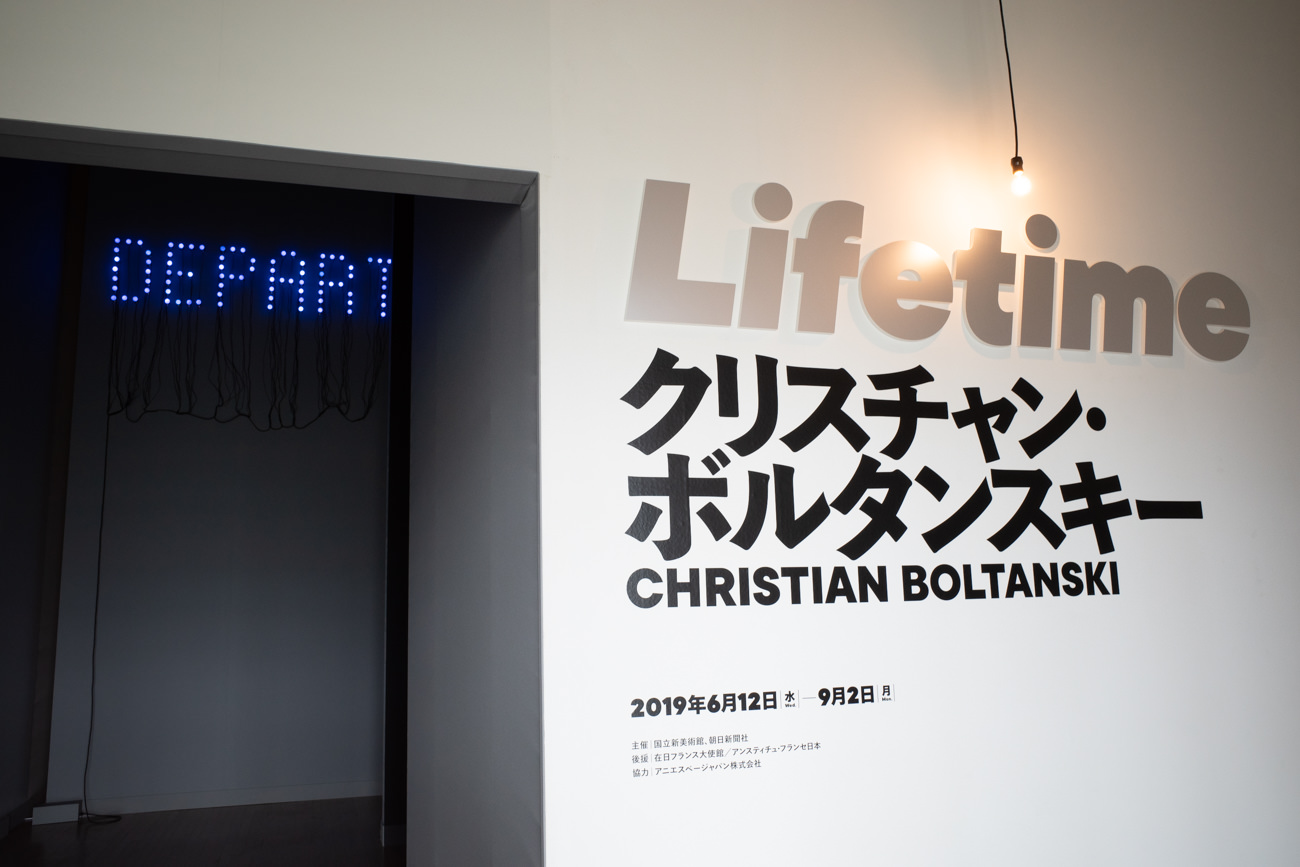
“Lifetime” means “one’s life.” Straight ahead, you can see the work “Départ.”
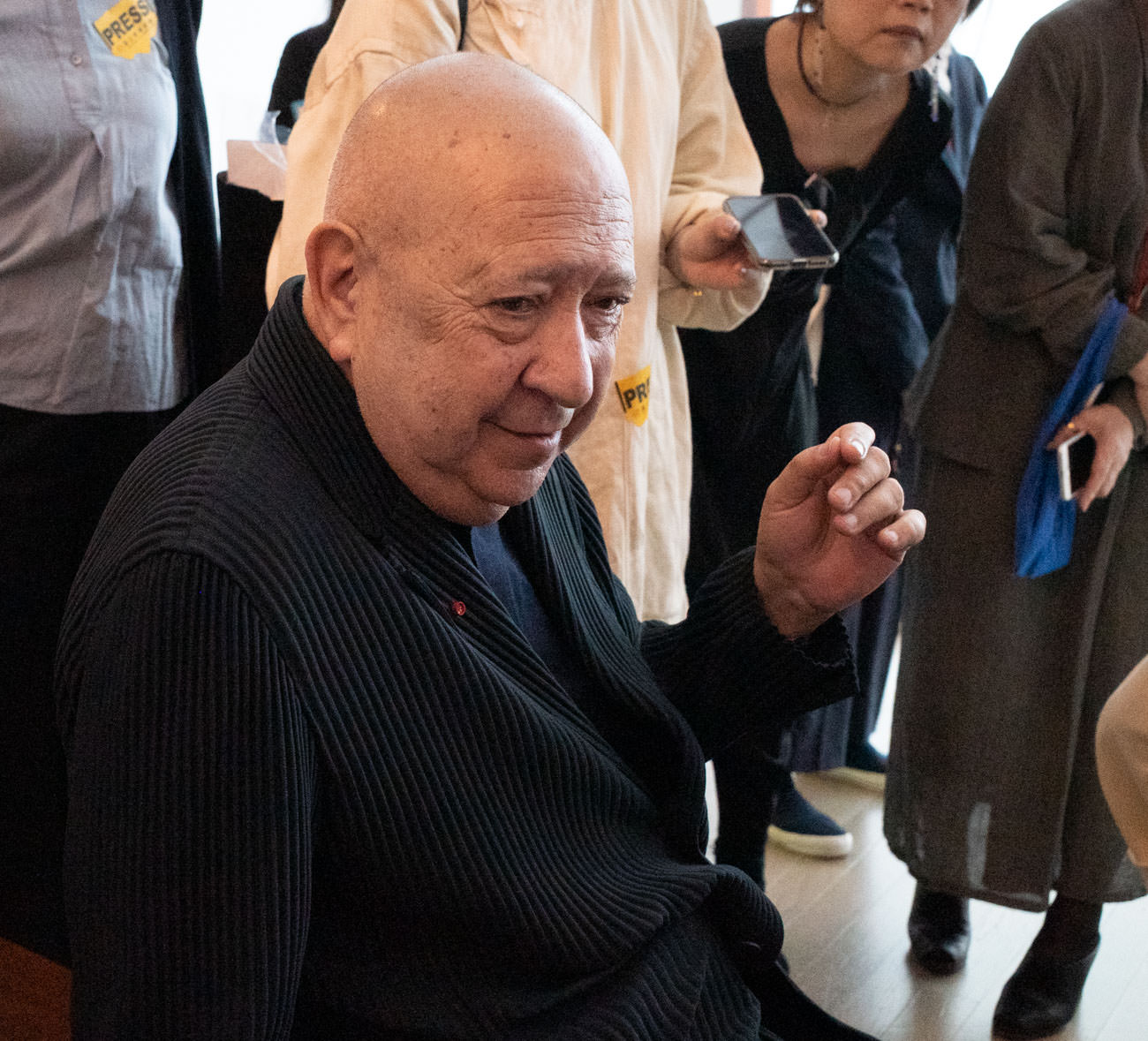
At the press preview of the Tokyo installment at The National Art Center, Tokyo — which opened after the Osaka show had closed — Boltanski, who arranged the entire exhibition himself, spoke about the intentions and feelings he had poured into it.
Christian Boltanski, surrounded by the press.
At the time of the Tokyo show, Boltanski was 74 years old, with a career spanning more than half a century. Even so, he insisted: “This is not a retrospective that lines works up chronologically.” That “on the offensive” stance toward the very idea of a retrospective was striking.
One characteristic is that, as befits a retrospective, both his “oldest” work and the “newest” one — created specially for the Tokyo show — are on view. The oldest is a 1969 video work, believed to be the short films “The Man Who Coughs” and “The Man Who Licks,” released the year after his first solo exhibition; they were being screened near the exhibition entrance.
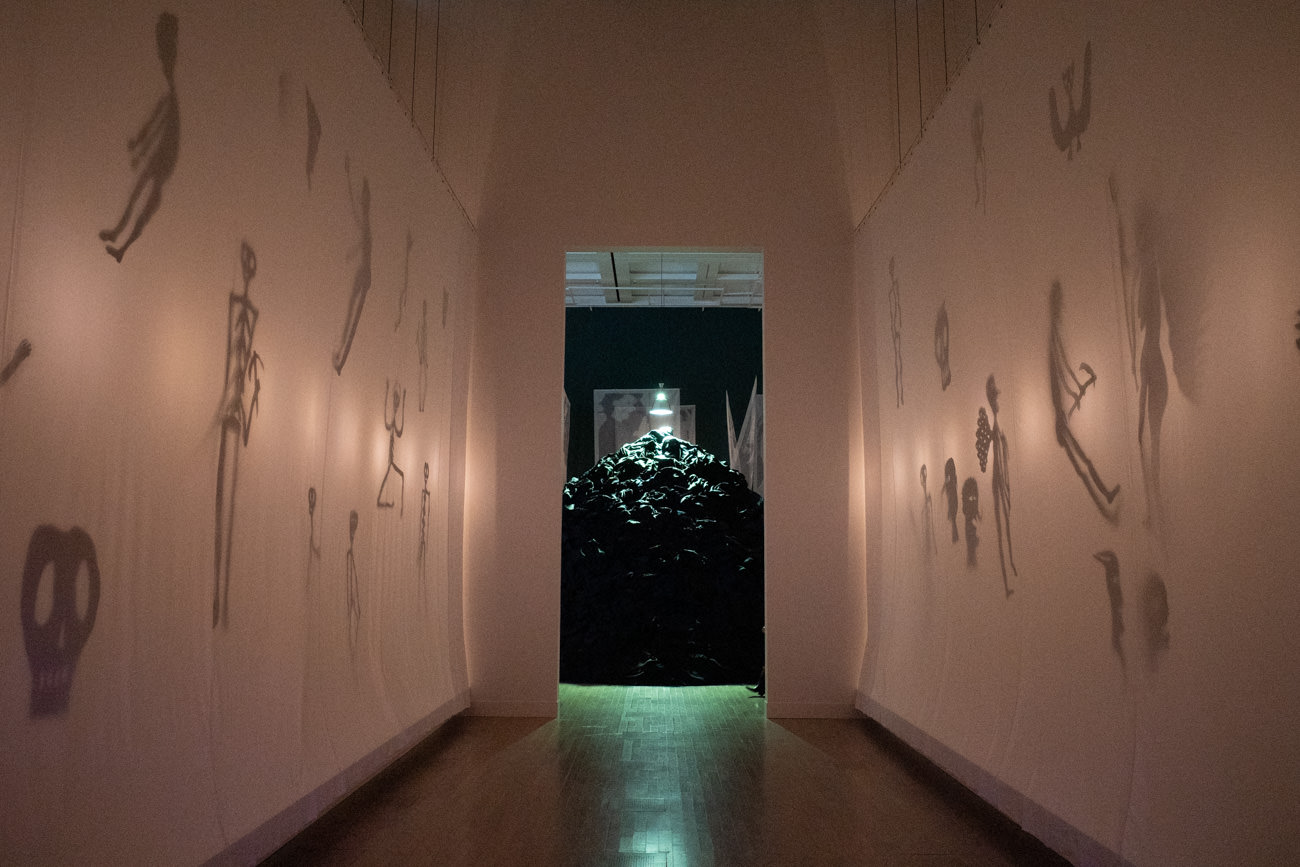
The newest is “Corridor of Ghosts,” a long passage with curtains draped on either side, on which oversized silhouettes of puppets are projected. It calls to mind the wall paintings of ancient ruins, yet the shadows of the puppets sway with the movement of the curtains, evoking ghosts as elusive beings.
“Corridor of Ghosts.” Beyond it, you can see “Slag Heap,” a work in which black clothes are piled up.
Also, no title labels are placed in front of individual works. Forty-seven works are exhibited at the Tokyo show, but this reflects Boltanski’s wish that “the exhibition itself be regarded as a single work.”
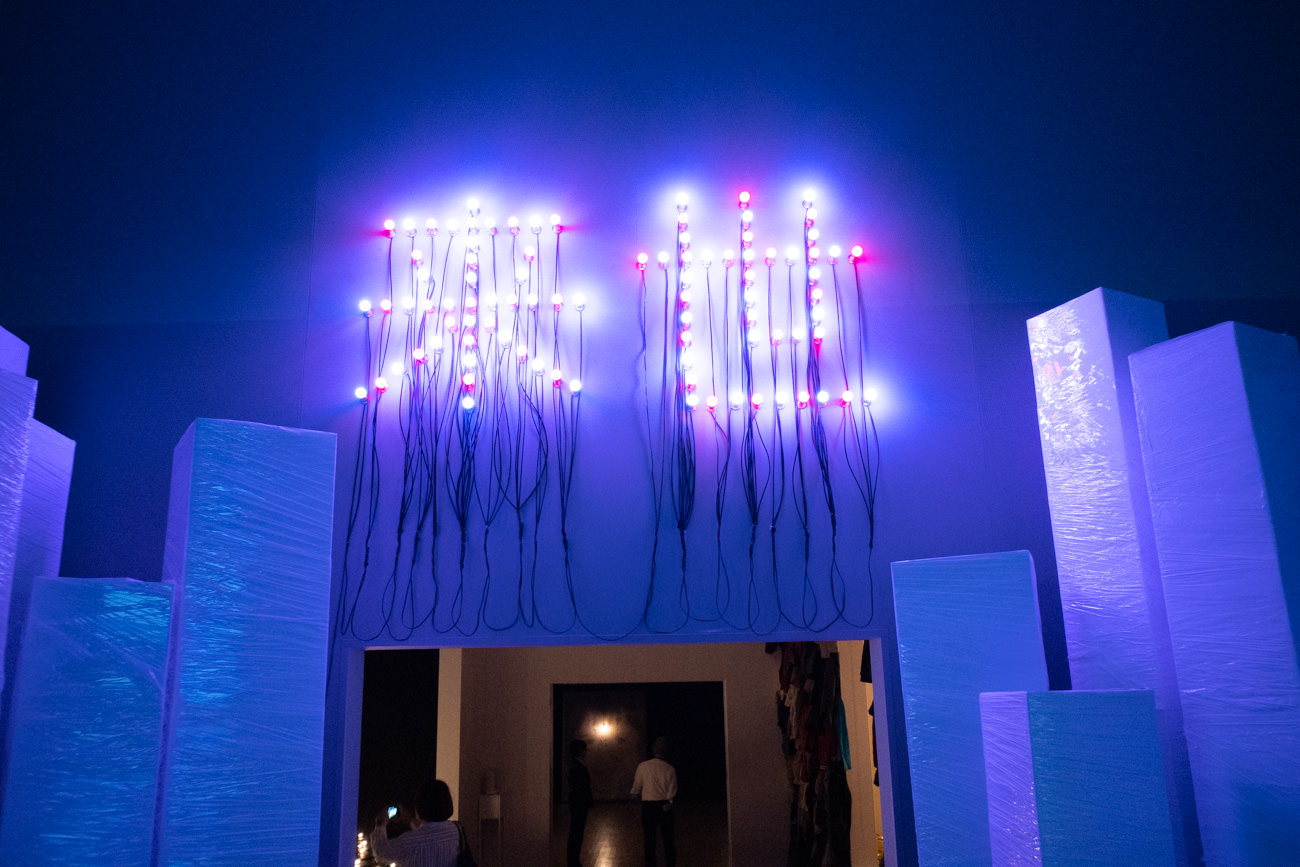
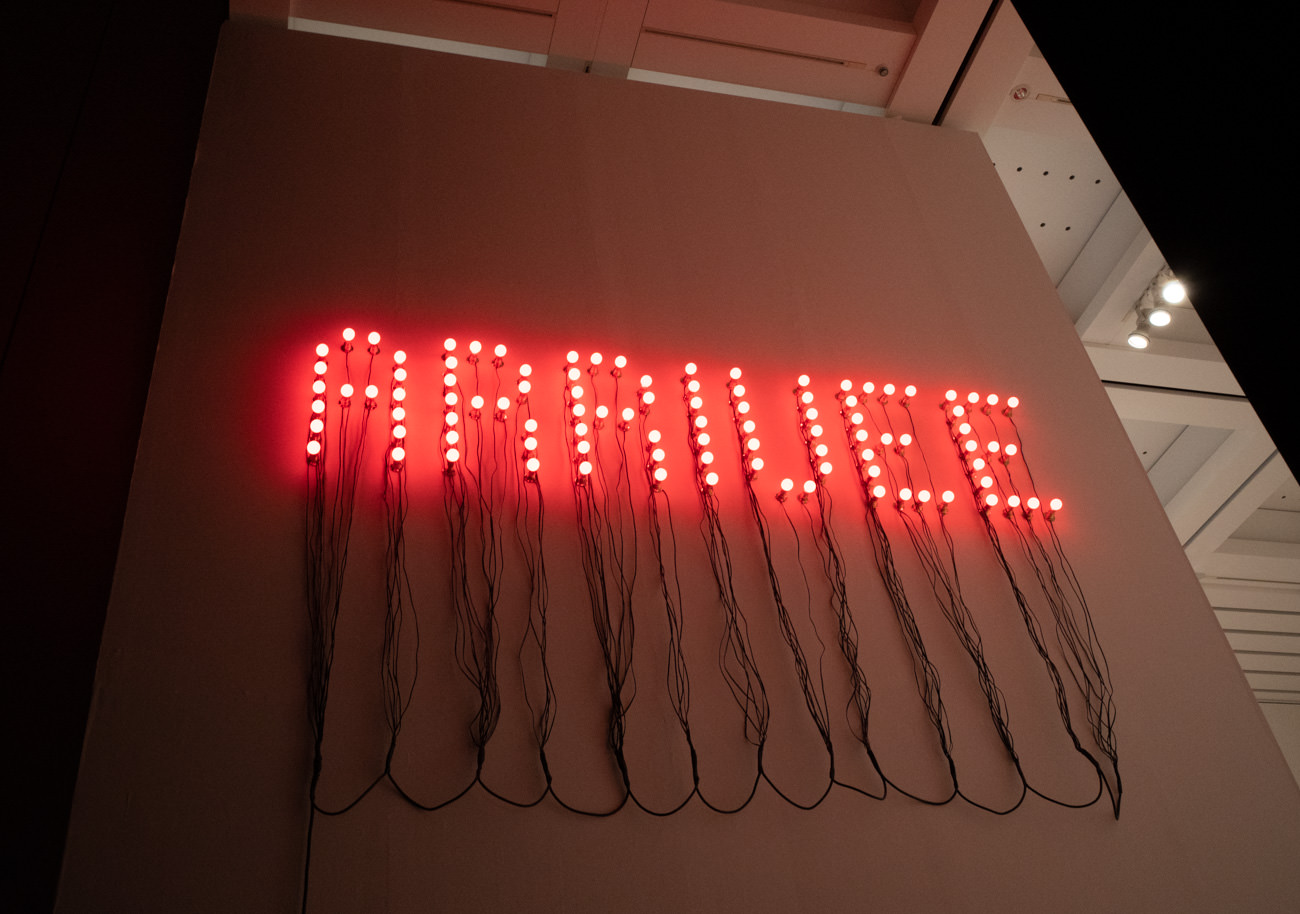
Just past the entrance stood a work spelling out “DEPART” in light bulbs; midway through the show, in the same style, was “Afterlife” in Japanese; and at the very end, “ARRIVÉE.” Treating even the “Afterlife” as part of a person’s life, Boltanski seems to have shaped the entire exhibition as “Lifetime = a life.” At the press preview, he himself called it “an exhibition that mirrors all of one’s life.”
“White Monument, Afterlife”“Arrivée”
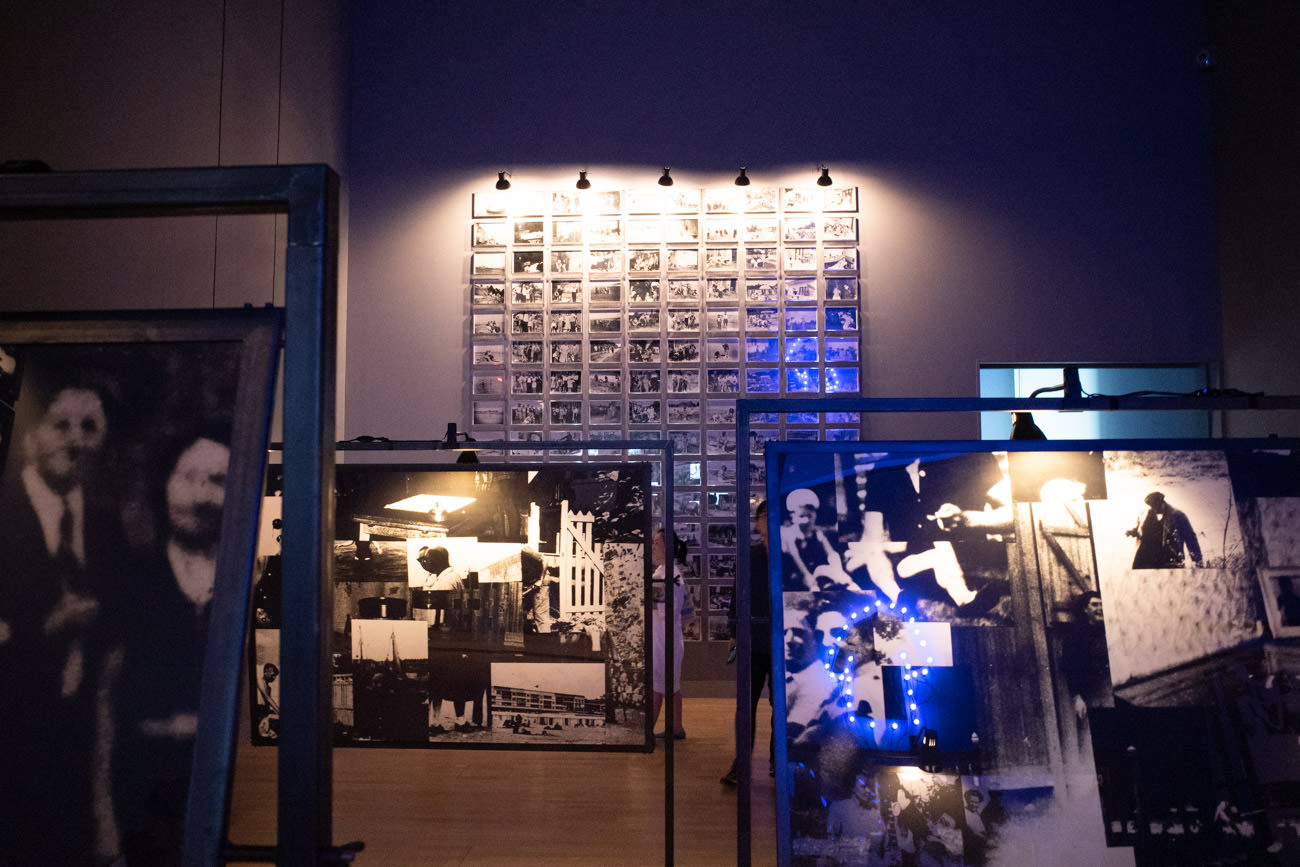
In the large area near the entrance, “Memories of Youth” — a work combining many photographs — is on view. Photography, so often used as a motif of memory, appears in numerous works throughout this exhibition.
“Memories of Youth.” Countless photographs — of strangers, and taken by Boltanski himself — are gathered onto the boards.
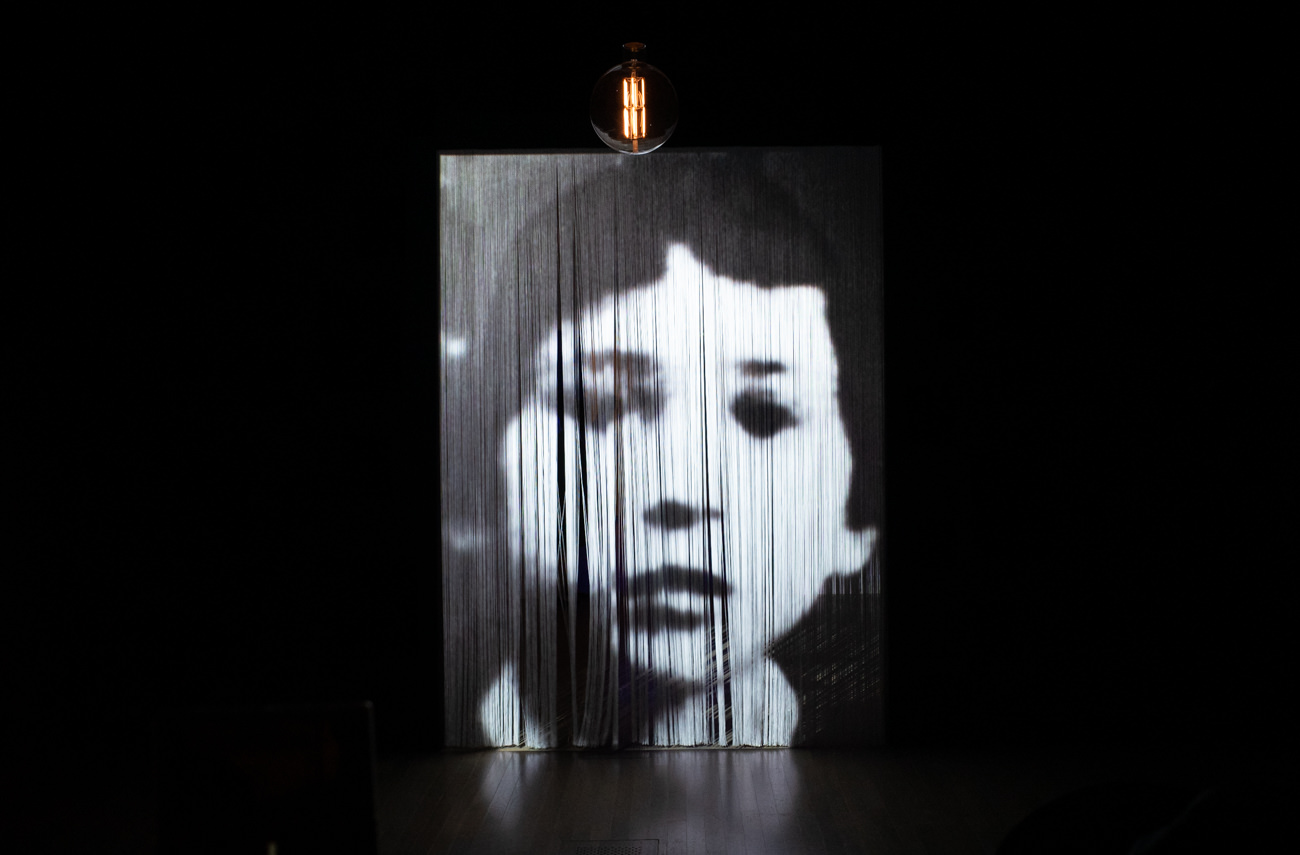
Emerging from this section, one hears the throb of a heartbeat: “The Heart Beats,” Boltanski has been saving heartbeats from people around the world since 2008, and since 2010 has been presenting them at the Teshima Art Museum as “Les Archives du Cœur.” This work uses Boltanski’s own heartbeat, provided from “Les Archives du Cœur.” Just beyond it hangs a curtain made of strings, onto which Boltanski’s own image, from age 7 to 65, is projected; visitors pass through it.
“Entre-Temps.” His face here changes with the passage of time.
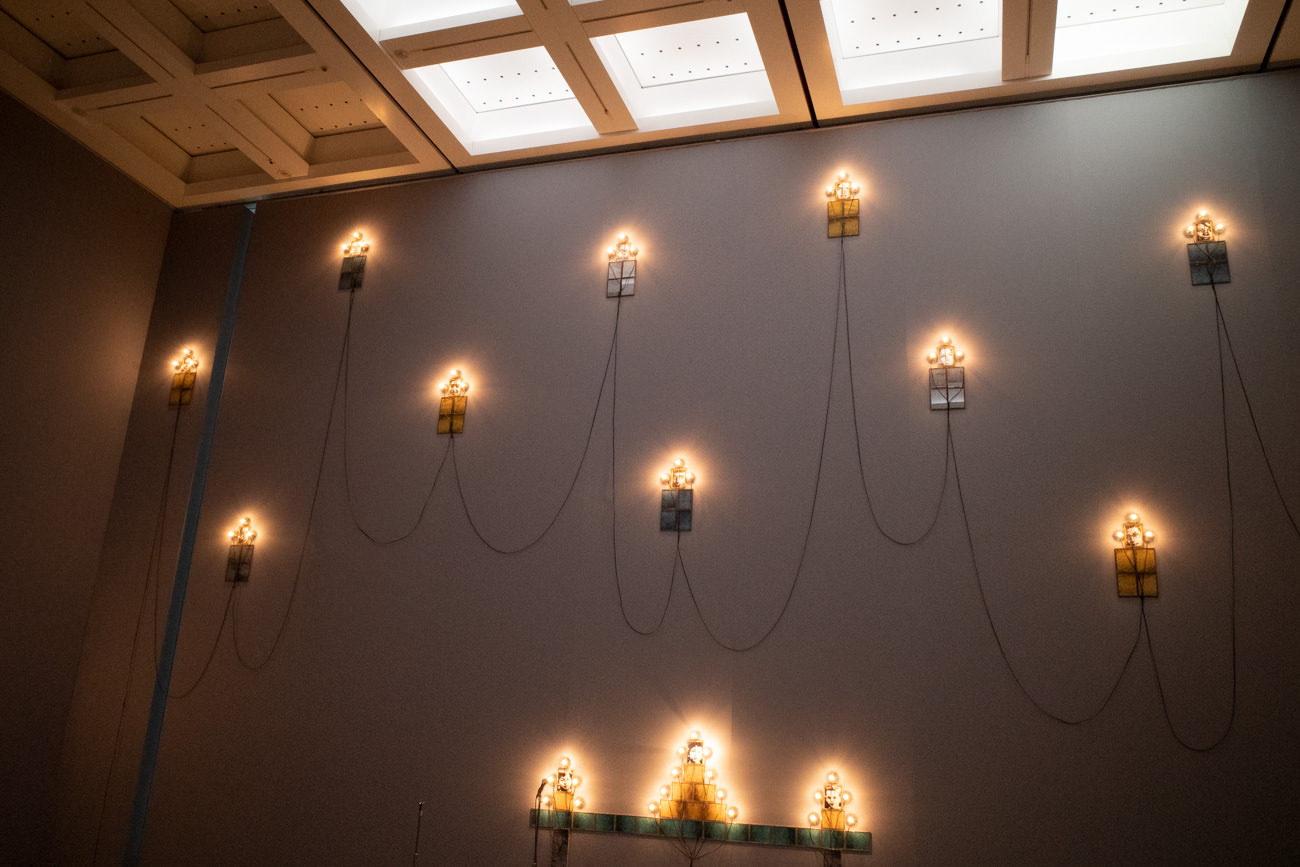
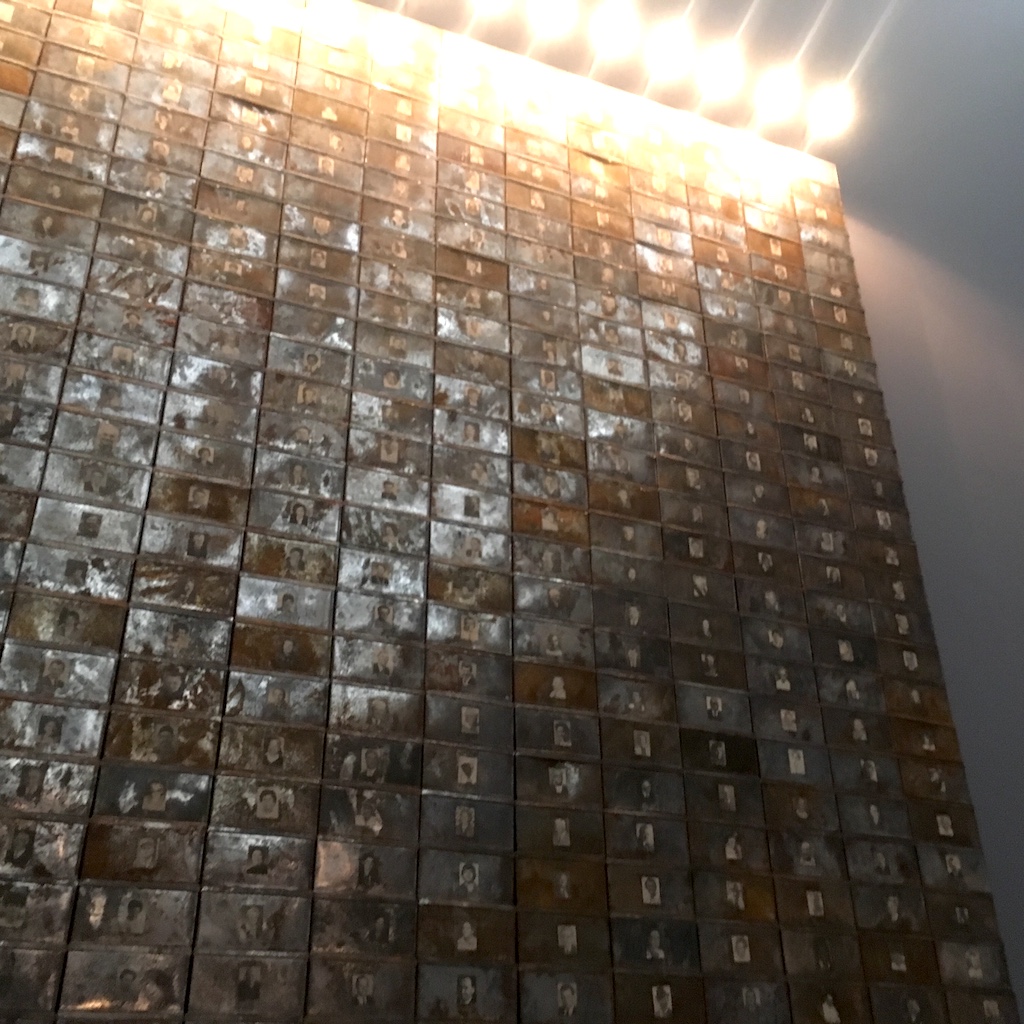
Next, an area gathers works reminiscent of altars. Boltanski has produced many pieces in which black-and-white photographs of people, framed, are dimly illuminated. Multiple works stacking tin boxes suggestive of urns are on view as well.
“Monument.” At the press preview, Boltanski stood right in front of this work as he spoke.“The Dead Swiss.” Photographs of Swiss citizens clipped from newspaper obituary columns are, we are told, affixed to metal boxes.
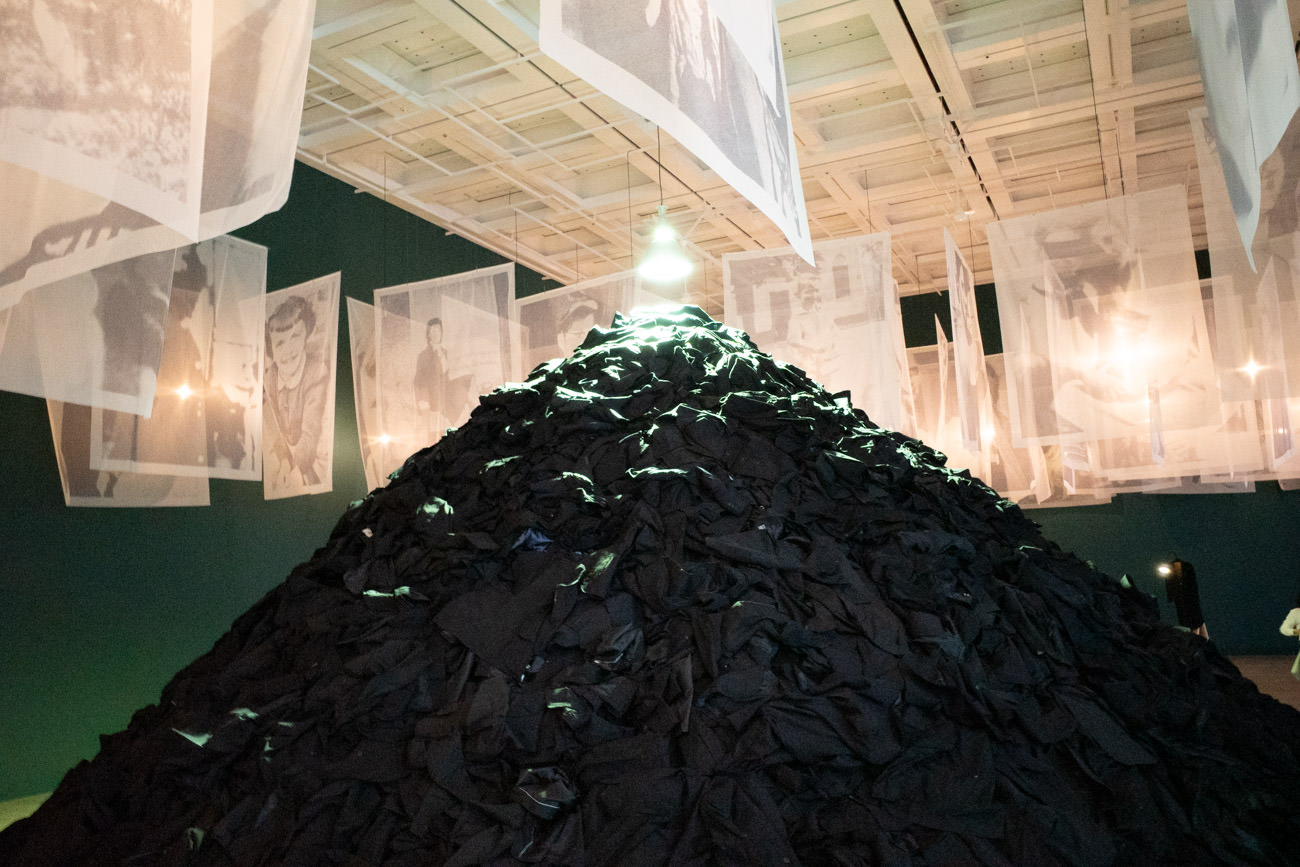
In the largest area of the exhibition, “Slag Heap,” a mound of piled-up black clothing, is encircled by “Speak Up,” a work in which black garments are hung one by one. Overhead, thin veil-like fabrics printed with photographs of figures hang as “Spirits.”
“Slag Heap” and “Spirits”
“Black clothing represents a person from whom the soul has departed,” Boltanski said. Combined with the works drifting overhead, one has the sensation that here, in this very space, souls are being softly released.
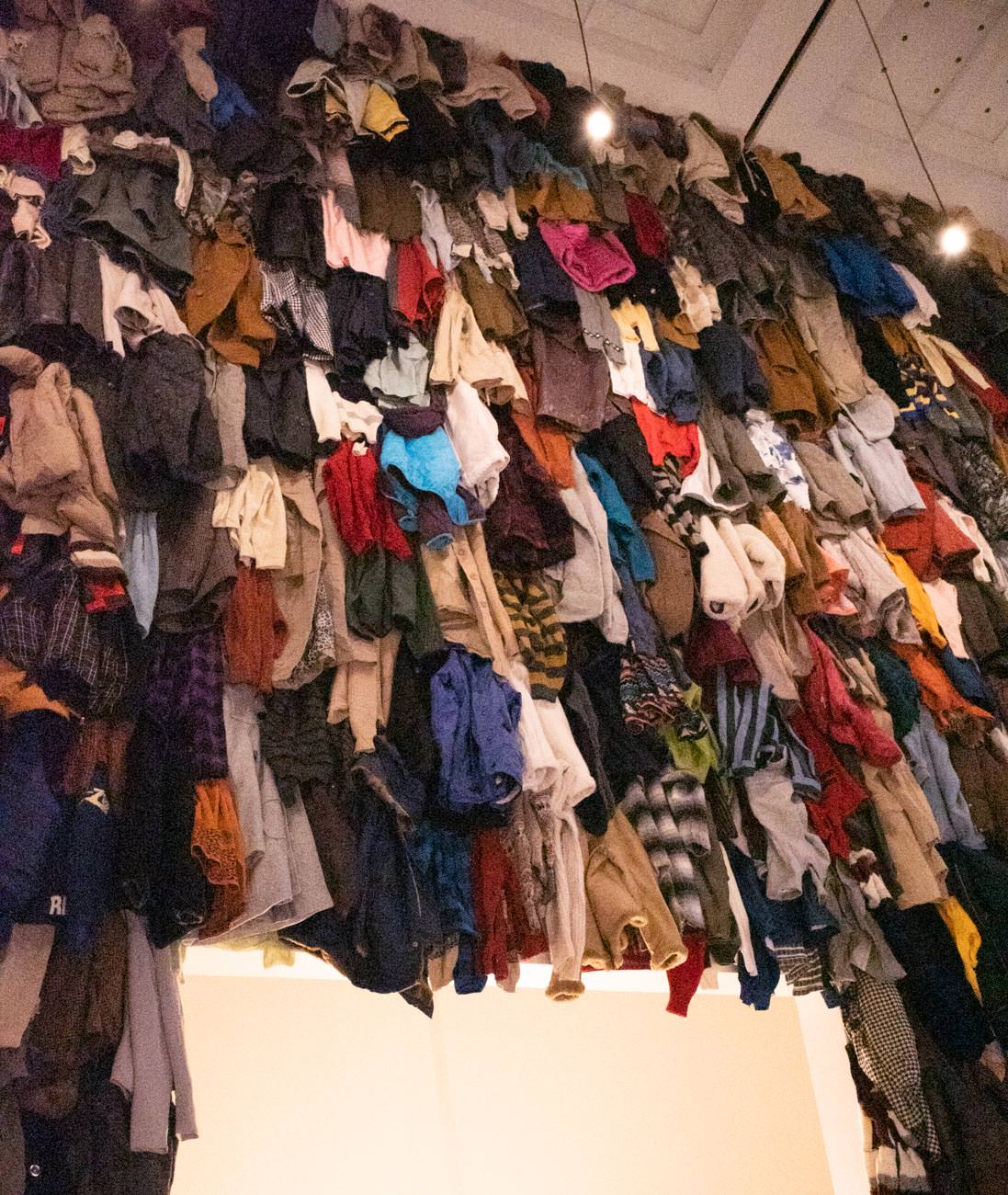
“Storage Area (Canada),” in which countless pieces of secondhand clothing hang on the walls: standing before it, the distinctive musty odor of used clothes stings your nose. That smell too must be part of the work. Though nothing tangible is present, this work overwhelms with a “sense of presence” of the people it evokes.
“Storage Area (Canada).” It was reportedly also shown at Art Tower Mito’s 1990 exhibition.
As Boltanski himself put it, “I composed these works taking advantage of the ceiling heights of The National Art Center, Tokyo”: “Slag Heap” and “Storage Area” have both been built up high, making for imposing works.
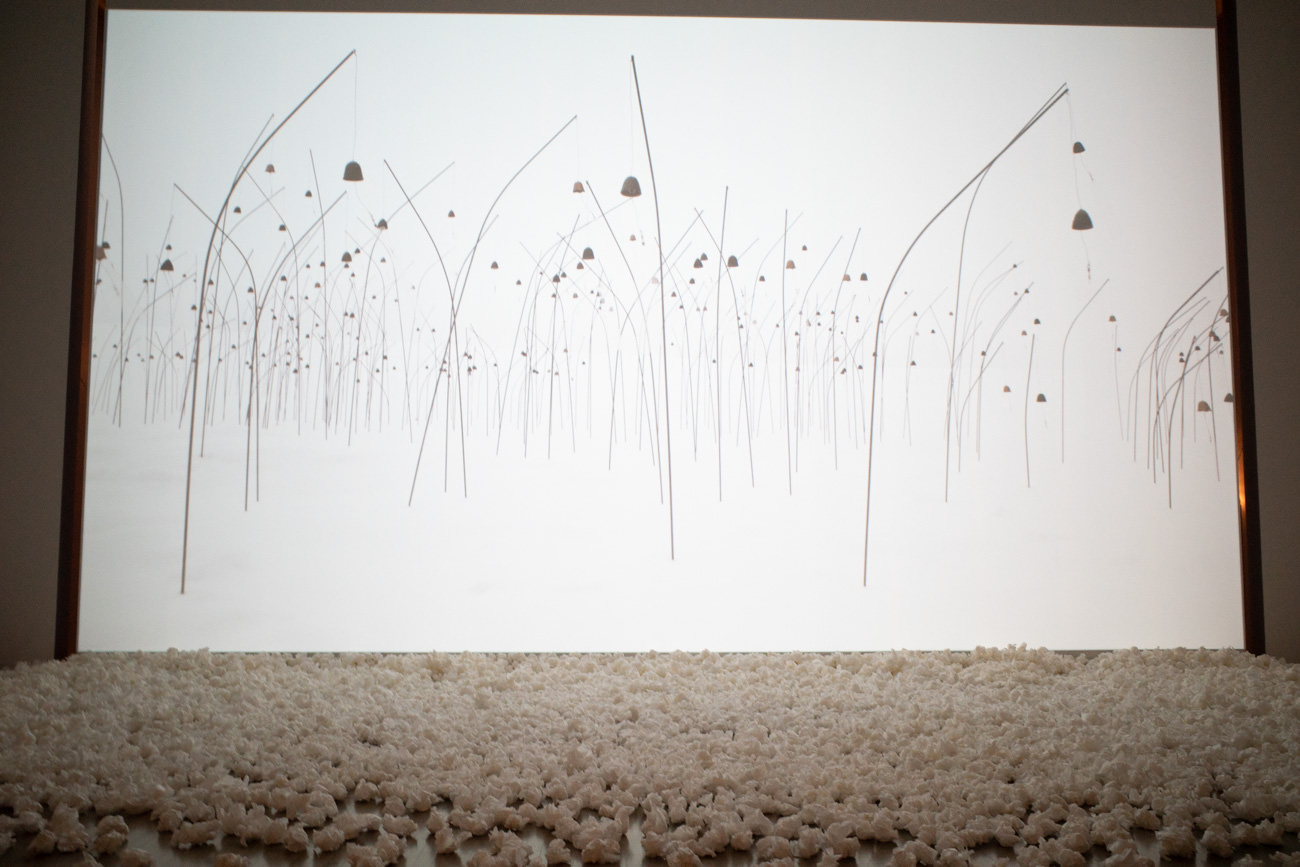
The video piece “Animitas (White)” was shot over ten hours in the snowfields of Canada, where numerous wind chimes have been installed. The faint tones give one the sensation of a breeze passing right beside you.
“Animitas (White).” “Animitas” means “little souls” in Spanish, we are told.
Boltanski has visited Japan often and has been deeply influenced by Japanese philosophy.
“Rather than being moved by an artwork, I hope people will take in various things from a work, raise questions within themselves, and quietly contemplate. Then each will return to his or her own ‘life.’ That’s what an exhibition is,” he said.
As the artist describes himself as “an artist of space,” even sound, smell, and the flow of air are staged as part of the work. Within the space Boltanski has fashioned, one comes to feel that human “existence” is not merely the existence of the body. The beat of the heart, the breath, the smell, and the memory of that person that lingers in someone else — all of these might be called human “existence.” How do you, yourself, wish to grasp that precious existence? The exhibition seemed to be asking that of us.
There is a sensation that cannot be conveyed by photographs alone — only by immersing yourself in this space. Everyone will find themselves reflecting on human “existence” and slipping into the mood of a philosopher. It was an exhibition that seemed to fill one’s whole body with circling thoughts.
Note: In another series of “Animitas” is scheduled to be screened at Espace Louis Vuitton Tokyo from June 13 to November 7, 2019.
* All photographs are installation views of “Christian Boltanski — Lifetime” at The National Art Center, Tokyo, 2019.
Christian Boltanski — Lifetime
提到法国当代艺术家的代表人物 Christian Boltanski,曾经有一位平时不太爱说非科学话题的朋友低声对我说:”他好像’看得见’什么。”
的确,走进 Christian Boltanski 的展览,生与死的界限并不那么清晰,反倒像是一条连绵的丝线。”我不这么觉得,但也许吧。”——我当时也是这样回答的。
Christian Boltanski 以运用心跳声、旧衣物、人物照片等,通过整个空间来表现”人类”这一存在的沉重与脆弱的作品而闻名。他曾参加过”大地艺术祭 越后妻有艺术三年展”、”濑户内国际艺术祭”等,与日本渊源深厚而广为人知。而在日本,他历来规模最大的回顾展「Christian Boltanski — Lifetime」将依序在大阪·国立国际美术馆、东京·The National Art Center, Tokyo、长崎·长崎县美术馆举办。
Lifetime 意为”人生”。正前方可以看到作品「出发」。
大阪展落幕后开幕的东京展在 The National Art Center, Tokyo 举办,亲自构成本展的 Boltanski 在预展上讲述了其中的意图与所倾注的情感。
另外,据说 Espace Louis Vuitton Tokyo 将于2019年6月13日至11月7日间放映「Animitas」的另一系列作品。
※所有照片均为「Christian Boltanski — Lifetime」展 2019年 The National Art Center, Tokyo 现场展览景观。
Christian Boltanski — Lifetime
프랑스를 대표하는 현대미술가 Christian Boltanski를 두고, 평소 비과학적인 말은 잘 하지 않는 한 친구가 “그는 뭔가 ‘보이는’ 듯한 느낌이 든다”고 중얼거린 적이 있습니다.
확실히, Christian Boltanski의 전시에 가면 삶과 죽음의 경계가 뚜렷하지 않고, 하나의 이어짐처럼 느껴지곤 합니다. “그렇게 생각하진 않지만, 어쩌면 그럴지도 모르지.” — 저 또한 그렇게 답했었습니다.
Christian Boltanski는 심장 소리, 헌 옷, 인물 사진 등을 사용하여 공간 전체로 “인간”이라는 존재의 무게와 덧없음을 표현하는 작품으로 유명합니다. 지금까지 “대지의 예술제 에치고쓰마리 아트 트리엔날레”나 “세토우치 국제 예술제” 등에도 참여해 왔으며, 일본과의 인연도 깊은 것으로 알려져 있습니다. 그런 그의 일본 내 사상 최대 규모의 회고전이 오사카·National Museum of Art, Osaka, 도쿄·The National Art Center, Tokyo, 나가사키·Nagasaki Prefectural Art Museum 의 순으로 개최되는 “Christian Boltanski — Lifetime”입니다.
Lifetime은 우리말로 인생이라는 뜻. 정면에 「출발」이라는 작품이 보입니다.
오사카전 폐막 후 시작된 The National Art Center, Tokyo에서의 도쿄전 프리뷰. 전시를 스스로 구성한 Boltanski는 그 의도와 담긴 마음에 대해 이야기하였습니다.
취재진에 둘러싸인 Christian Boltanski.
Boltanski는 도쿄전 개최 당시 74세, 경력은 50년이 넘습니다. 그럼에도 불구하고 “시계열로 작품을 나열한 것 같은 회고전이 아닙니다”라고 말했으며, 회고전이라는 형식에 대한 “공격적인” 자세가 인상적이었습니다.
특징 중 하나는, 회고전답게 그의 “가장 오래된” 작품과 이번 도쿄전을 위해 제작된 “가장 새로운” 작품이 함께 있다는 점입니다. 가장 오래된 것은 1969년의 영상 작품. 첫 개인전 다음 해에 발표된 단편 영화 「기침하는 남자」 「핥는 남자」로 추정되며, 전시 입구 근처에서 상영되고 있었습니다.
한편, 최신작은 긴 통로의 좌우에 드리워진 커튼에 인형의 커다란 그림자가 비쳐지는 「유령의 회랑」이라는 작품. 유적의 벽화를 떠올리게 하지만, 인형의 그림자는 커튼의 움직임에 따라 흔들거리며, 불확실한 존재인 유령을 느끼게 합니다.
「유령의 회랑」. 안쪽에는 검은 옷이 쌓아 올려진 「보타산(폐석 더미)」이라는 작품이 보입니다.
또한, 개별 작품 앞에는 작품 이름이 표시되어 있지 않습니다. 도쿄전에는 47점의 작품이 출품되어 있으나, “이 전시 자체를 하나의 작품으로 봐 주었으면 한다”(Boltanski)는 뜻에서 비롯된 듯합니다.
입구에는 “DEPART”라고 전구로 표시된 작품이 있으며, 같은 스타일로 회장 중간쯤에는 일본어로 “來世(내세)”, 마지막에는 “ARRIVÉE”라는 작품이 있었습니다. “내세”까지도 그 사람의 인생으로 보고, 전시 자체를 “Lifetime=인생”으로 구성한 것이겠지요. 프리뷰에서 Boltanski 스스로도 “인생의 모든 것을 비추는 전시”라고 칭했습니다.
「하얀 기념비, 내세」「도착」
입구 근처의 넓은 구역에는 여러 사진을 조합한 작품 「청춘 시절의 기억」이 있습니다. 사진은 기억의 모티프로 자주 사용되며, 이번 전시에서도 다수의 작품에서 사용되고 있습니다.
「청춘 시절의 기억」. 낯선 사람들이나 Boltanski 자신이 촬영한 방대한 사진들이 보드에 정리되어 있습니다.
이 구역을 지나면 두근두근 심장 고동 소리가 들립니다. 「심장 소리」라는 작품입니다. Boltanski는 2008년부터 전 세계 사람들의 심장 소리를 보존해 왔고, 2010년부터는 「심장 소리 아카이브」로 데시마 미술관에서 발표하고 있는데, 이번 작품에서는 「심장 소리 아카이브」로부터 제공된 Boltanski 자신의 심장 소리를 사용하고 있습니다. 그 앞에는, Boltanski 자신의 7세부터 65세까지의 이미지가 투영된 끈으로 만들어진 커튼이 있으며, 관객은 이 커튼을 지나가게 됩니다.
「그 사이에」. 이곳의 그의 얼굴은 시간의 흐름에 따라 변화한다고 합니다.
다음으로 주목할 것은 제단을 연상시키는 작품들이 모여 있는 구역입니다. Boltanski는 액자에 담긴 인물의 흑백 사진에 어렴풋한 빛을 밝힌 작품을 다수 만들어 왔습니다. 유골 단지를 떠올리게 하는 금속 상자를 쌓아 올린 작품도 여러 점 전시되어 있습니다.
「기념비」. 프리뷰에서는 이 앞에 서서 이야기하고 있던 Boltanski.「죽은 스위스인의 자료」. 금속 상자에, 사망 부고란에서 오려낸 스위스인의 사진이 붙어 있다고 합니다.
이 전시에서 가장 넓은 구역에는, 검은 옷을 쌓아 올린 「보타산」의 주위에, 검은 옷을 한 벌씩 걸어 놓은 「발언한다」라는 작품이 놓여 있습니다. 또한, 천장에서는 얇은 베일과 같은 천에 인물 사진을 프린트한 「스피릿」이라는 작품이 걸려 있습니다.
「보타산」 「스피릿」
“검은 옷은 영혼이 빠져나간 뒤의 사람을 나타냅니다”라고 Boltanski는 말했는데, 이 머리 위를 떠도는 작품과 어우러져, 마치 이 공간에서 영혼이 훌쩍 빠져나가는 것 같은 느낌마저 듭니다.
엄청난 양의 헌 옷이 벽에 걸린 「보관실(캐나다)」. 이 작품 앞에 서면 헌 옷 특유의 톡 쏘는 냄새가 코를 찌릅니다. 이 냄새 또한 작품의 일부일 것입니다. 실체는 없지만, 사람의 “존재감”에 압도되는 작품입니다.
「보관실(캐나다)」. 1990년 Art Tower Mito 전시에서도 전시된 바 있다고 합니다.
“The National Art Center, Tokyo의 천장 높이를 살려 작품을 구성했습니다”라고 Boltanski가 말한 그대로, 「보타산」 「보관실」도 높이 쌓아 올려져 박력 있는 작품으로 완성되었습니다.
영상 작품 「Animitas (하양)」은 캐나다의 눈밭에 수많은 풍경(風鈴)을 설치하고 그 모습을 10시간 촬영한 것. 희미한 음색에, 마치 바람이 곁을 스쳐 지나가는 듯한 감각이 있었습니다.
Boltanski는 일본을 자주 방문하며, 일본 철학으로부터 크게 영향을 받았다고 합니다.
“작품에 감동하기보다는 작품에서 여러 가지를 느끼고, 자신 안에서 문제를 제기하고, 침사묵고(沈思默考)해 주었으면 합니다. 그러고 나서, 각자가 자신의 ‘인생’으로 돌아갑니다. 전시란 그런 것입니다”라고 말했습니다.
작가 스스로가 자신을 “공간의 아티스트”라고 형용하듯, 소리, 냄새, 공기의 흐름조차도 작품으로 연출되고 있습니다. Boltanski가 만들어 낸 공간을 통해, 인간의 “존재”가 단지 신체의 존재만은 아니라는 것을 느끼게 됩니다. 심장이 뛰는 소리, 숨결, 냄새, 그리고 누군가의 마음속에 남는 그 사람의 기억…… 이 모든 것이 인간의 “존재”라 할 수 있을 것입니다. 그 소중한 존재를 나 자신은 어떻게 받아들이고 있는지, 어떻게 받아들이고 싶은지, 그렇게 묻는 듯했습니다.
사진으로는 결코 느낄 수 없는, 이 공간에 몰입해야만 맛볼 수 있는 감각. 누구든 인간의 “존재”에 대해 생각을 기울이며 철학자의 기분이 될 것 같습니다. 자신의 몸이 순환하는 사고로 가득 차오르는 듯한 전시였습니다.
또한, Espace Louis Vuitton Tokyo에서 2019년 6월 13일~11월 7일에 「Animitas」의 별도 시리즈가 상영된다고 합니다.
※사진은 모두 “Christian Boltanski — Lifetime” 전 2019년 The National Art Center, Tokyo 전시 전경.