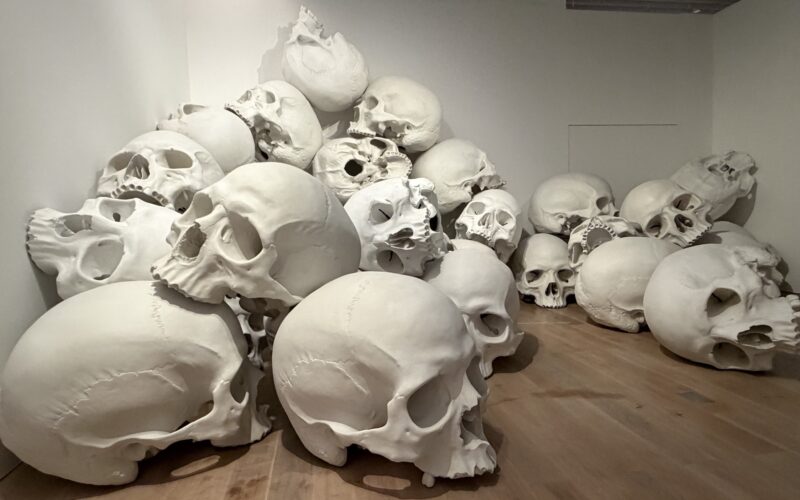
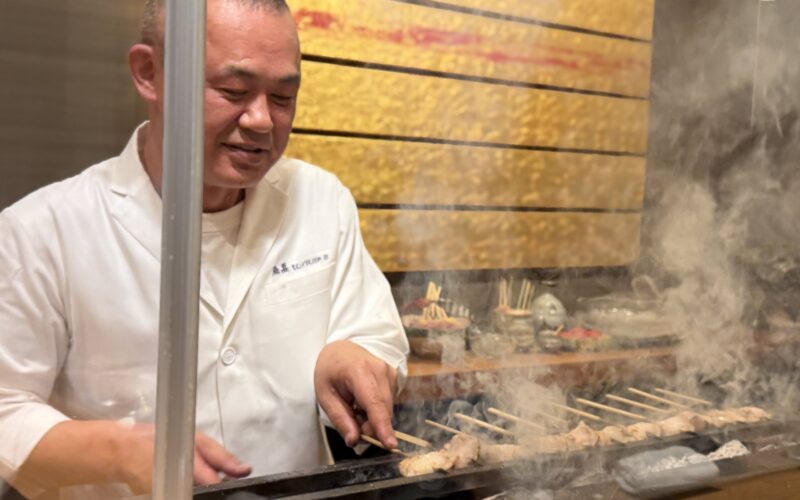
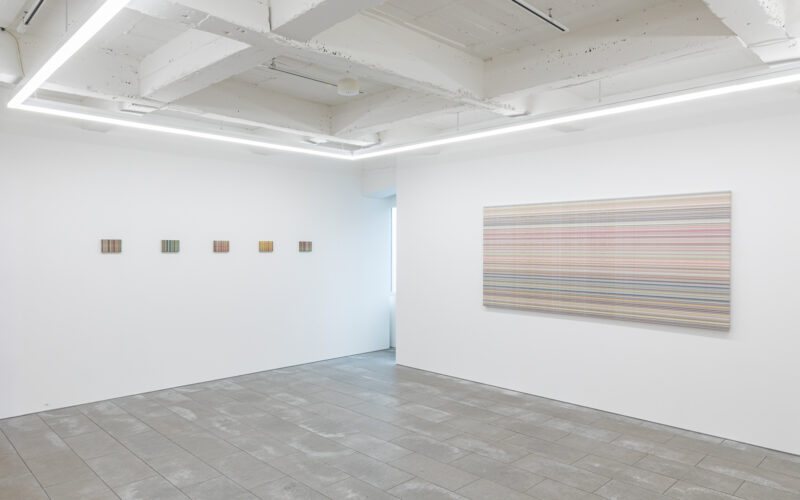
This article is a review I had originally planned to write up properly after the end of mé’s “Not Quite Clear,” now on view at Chiba City Museum of Art.
Given the unified etiquette that runs through the exhibition — the tacit rule that visitors should not reveal spoilers — I confess I was avoiding the need to write cautiously about it. However, I changed course and decided to publish the summary article as early as possible during the exhibition period.
…That decision came because, ever since I gave a brief mention of the show in the site’s weekly diary “Burart Diary” (published on November 18), we have been seeing significant sustained traffic, growing further day by day.
Alongside the access counts, records of many related search queries have also been streaming in, and I can feel a strong sense of energy from our visitors.
This article is written and posted quickly, aimed at readers who may be curious about the “Not Quite Clear” exhibition — clearly generating buzz — in the hope of nudging even a few more people to actually visit.
*This article contains photos taken inside the museum and viewing commentary; it cannot fully eliminate spoilers. Readers who plan to visit before reading, please proceed with caution. That said, the article does not touch on the core essence of the exhibition.
mé
mé is an artistic unit of three: artist Haruka Kojin, director Kenji Minamigawa, and installer Hirofumi Masui. Through installation works and other means, they engage in activities with a consciousness aimed at bringing us viewers moments of “awareness.”
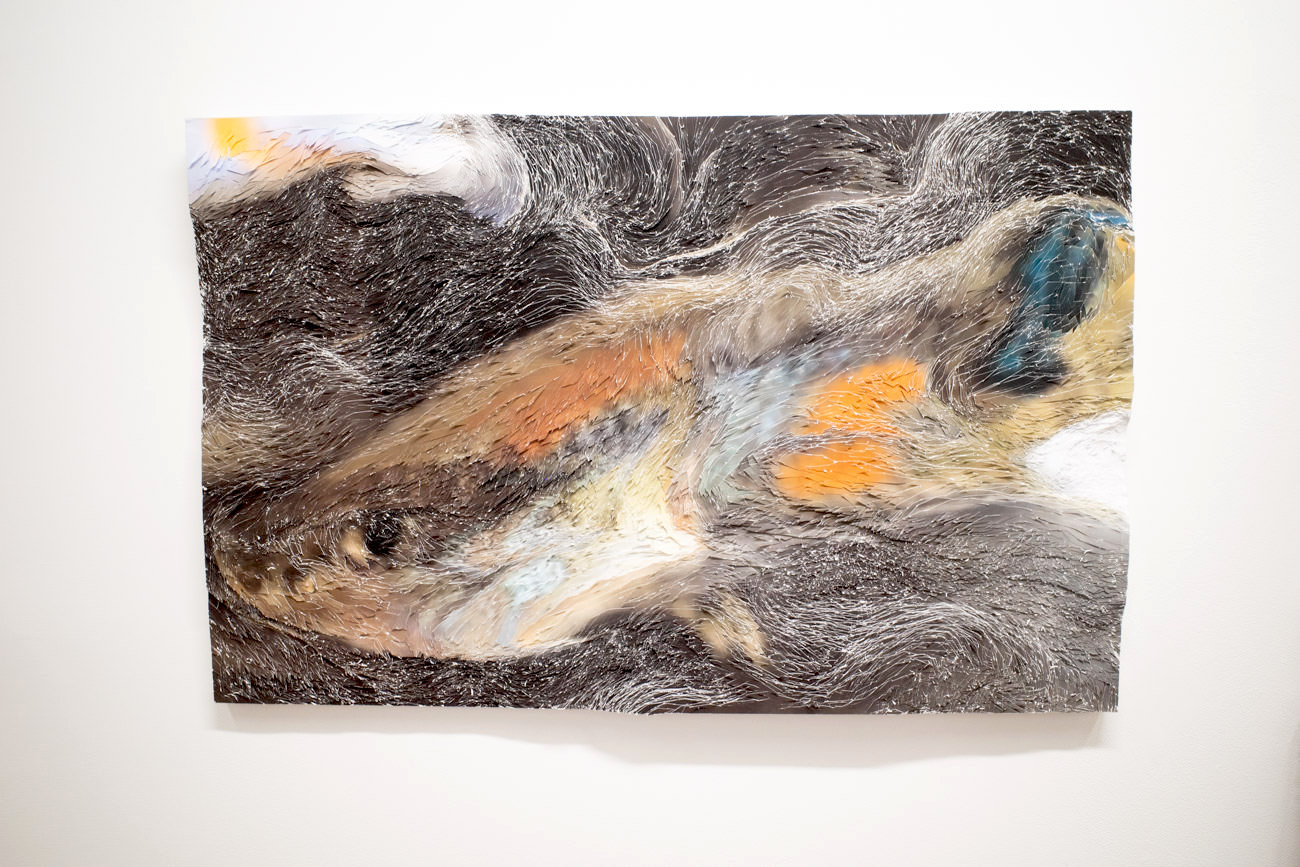
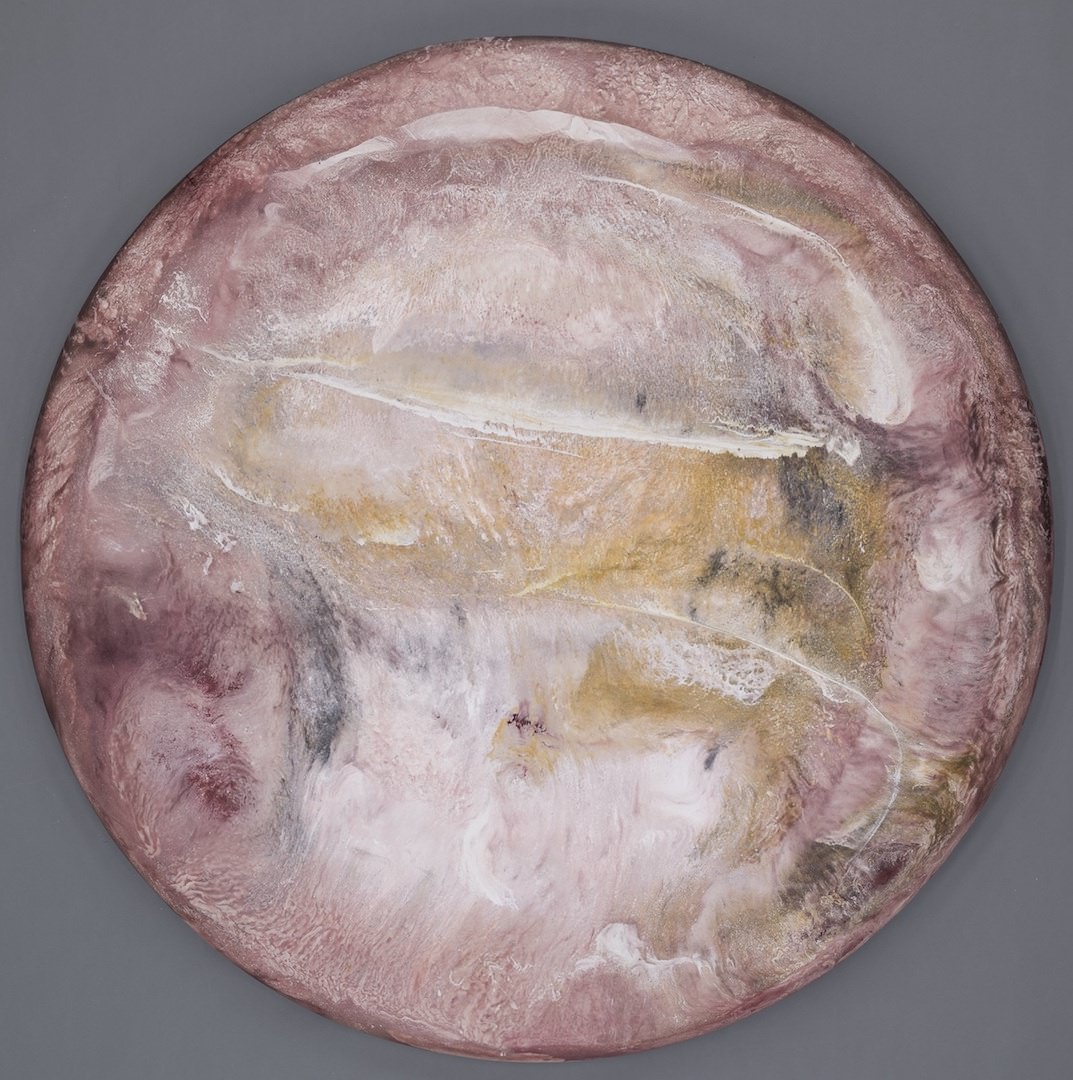
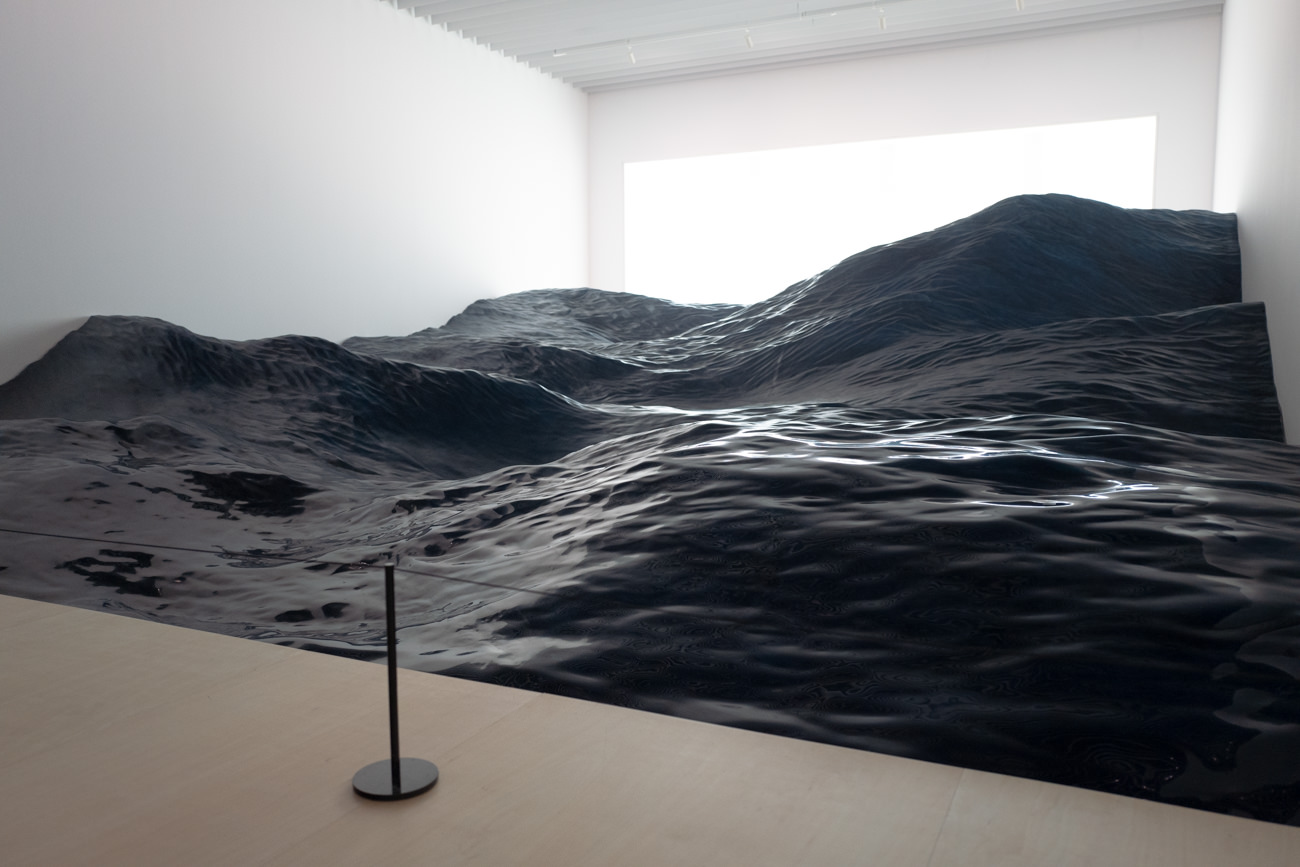
The following two works were photographed by this writer while covering exhibitions (group shows) held in 2019.
Both were pieces that shook the body from the eyes downward — the surroundings vanished from view, and I fell into the illusion of being swallowed by the work.
mé, “Acrylic Gas,” resin, acrylic, and other materials — from VOCA 2019 *A work included in this exhibitionmé, “Scenery Body,” 2019 — from Roppongi Crossing
mé, “Not Quite Clear”
Now, on to mé’s “Not Quite Clear.”
The Chiba City Museum of Art, where the show is being held, is scheduled for a large-scale renovation, and this exhibition is being held right on the eve of a full closure period running from January to the end of June 2020.
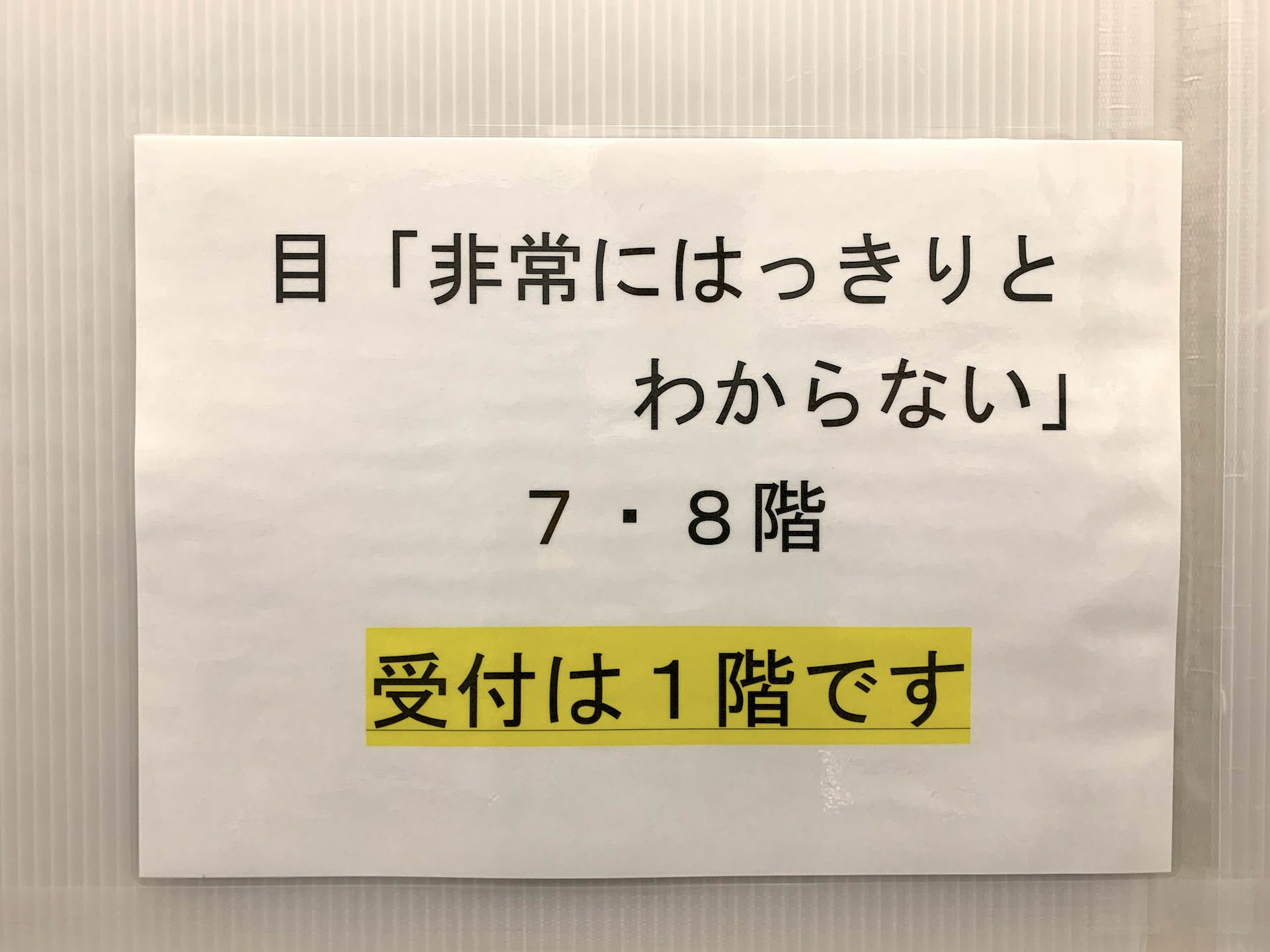
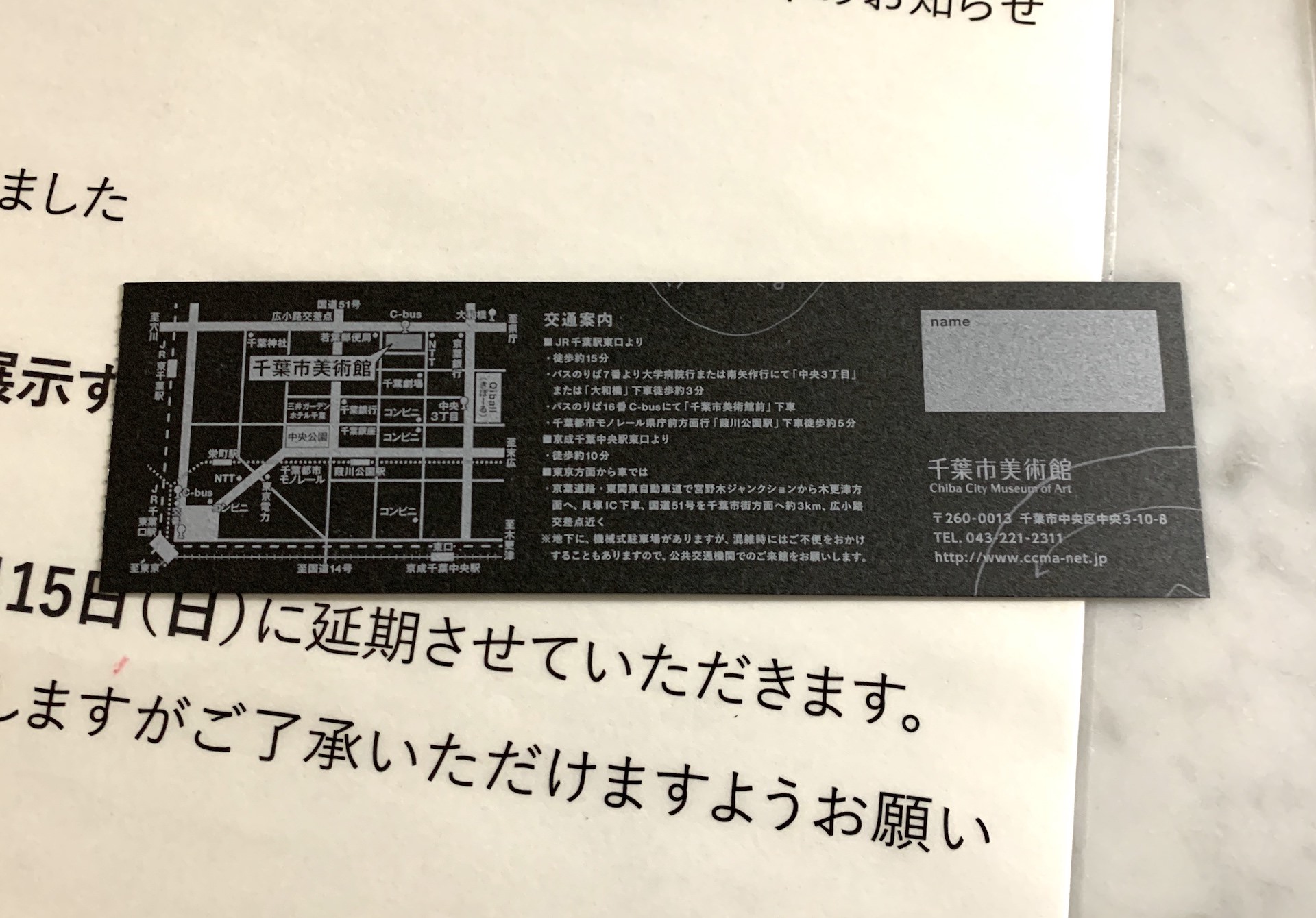
First, head to the reception desk on the first floor
The exhibition is composed as though skillfully absorbing that state of the museum itself. It is a project that envelops the entirety of the Chiba City Museum of Art facility as a large-scale installation work.
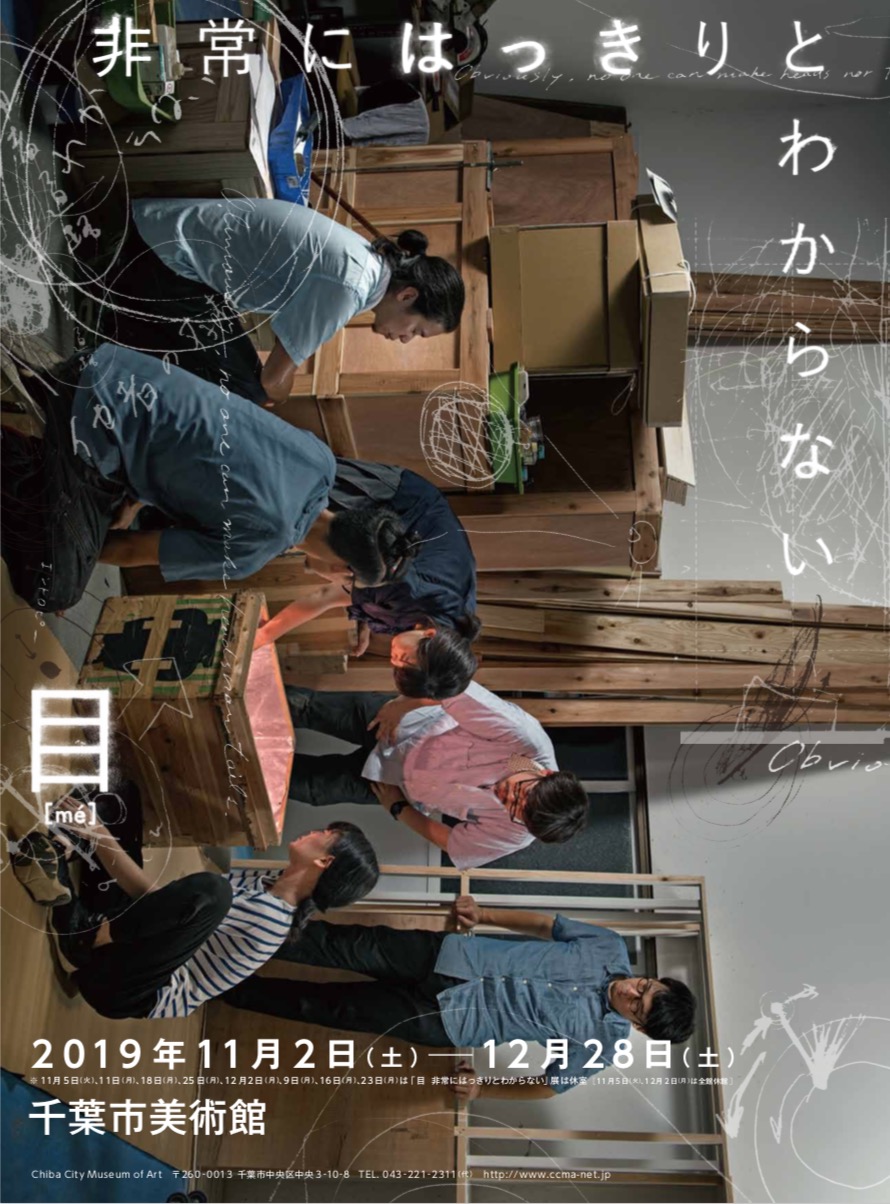
mé, “Not Quite Clear” — main visual
Tickets are named-holder issued, and the holder may re-enter as many times as they wish.Exhibition view of the first-floor space
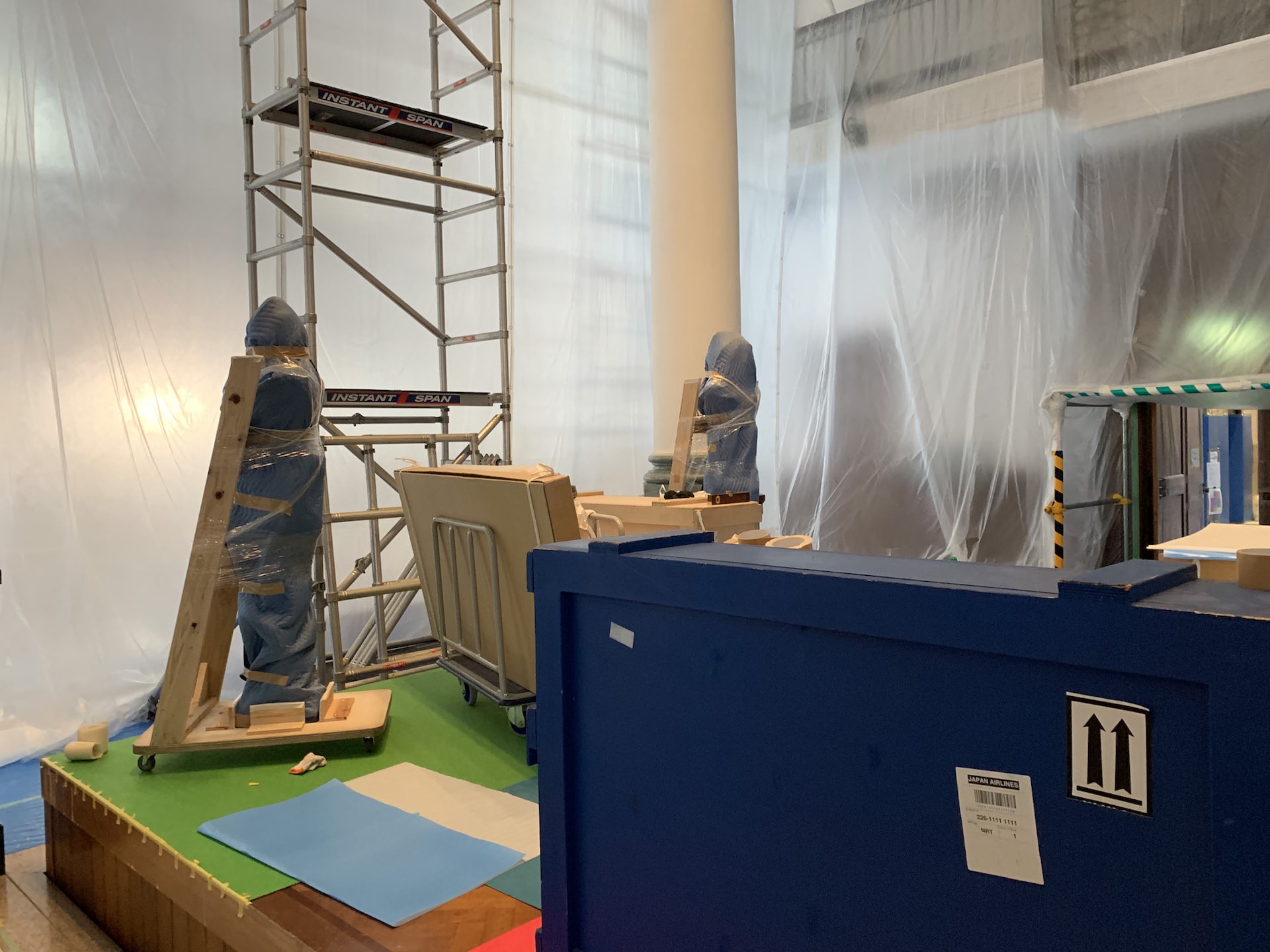
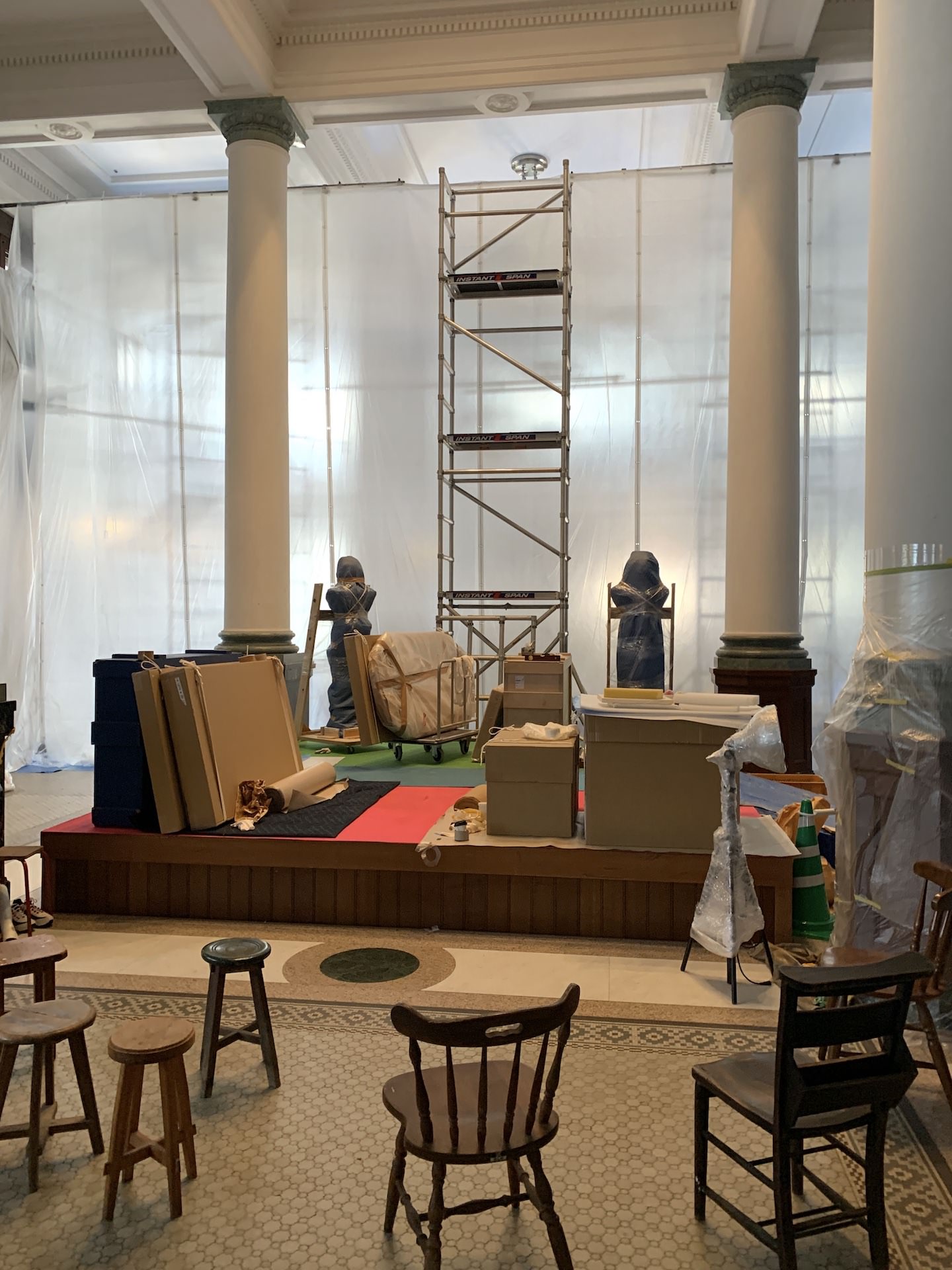
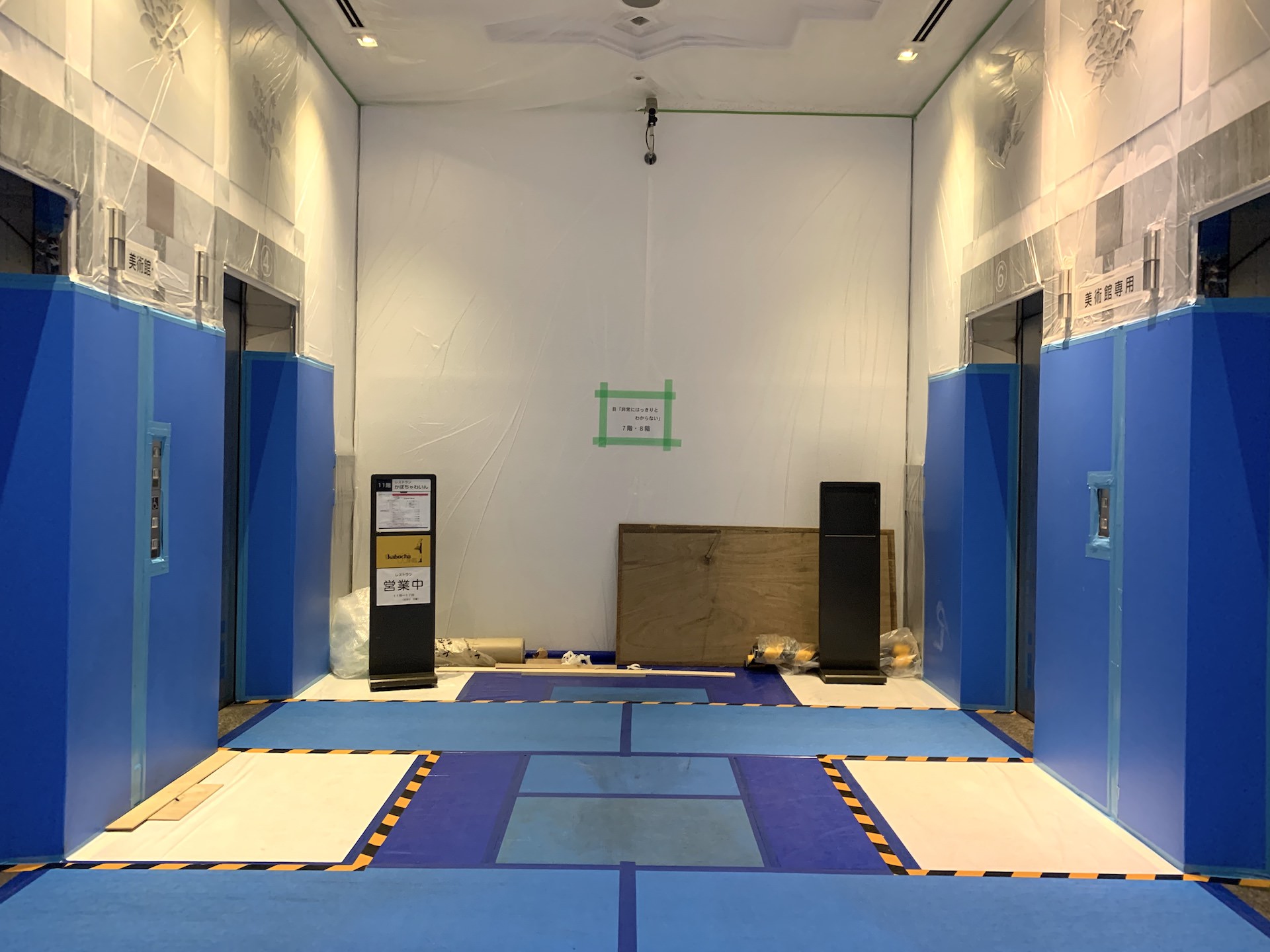
Only the first-floor space of the exhibition is open for photography, but what greets visitors is a cluttered scene that at first glance appears to be renovation work already underway. The exhibition has already begun here. Feeling a strange, uncanny dissonance, we walked to the elevator that goes up to the exhibition floors on the 7th and 9th floors.
The first-floor elevator area — even for the media, photography is permitted only up to this point.
The elevator hall too is covered with protective sheeting, and tape marking off-limit zones restricts visitors’ movement so they can only walk in permitted areas.
As the exhibition title suggests, one becomes convinced of the “not quite clear” state of things upon reaching the exhibition floors on the 7th and 8th floors.What one discovers on the exhibition floors is that the concept is entirely different from that of an ordinary art exhibition space. Perhaps clues are hidden — or perhaps not — in the exhibition statement quoted below.
Greetings
(Preamble omitted)
We present the first large-scale solo museum exhibition of “mé,” a contemporary art team that has garnered significant attention both domestically and internationally through works — such as large-scale spatial transformations — that bring the uncertainty of the real world close to people’s actual experience.
Just as with Chiba Prefecture’s geomagnetic reversal stratum (Chibanian) and the geological science it embodies, our reality — the surface world we stand on — rests upon a continuous succession of natural cataclysms whose causes still resist explanation. In this exhibition, in addition to the exhibits themselves, the entire situation of the Chiba City Museum of Art facility, including visitors’ movements and moments of awareness, will be deployed as an installation work, drawing people into the museum as a reality that has been thrust away.
The dynamic exhibition space in which various situations accumulate will, as if peeling away the meanings and essences that visitors thought they understood, provide an opportunity to re-grasp — with fresh sensation — the real world that we tend to overlook as something obvious.
(Postscript omitted)
As the statement indicates, there is a subtle art to the works, the exhibition method, and the manner of presentation, all inspired by the discovery of the geomagnetic reversal stratum (Chibanian). Those exhibition methods — quoted from a condition in which time and place are indeterminate — are once-in-a-lifetime experiences that can only be felt on site. And depending on the timing of one’s visit to the museum too—
“A great work of art is nothing other than one that moves the viewer’s heart.” This is a line the art critic Noi Sawaragi wrote in his book “Sensibility Does Not Move Us”; I too find it deeply resonant. That there are not a few viewers whose hearts move in this exhibition can be taken as evidence of an excellent show.
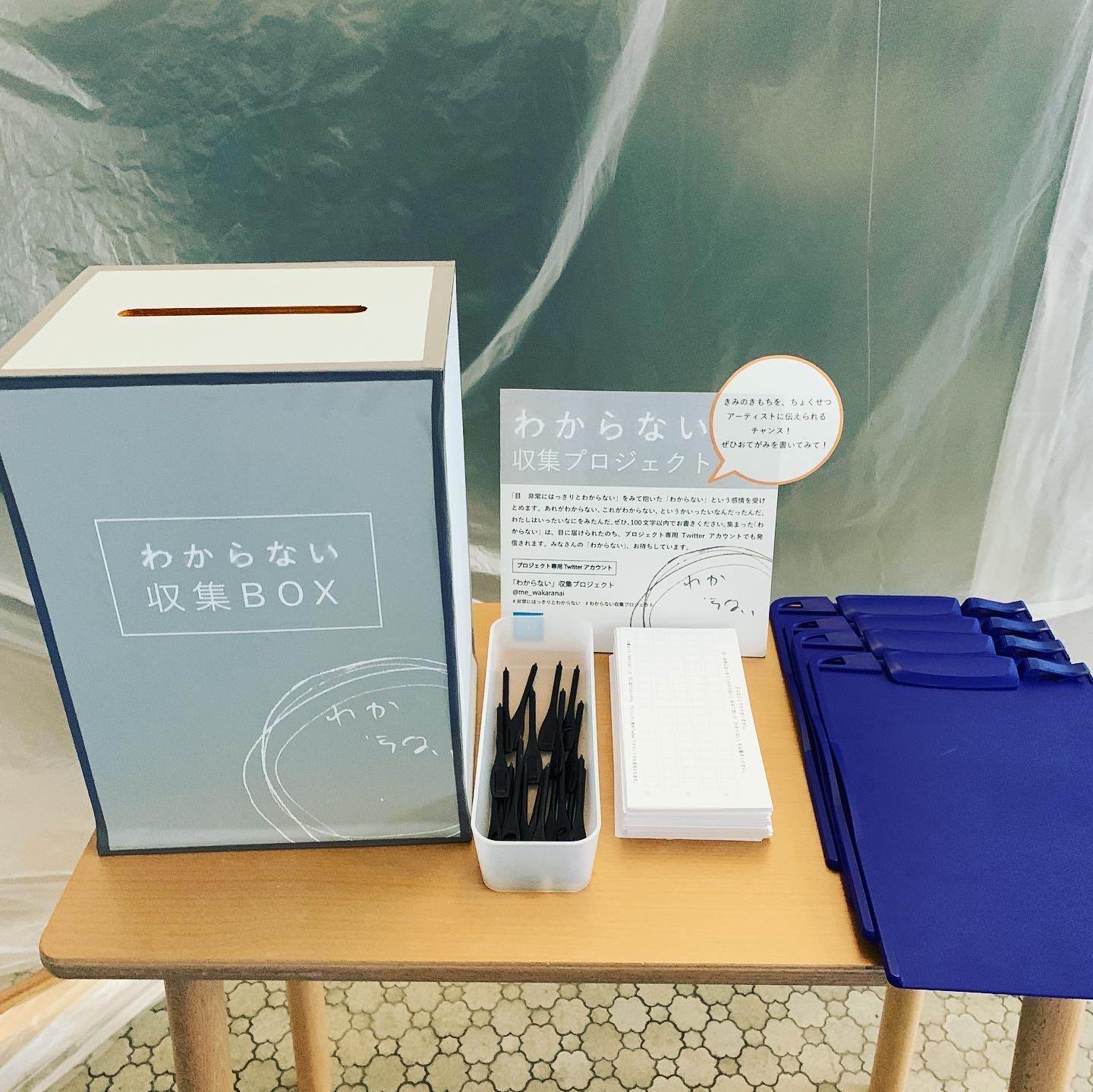
For those unable to make sense of the exhibition, there was a box installed titled “Not-Clear Collection Box.”
Not-Clear Collection Box
Posts made in the “Not-Clear Collection Box” are shared publicly through a linked Twitter account. Looking at the posts, you’ll find contributions from viewers who did understand as well, and if you check them after your own visit, the content becomes flavorful and quite enjoyable.
*For this writer, it was an exhibition I was able to enjoy and understand on my own terms.
Museum Shop
At the museum shop on the 7th floor, the exhibition poster and catalog (pre-order) are on sale.
The catalog is scheduled for publication at the end of December, priced at 2,800 yen (tax included). Only pre-orders will be shipped with free postage (with a sticker exclusive to pre-order buyers).
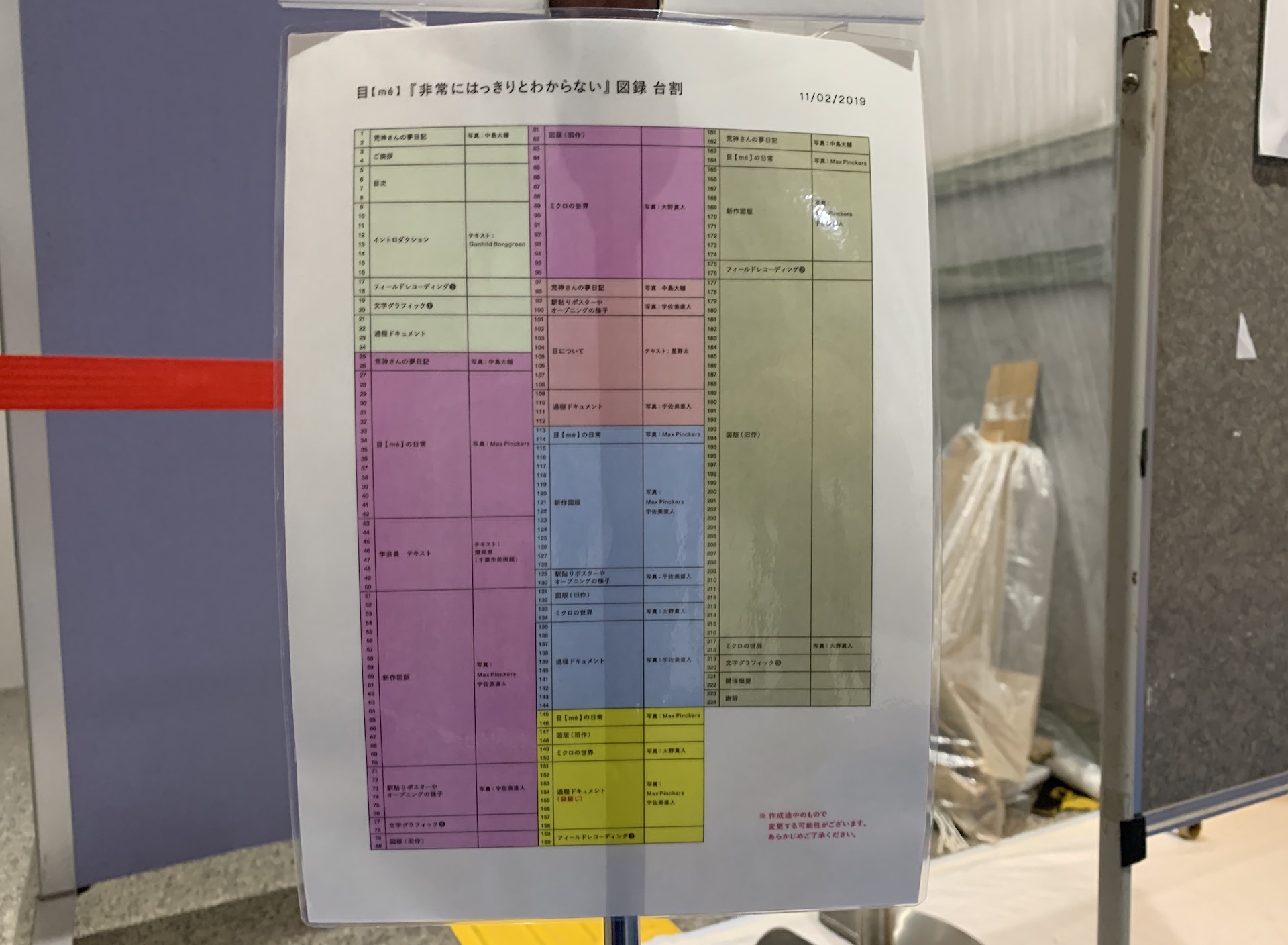
For some reason, the catalog’s page layout was posted on the first floor.
The following limited items were also on sale:
(1) Not Quite Clear: Drawing-Signed Poster α ¥10,000 (tax included)
(2) Not Quite Clear: Drawing-Signed Catalog α ¥20,000 (tax included)
*Each item features a different drawing.
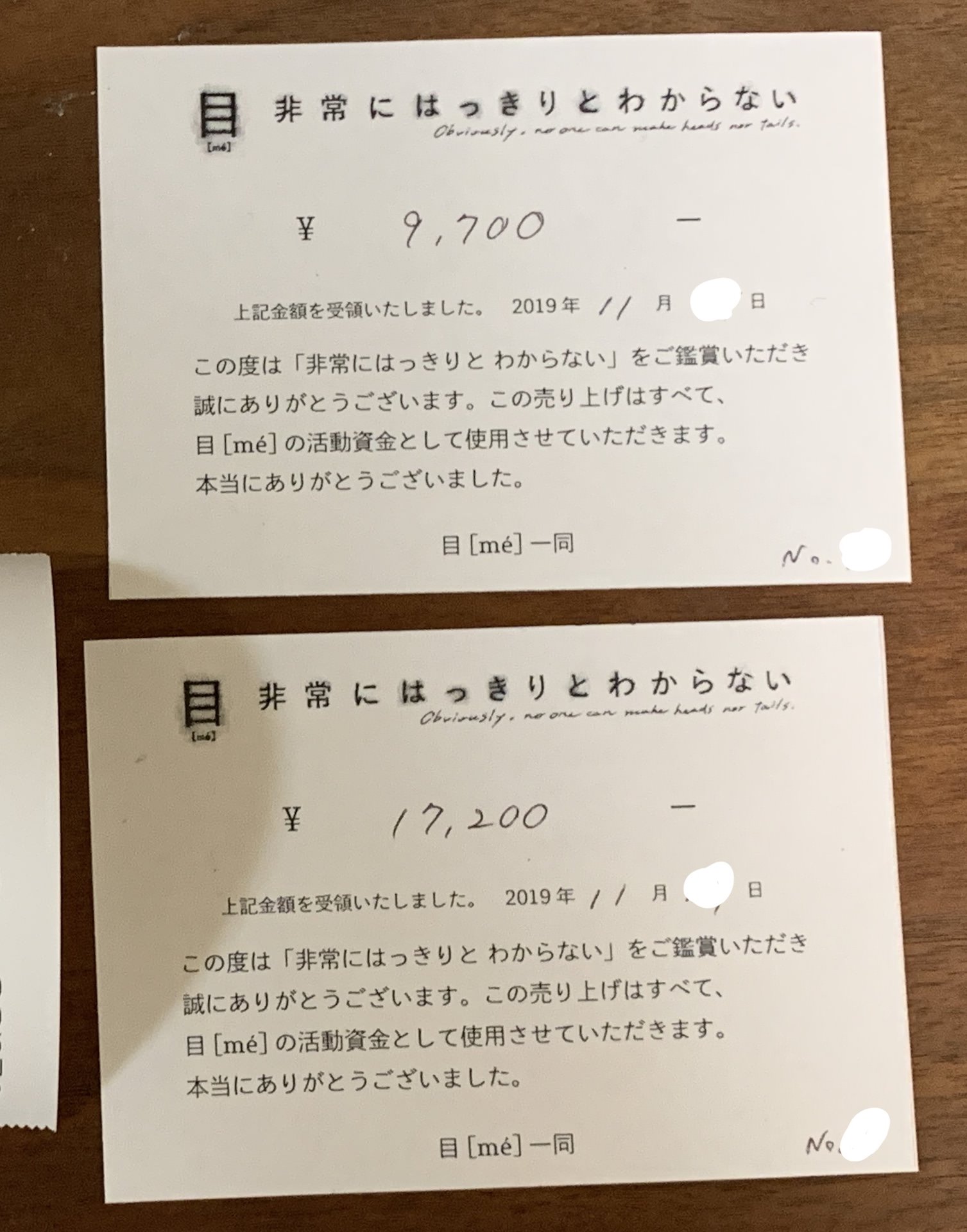
I purchased the drawing-signed poster and the same catalog. I hear it will go toward mé’s activities fund. *The amount listed is a receipt showing only the activities-funding portion. Furthermore, at the [mé Book Selection] corner, three books were introduced and sold: Hideki Yukawa’s “Things Unseen,” “A Stroll Through the Worlds of Animals and Men,” and “The Tree of Knowledge.” The selection feels suggestive of the exhibition itself.
Summary
Rather than the popular-artist shows at Mori Art Museum where camera shutters clatter in pursuit of Instagram-ready shots, this exhibition — photography forbidden, time, action, and heart all commanded, thought and values profoundly shaken — is one I strongly recommend.
*That said, in this age of intersecting values, there will surely be viewers with no interest whatsoever in this show. And of course, this site cannot reject or oppose such people.
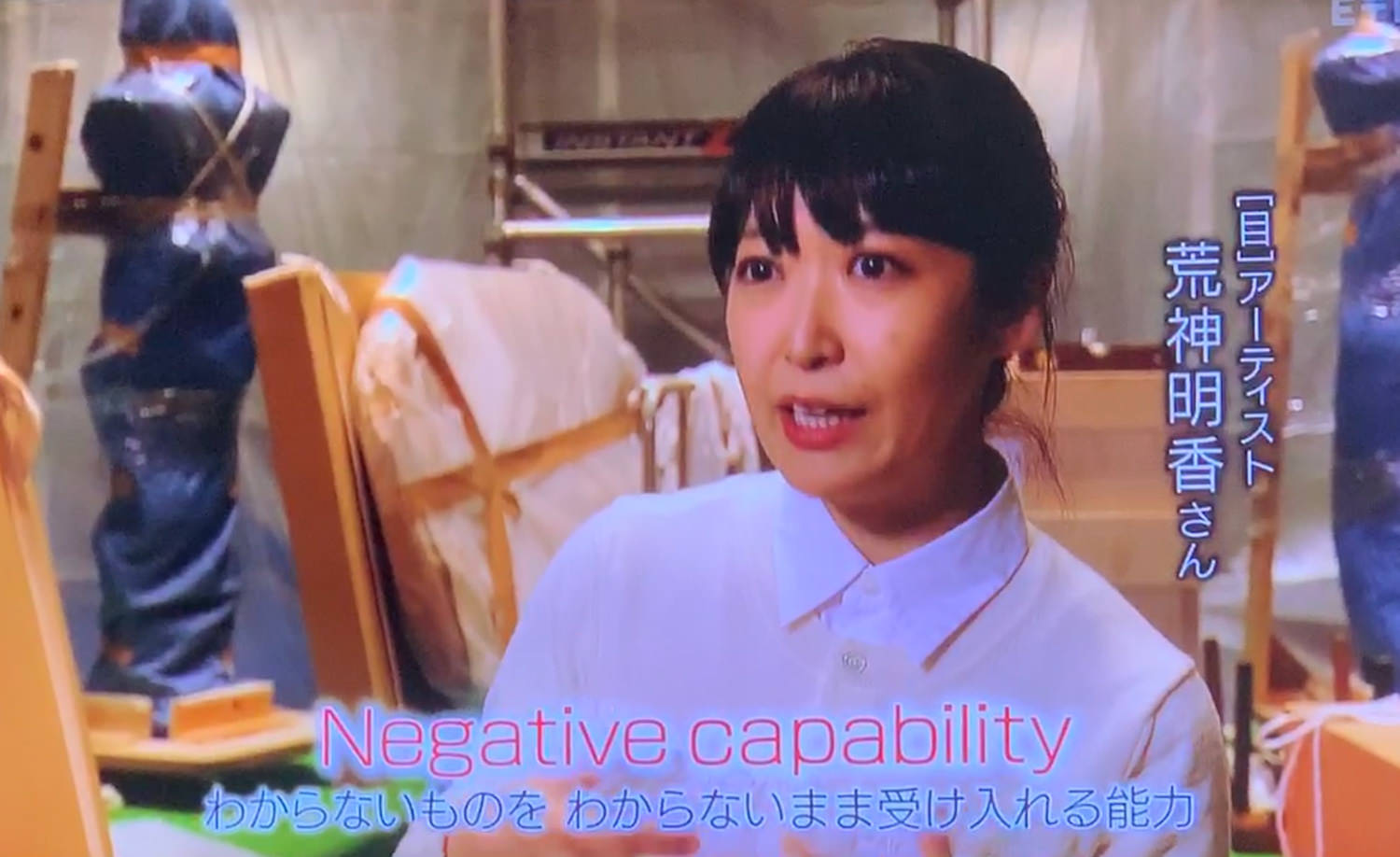
Haruka Kojin of mé, who describes the theme as “Negative capability” From NHK’s “Nichiyo Bijutsukan: Art Scene,” broadcast on December 8, 2019
As the title “Not Quite Clear” suggests, whether visitors understood the exhibition’s content or not, each person’s individual response can be simply accepted as it is.
It was an exhibition I would love many people to visit.
본 기사는 지바 시립미술관에서 열리고 있는 mé “매우 명확하게는 알 수 없다”전 회기가 끝난 뒤에 제대로 정리하려고 했던 리뷰 기사입니다.
본 전시에는 통일된 예절 — 관객은 스포일러 발언을 해서는 안 된다는 암묵적 규칙이 자리하고 있어, 신중하게 글을 써야 하는 부담에서 도망치던 부분도 있었습니다. 그러나 회기 중에 가능한 한 빨리 정리 기사를 올리자! 라고 방침을 전환하기에 이르렀습니다.
…라는 것도, 최근(11월 18일) 공개한 본 사이트의 주간 일기 “Burart Diary”에서 본전을 가볍게 소개한 이후, 상당한 방문량이 계속 기록되고 있으며 날이 갈수록 늘어나는 상황이 있기 때문입니다.
방문 수치와 함께 관련된 검색 키워드가 다수 유입되고 있다는 기록도 잇따르고 있어, 방문자로부터 강한 에너지를 느끼고 있습니다.
본 기사는 “매우 명확하게는 알 수 없다”전이 왠지 상당한 화제가 되고 있는 게 아닐까? 하는 관심을 가진 방문자 분들을 위해, 조금이라도 전시장에 발걸음을 하시길 기대하는 마음을 담아 서둘러 정리한 기사입니다.
※본 기사는 관내 사진 및 관람 코멘트를 포함하는 기사로, 스포일러를 완전히 배제하지는 못했습니다. 관람 전에 읽으시는 분은 주의해 주십시오. 다만, 본전의 핵심 부분은 다루고 있지 않습니다.
mé
mé는 세 명의 아티스트 — 아티스트 Haruka Kojin, 디렉터 Kenji Minamigawa, 인스톨러 Hirofumi Masui로 구성된 예술 유닛입니다. 설치 작품 등을 통해, 우리 관람자에게 “알아차림”을 안겨주는 의식을 지니고 활동하고 있습니다.
아래 두 작품은 필자가 취재한 2019년 개최 전시(그룹 기획전)에서 촬영한 작품입니다.
어느 쪽도 시각으로부터 몸이 흔들리는 듯한 작품으로, 주위의 풍경이 사라지고 작품에 삼켜지는 듯한 착각을 일으켰습니다.
자, mé “매우 명확하게는 알 수 없다”전입니다.
개최 회장인 지바 시립미술관은 대규모 리뉴얼이 확정되어 있어, 본전은 전관 휴관 기간인 2020년 1월~6월 말을 목전에 둔 시점에 열리고 있습니다.
우선 1층에서 접수처로 향합니다
본전은 그러한 미술관의 상황을 능숙하게 흡수한 듯 구성되어 있었습니다. 지바 시립미술관의 시설 전체를 대형 설치 작품으로 감싼 기획입니다.
mé “매우 명확하게는 알 수 없다” 메인 비주얼
티켓은 기명제로, 본인이라면 몇 번이든 재입장이 가능합니다.1층 플로어의 전시 전경
본전은 1층 플로어만 촬영이 허가되어 있는데, 언뜻 보면 리뉴얼 공사가 진행되고 있는 것처럼 어수선한 광경이 눈에 들어옵니다. 이미 여기서부터 전시가 시작되고 있는 것입니다. 묘한 위화감을 느끼면서, 전시장이 있는 7층, 9층 플로어로 올라가는 엘리베이터까지 걸어갑니다.
1층 엘리베이터 홀 — 미디어 취재라 할지라도 촬영은 여기까지입니다.
엘리베이터 홀도 양생 처리가 되어 있고, 출입 금지 구역을 표시하는 테이프에 의해 허용된 장소만 걸을 수 있도록 관람자의 동선이 제한됩니다.
전시 타이틀 그대로 “매우 명확하게는 알 수 없다”는 상황을 확실히 인식하게 되는 것은 7층과 8층의 전시 플로어에 도달했을 때입니다.전시 플로어에 가면 알 수 있는 것은, 통상적인 미술 작품 전시장과는 컨셉이 전혀 다르다는 점입니다. 아래에 인용한 전시 스테이트먼트에 힌트가 숨겨져 있을지도 모릅니다(어쩌면 담겨 있지 않을지도 모릅니다).
인사말
(전략)
공간을 대규모로 변용시키는 표현 등을 통해, 현실 세계의 불확실성을 사람들의 실감으로 끌어당기는 작품을 전개하며 국내외에서 큰 주목을 받고 있는 컨템포러리 아트 팀 “mé”의, 미술관에서의 첫 대규모 개인전을 개최합니다.
지바현의 지구자기장 역전 지층(Chibanian)이나 그 지질학이 보여주듯, 아직도 원인이 밝혀지지 않은 천재지변의 연속 위에 우리의 현실이라는 지표의 세계는 성립되어 있습니다. 본전에서는 전시물에 더해, 관람자의 동선과 알아차림을 포함한 지바 시립미술관 시설 전체의 상황을 설치 작품으로 전개하여, 밀어낸 현실로서의 미술관으로 사람들을 이끕니다.
다양한 상황이 축적되어 가는 역동적인 전시 공간은, 방문객이 알고 있다고 여겼던 의미나 본질을 벗겨나가듯, 당연한 것으로 여겨 어딘가 지나쳐 왔던 현실 세계를 새로운 감각으로 다시 붙잡는 기회가 될 것입니다.
(후략)
스테이트먼트에 있듯이, 지구자기장 역전 지층(Chibanian)의 발견에서 착상을 얻어 기획된 작품과 전시 방식, 보여주는 방식에 묘미가 있습니다. 시간도 장소도 부정不定한 상태에 놓이는 데서 인용된 그 전시 방식은, 현장에서만 체감할 수 있는 일기일회의 체험입니다. 그리고 미술관을 찾는 타이밍에 따라서도
“뛰어난 미술작품이란, 보는 이의 마음을 움직이는 것에 다름 아니다”라고 한 것은 미술평론가 Noi Sawaragi가 그의 저서 “감성은 감동하지 않는다”에서 쓴 말로, 필자도 매우 공감하는 말입니다. 본전에서 마음이 움직이는 관람자가 결코 적지 않다는 점은, 뛰어난 전시로 볼 수 있다고 생각합니다.
전시 내용을 이해할 수 없었던 이들을 위해 “모름 수집 BOX”라는 것이 설치되어 있었습니다.
모름 수집 BOX
“모름 수집 BOX”에 투고된 내용은 Twitter와 연동되어 공개됩니다. 투고를 보면 이해한 사람의 투고도 포함되어 있어, 관람 후에 보면 감칠맛 나고 즐겁게 느껴지는 콘텐츠입니다.
7층의 뮤지엄 숍에서는 본전의 포스터와 도록(예약 판매)이 진행되고 있습니다.
도록은 12월 말 발행 예정으로, 가격은 2,800엔(세금 포함)입니다. 예약 판매만 배송료 무료로 발송됩니다. (예약자 한정 스티커 증정)
도록의 페이지 구성은 어째서인지 1층 플로어에 게시되어 있었습니다.
또한 아래 한정 아이템의 판매도 이루어지고 있었습니다.
①매우 명확하게는 알 수 없다: 드로잉 사인 포스터 α <한정 30장> ¥10,000(세금 포함)
②매우 명확하게는 알 수 없다: 드로잉 사인 카탈로그 α <한정 50권> ¥20,000(세금 포함)
※한 점 한 점 드로잉 내용이 다릅니다.
드로잉이 딸린 포스터와 동 도록을 구입했습니다 — mé의 활동 자금으로 사용된다고 합니다. ※기재된 금액은 활동비만 기재된 영수증입니다. 또한 【mé Book Selection】이라는 선서 코너에서는 3권의 책이 소개, 판매되고 있었습니다. Hideki Yukawa 《눈에 보이지 않는 것》, 《생물에서 본 세계》, 《지혜의 나무》 3권입니다. 본전을 시사하는 듯한 선서입니다.
맺음말
인스타 감성을 노리는 카메라 소리가 분주한 Mori Art Museum의 인기 작가전보다도, 촬영 금지에 시간과 행동과 마음을 지배당하고, 사고와 가치관이 크게 흔들리는 본전을 강력히 추천하는 바입니다.
※그렇다고는 해도, 다양한 가치관이 교차하는 현대에는 본전에 아무 관심도 없는 관람자도 있을 것입니다. 물론 본 사이트는 그런 분들을 거부하거나 반대하지 않습니다.
“Negative capability를 테마로 삼았다”고 말하는 mé의 Haruka Kojin 2019년 12월 8일 방송된 NHK “일요미술관 아트씬”에서
“매우 명확하게는 알 수 없다”라는 타이틀이 나타내듯, 관람자 각자가 전시 내용을 이해했든 이해하지 못했든, 자신이 받은 감각을 그대로 삼켜도 좋다고 느꼈습니다.
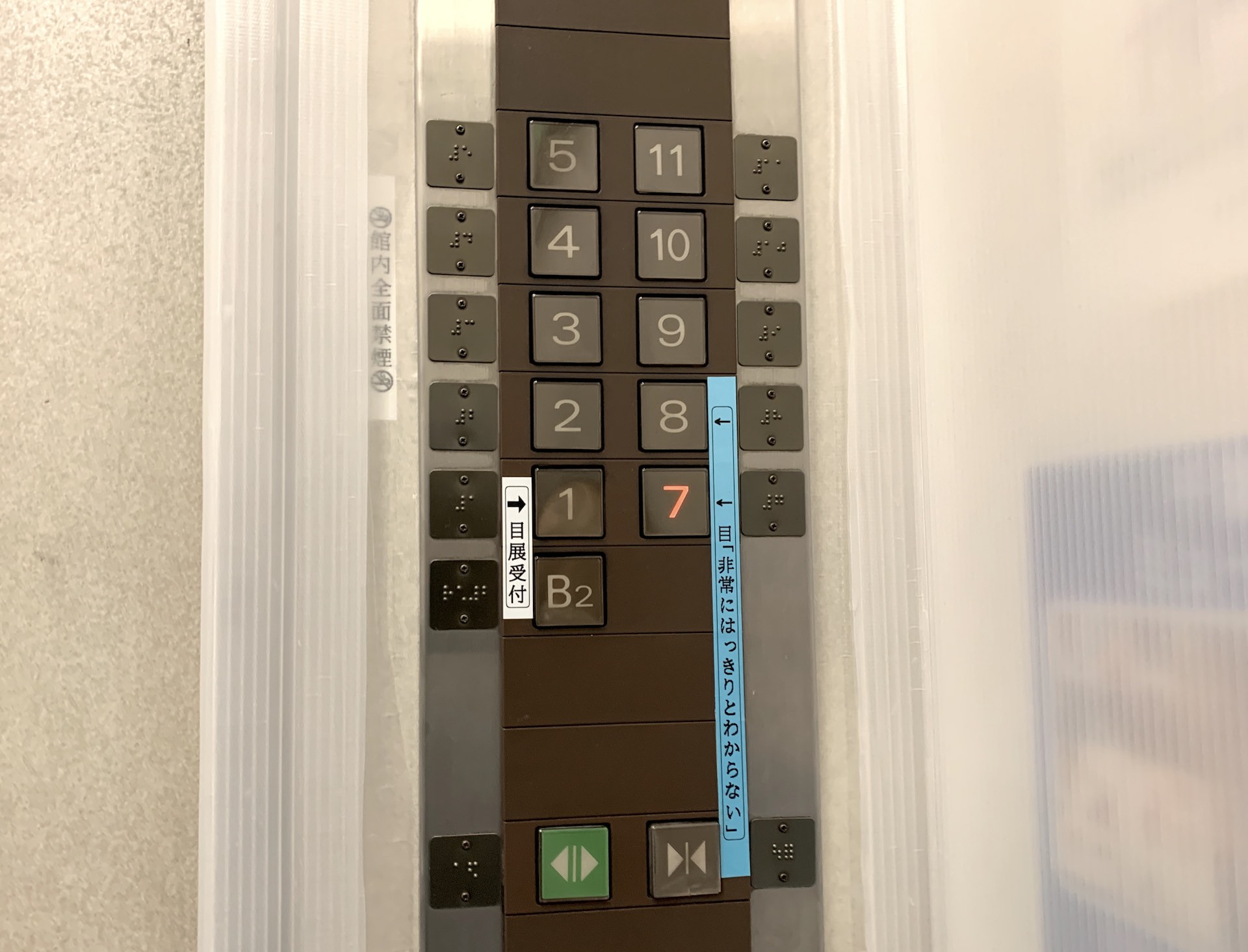 展示フロアに行くと分かるのは、通常よくある美術作品の展示会場とは全くコンセプトが異なる、ということです。以下に引用した展覧会ステイトメントにヒントが隠されているのかも知れません(含まれていないのかも知れません)。