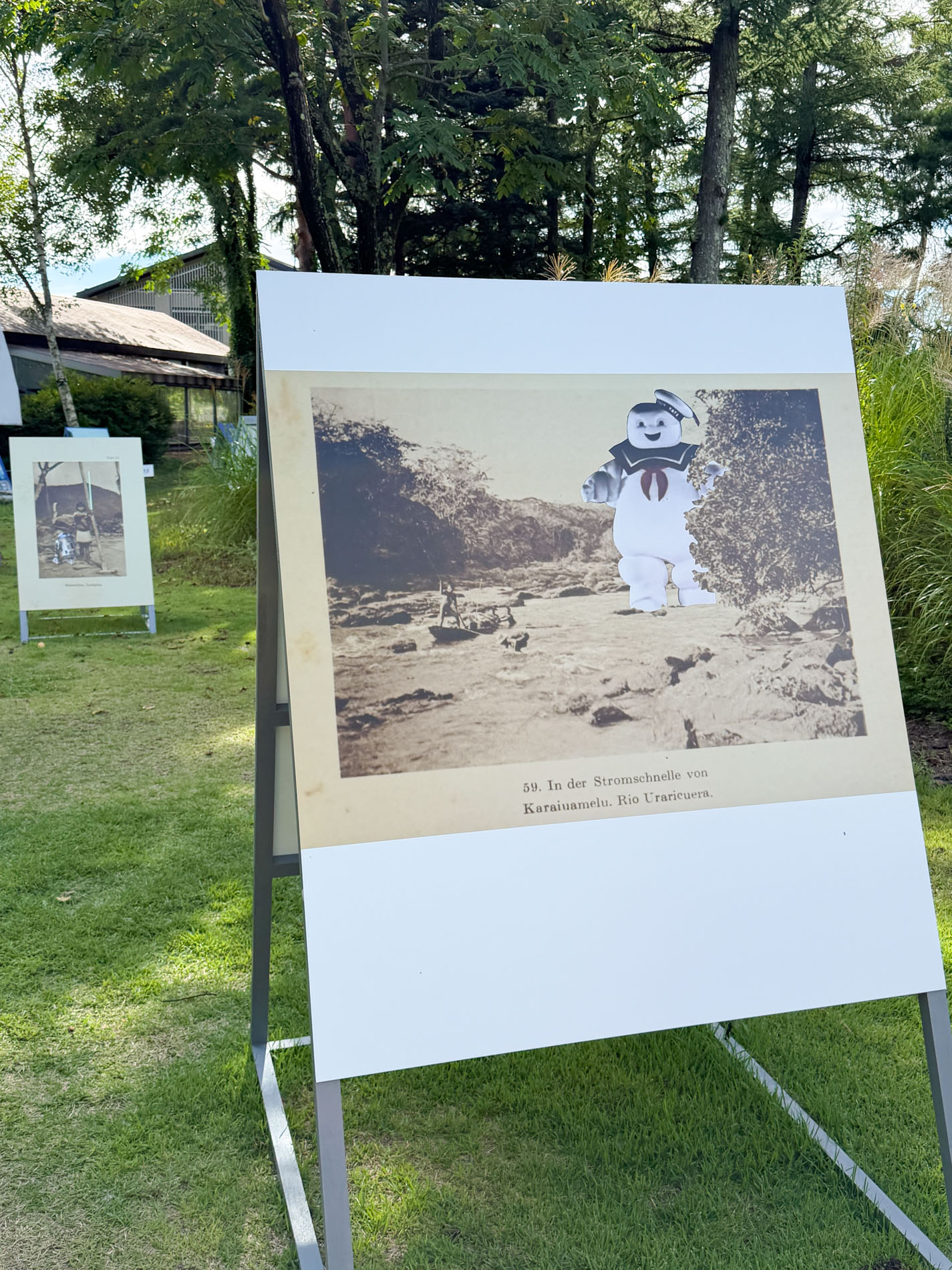
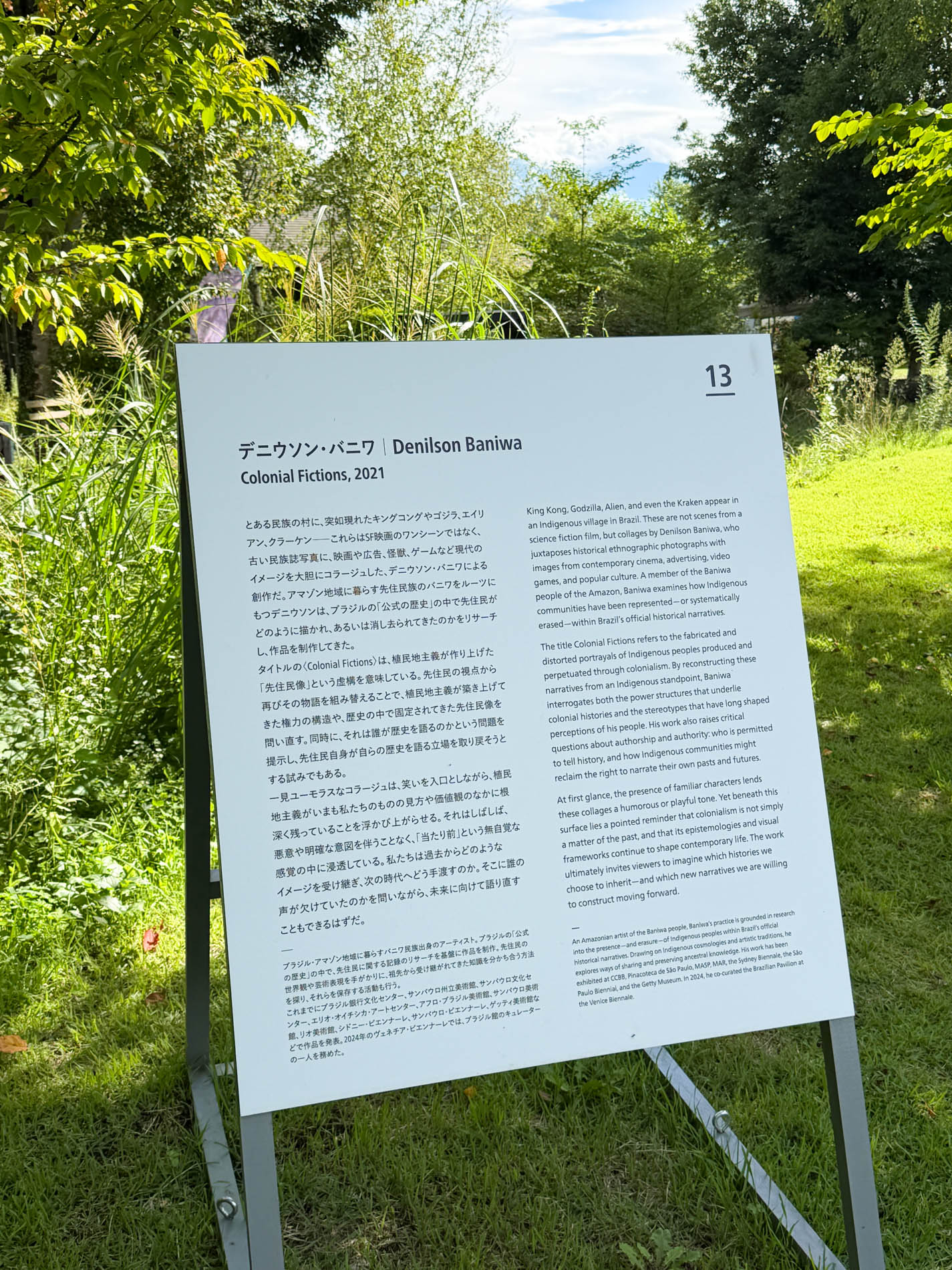
“59. In der Stromschnelle von Karaiuamelu, Rio Uraricuera” の急流に、マシュマロマン。キャプションは作品の中に残されています。解説は日英併記で、屋外に一枚ずつ立っています。読みやすくて良かったです。
庭を歩く
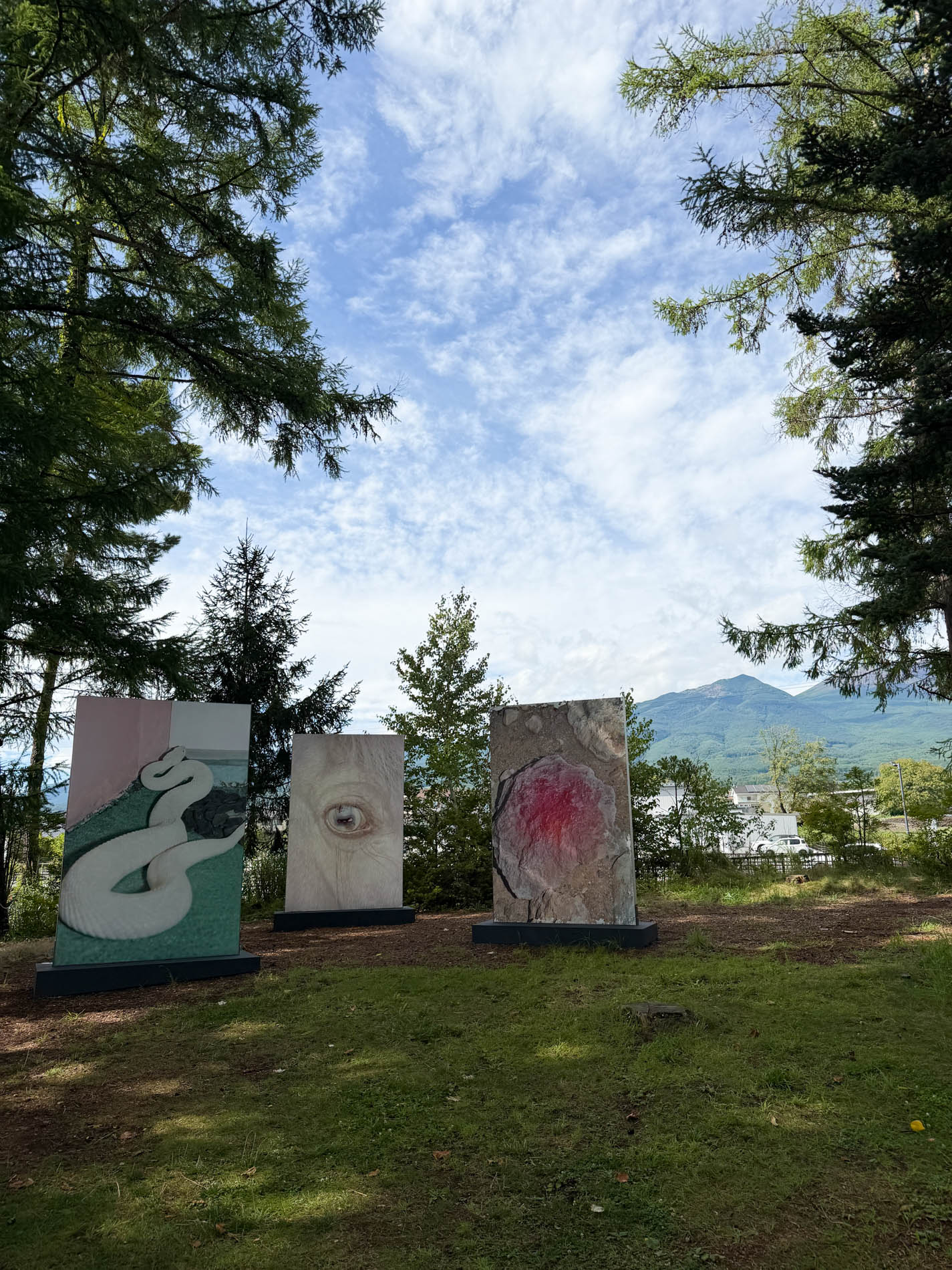
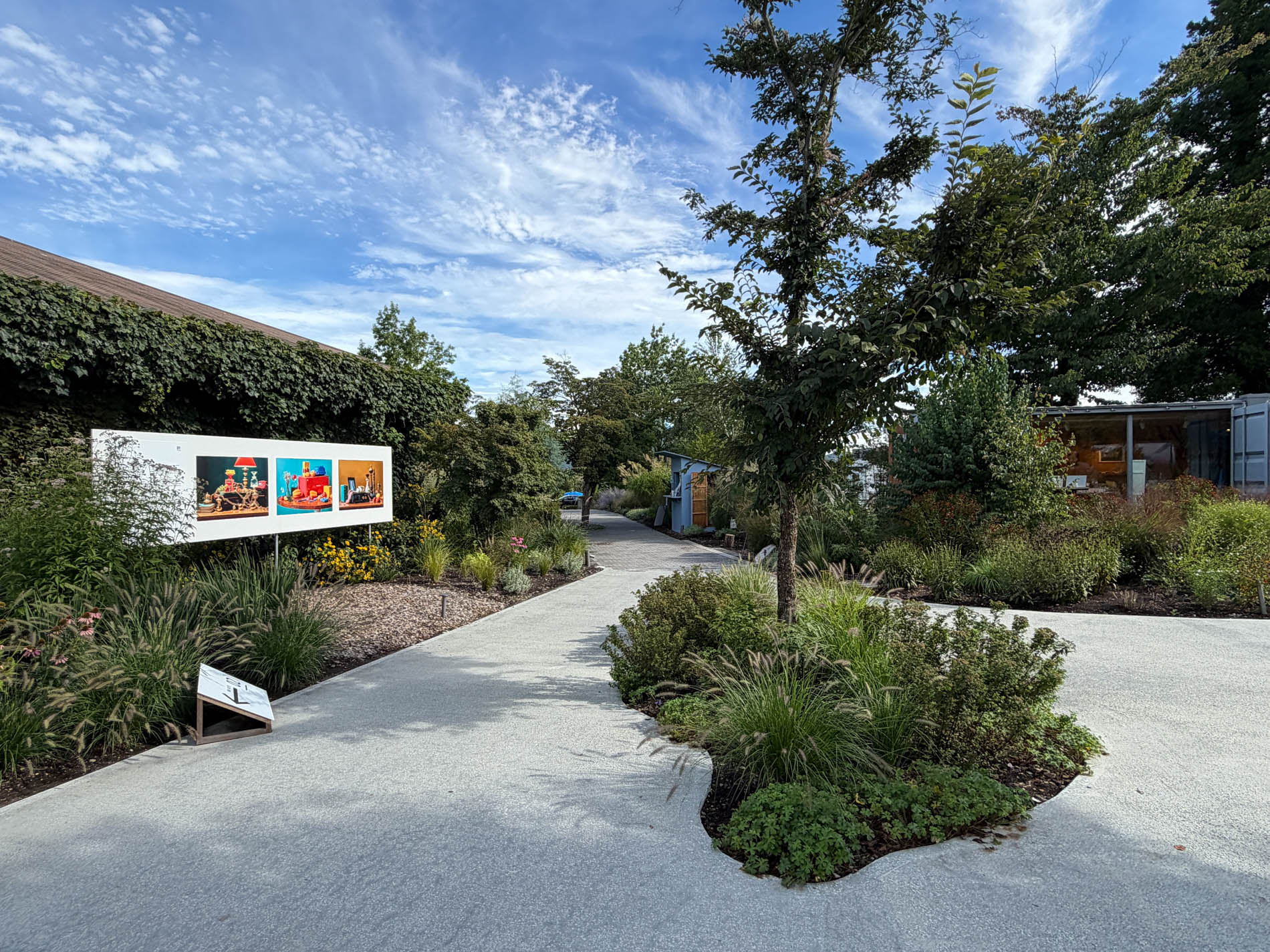
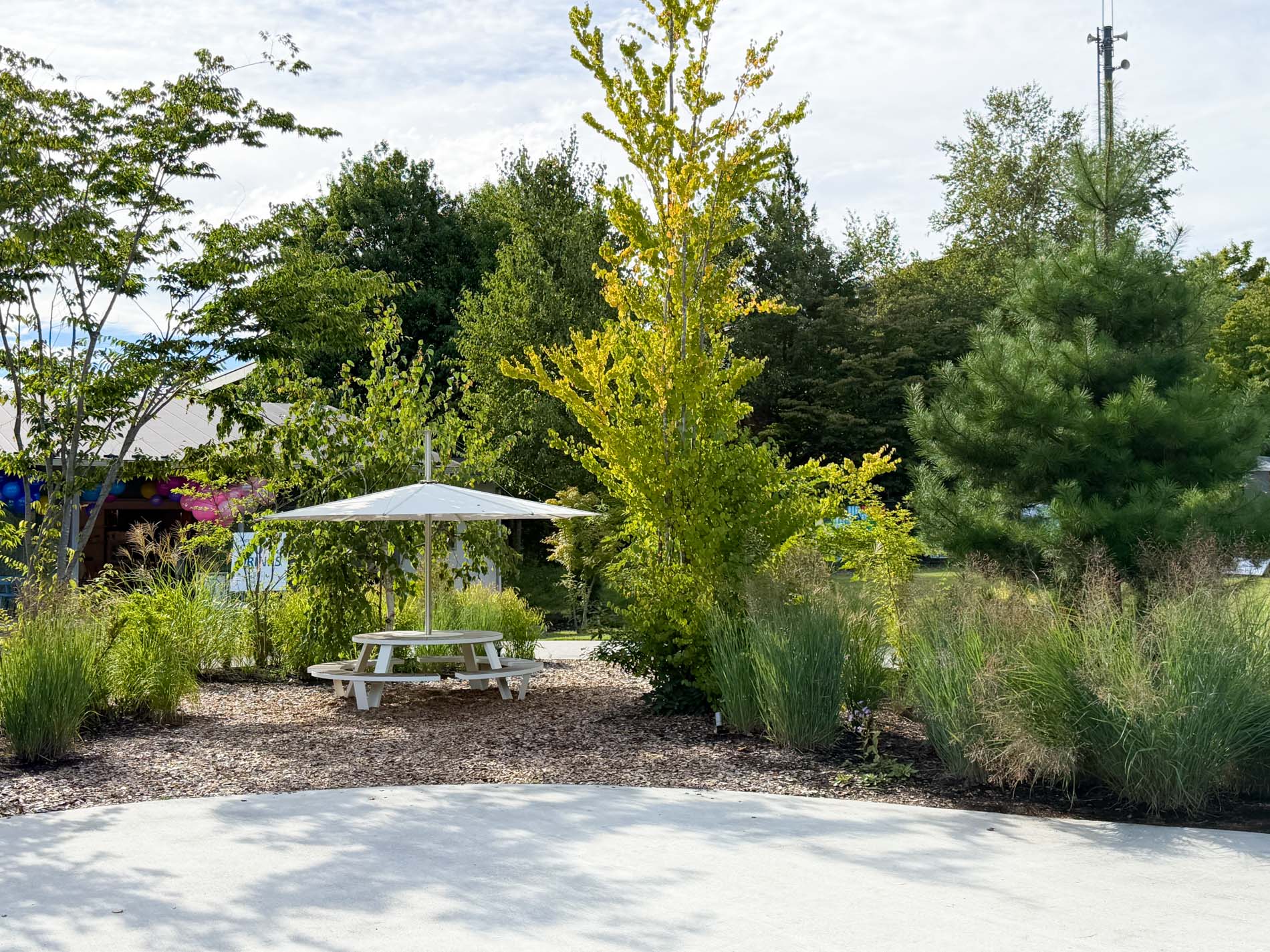
林の縁に3点。遠藤文香《Kamuy Mosir》(2020)です。白い蛇、馬の眼、岩肌に滲む赤。コロナ禍で社会とのつながりが断たれた経験から始まったシリーズで、「自然」と呼んでいるものの多くが人の営みと切り離せない、という問い直しがあります。奥に浅間山が見えるロケーションです。園路の脇に、横長のパネルで静物が3点。アーカイヴス《Vanitas》です。果物やゲーム機やタブレットが並ぶこの静物は、すべて AI が生成した架空のイメージで、ブランドロゴに見える文字もどれも実在しません。園路からファサードを望みます。植栽があちこちにあって、写真とおなじように自然を感じる時間が楽しめました。ベンチとパラソル。作品と作品のあいだに休むところがあります。
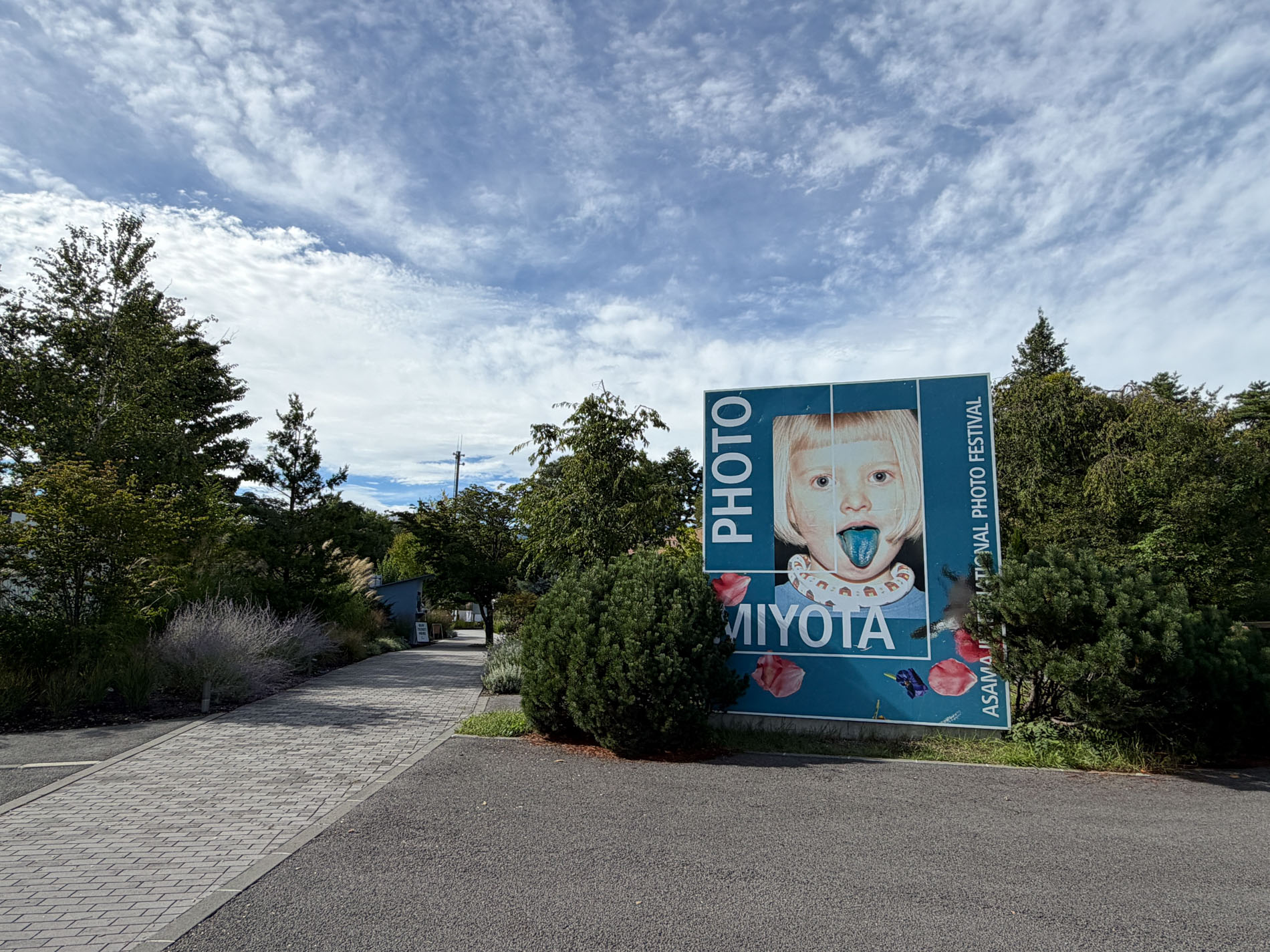
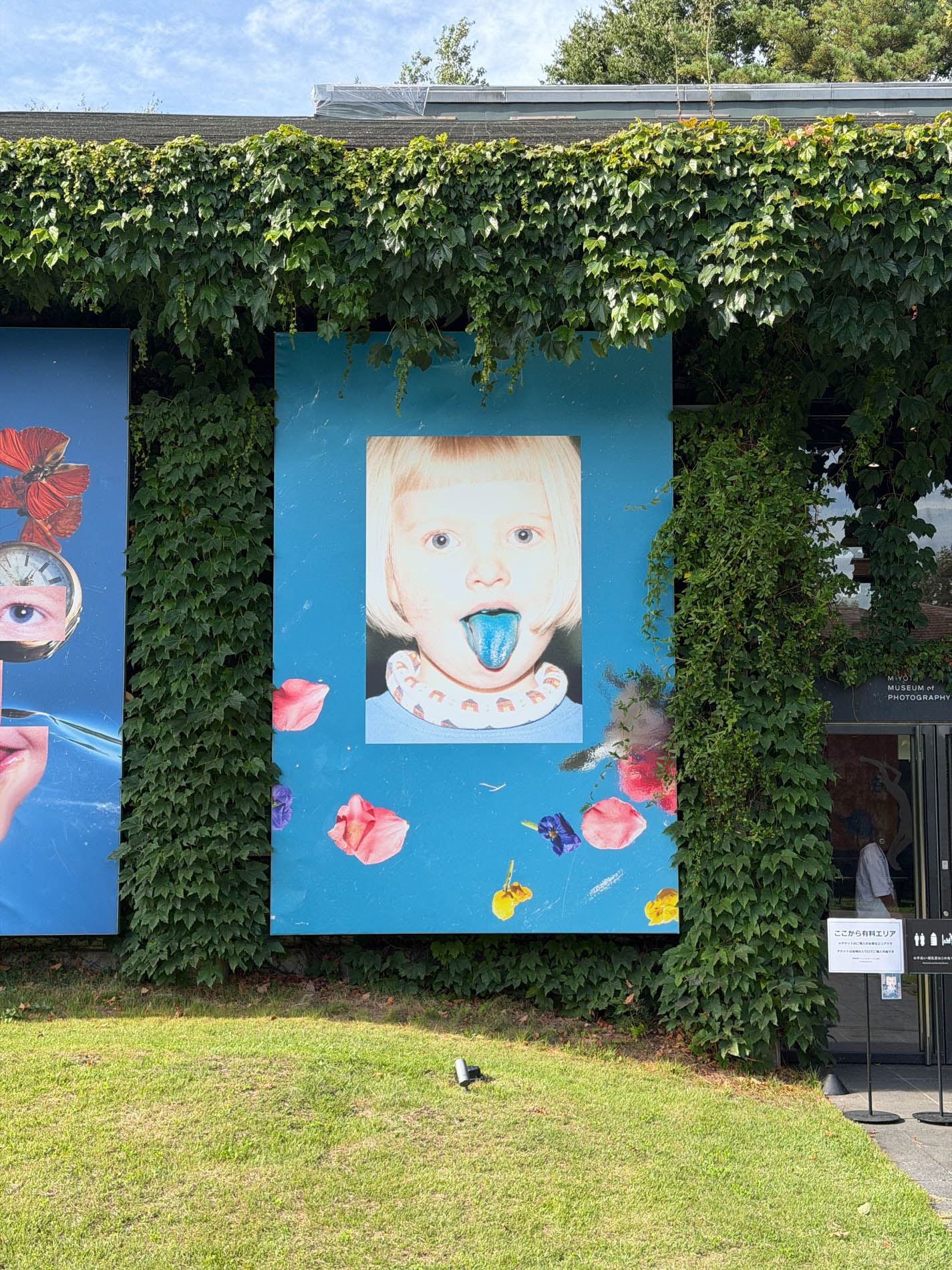
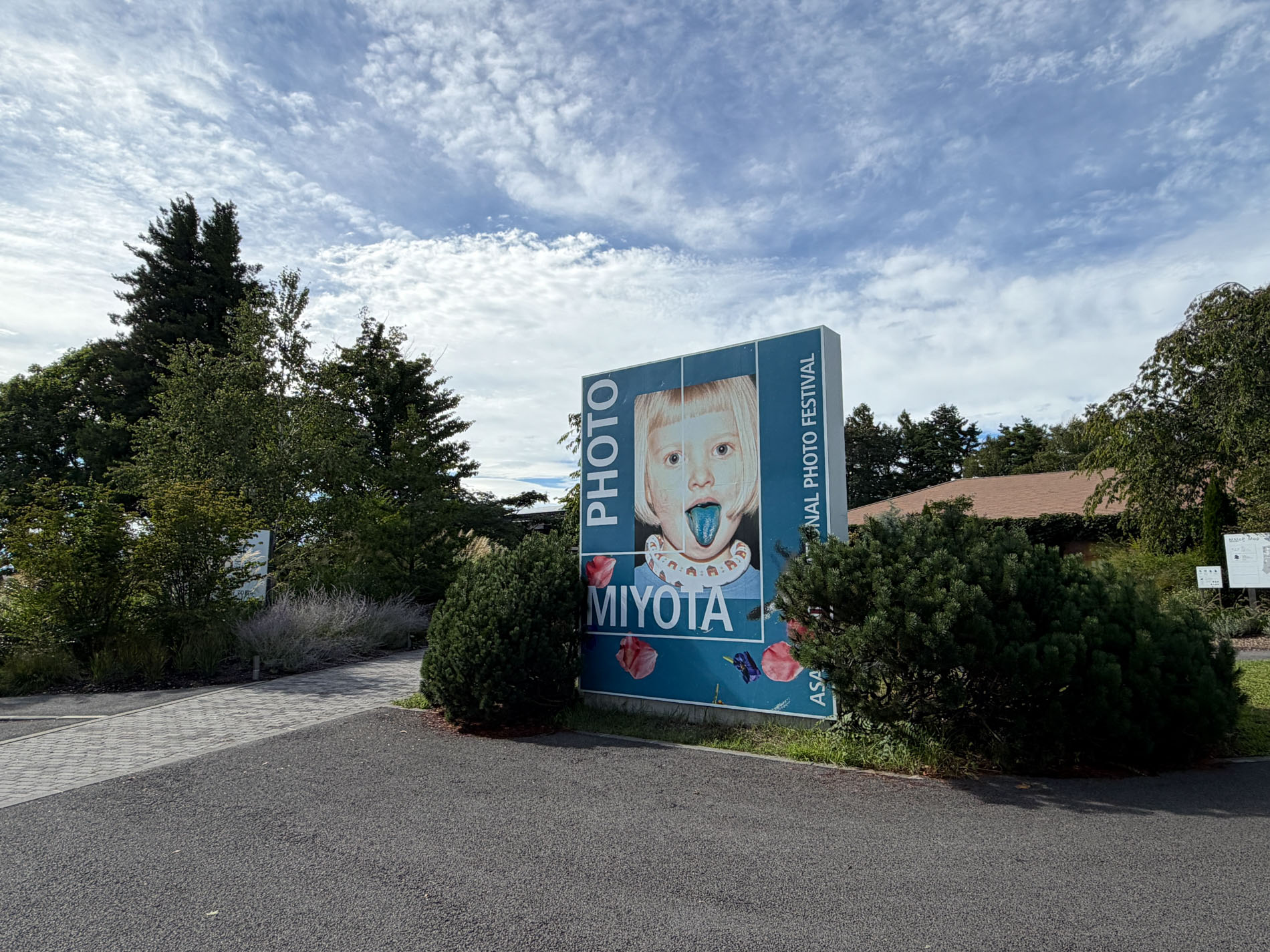
The entrance to MMoP. The key visual is Henriette Sabroe Ebbesen’s Growing Up (2017–). A photograph of a child sticking out a blue tongue has become the signboard itself.
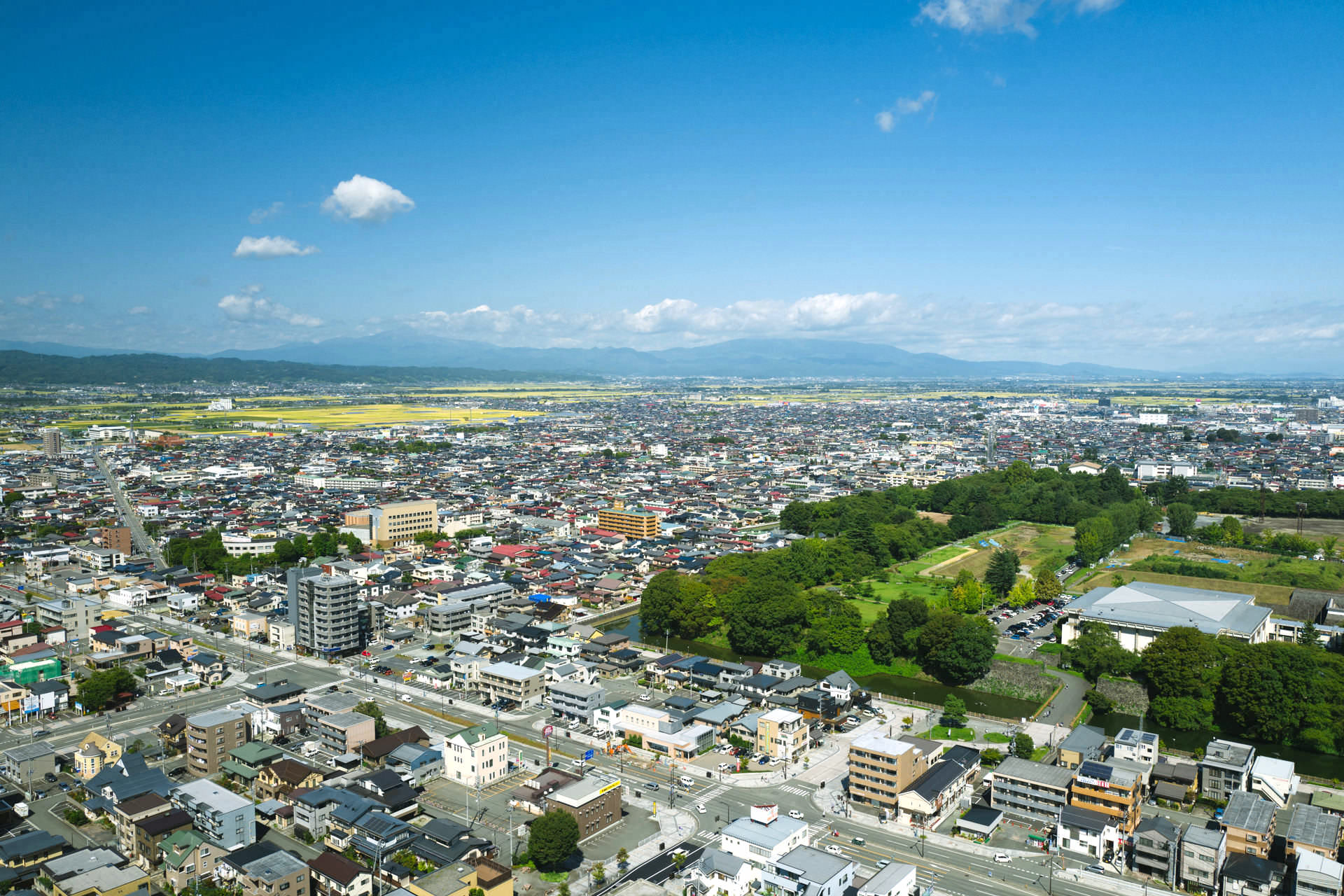
At the southern foot of Mt. Asama lies the town of Miyota, Nagano Prefecture. Ten minutes on foot from Miyota Station on the Shinano Railway, up a gentle slope, stands a complex called MMoP. Across grounds planted with lawn and ornamental grasses, photographs printed at large scale are shown outdoors. ASAMA INTERNATIONAL PHOTO FESTIVAL 2026 PHOTO MIYOTA; this year’s theme is “After the Image.”
A photograph is not finished at the instant the shutter falls; it keeps changing meaning as it is looked at, shared and remembered. That is the theme this show sets out. And so this photo festival shows photographs on ivy-covered walls, hangs them among the trees and stands them on the lawn, turning them into something exposed to wind, rain and light. Twenty-two artists and groups from Japan and abroad; around three hundred works on view.
Children Lined Up on a Wall of Ivy
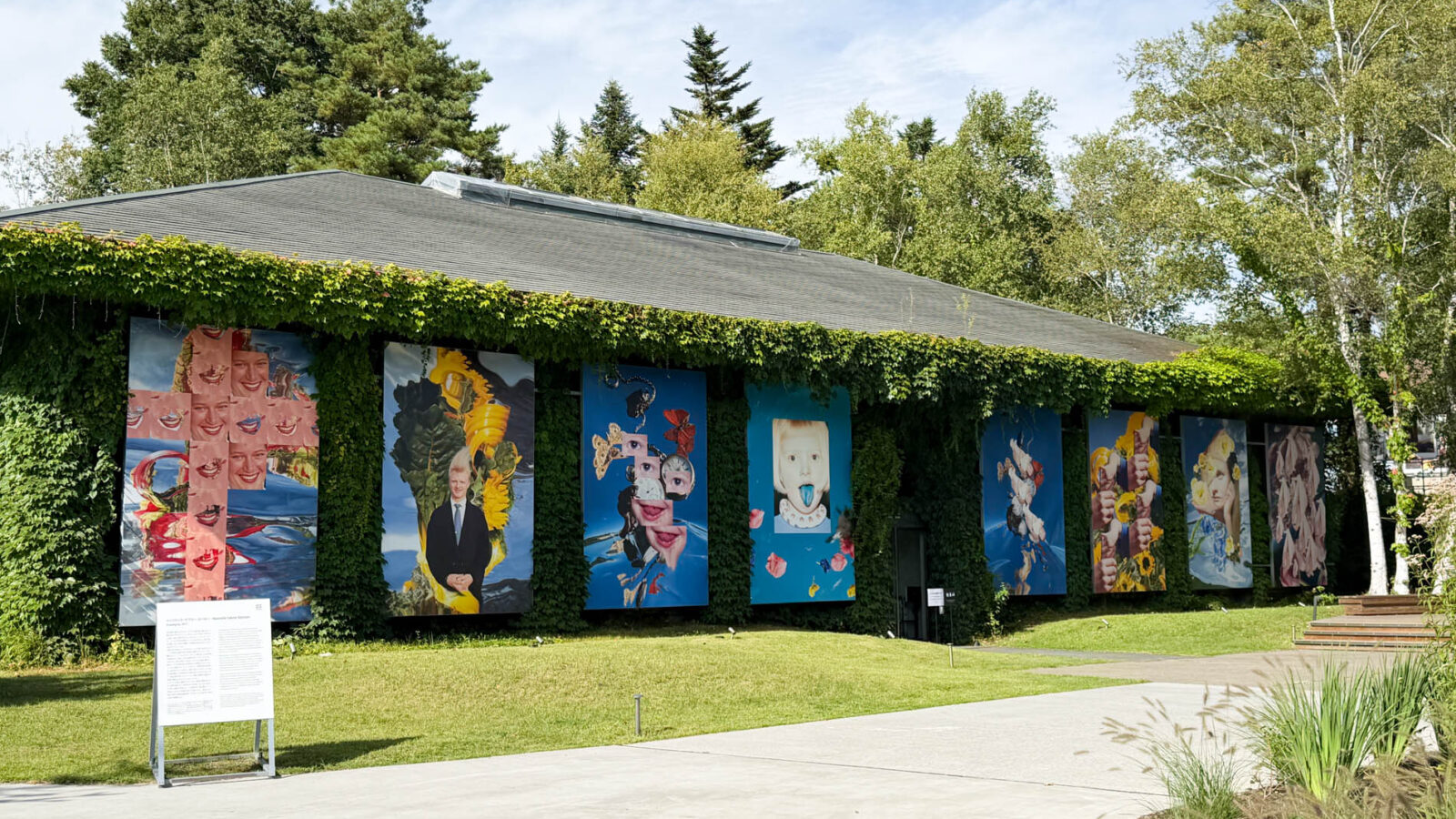
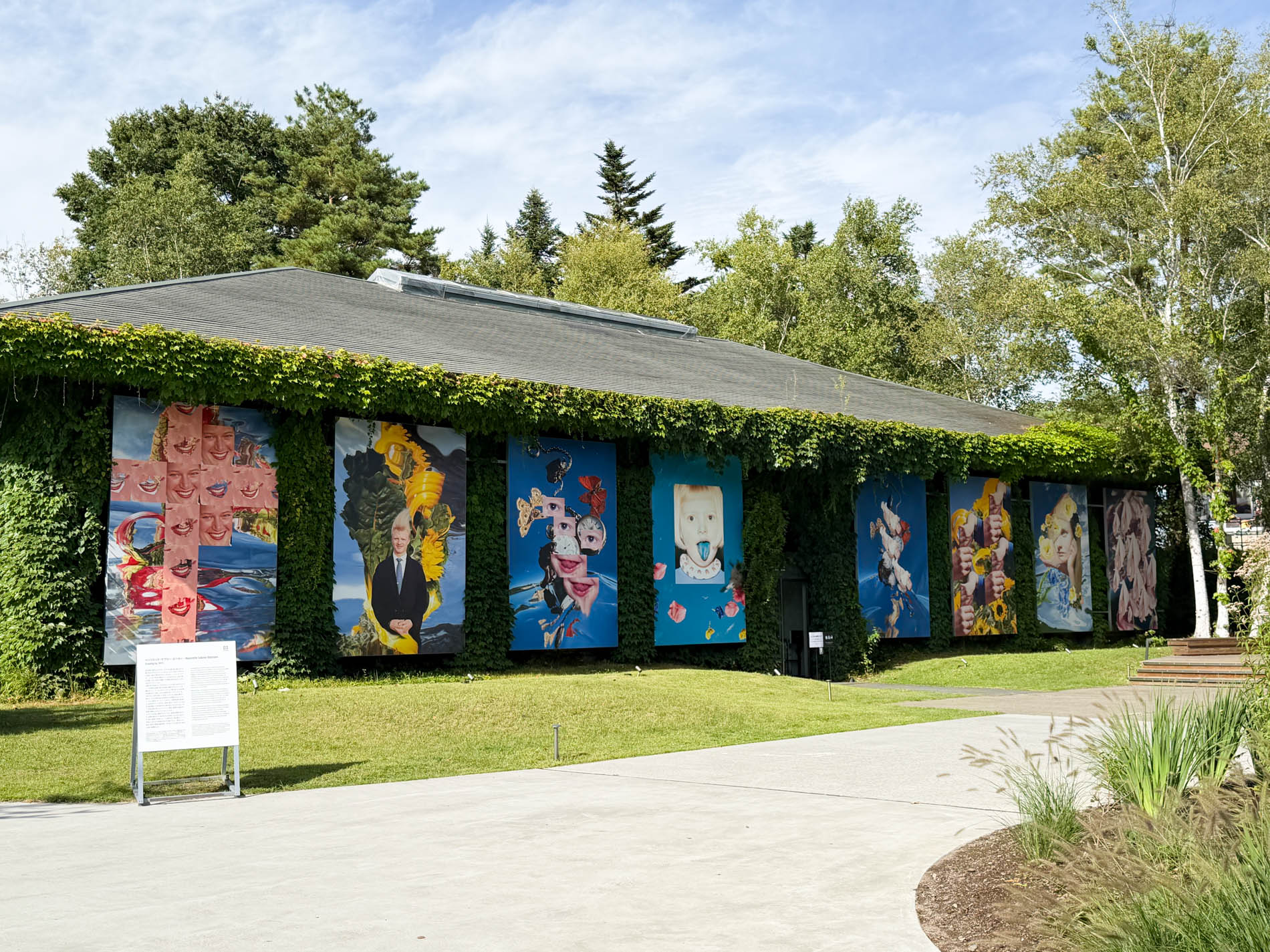
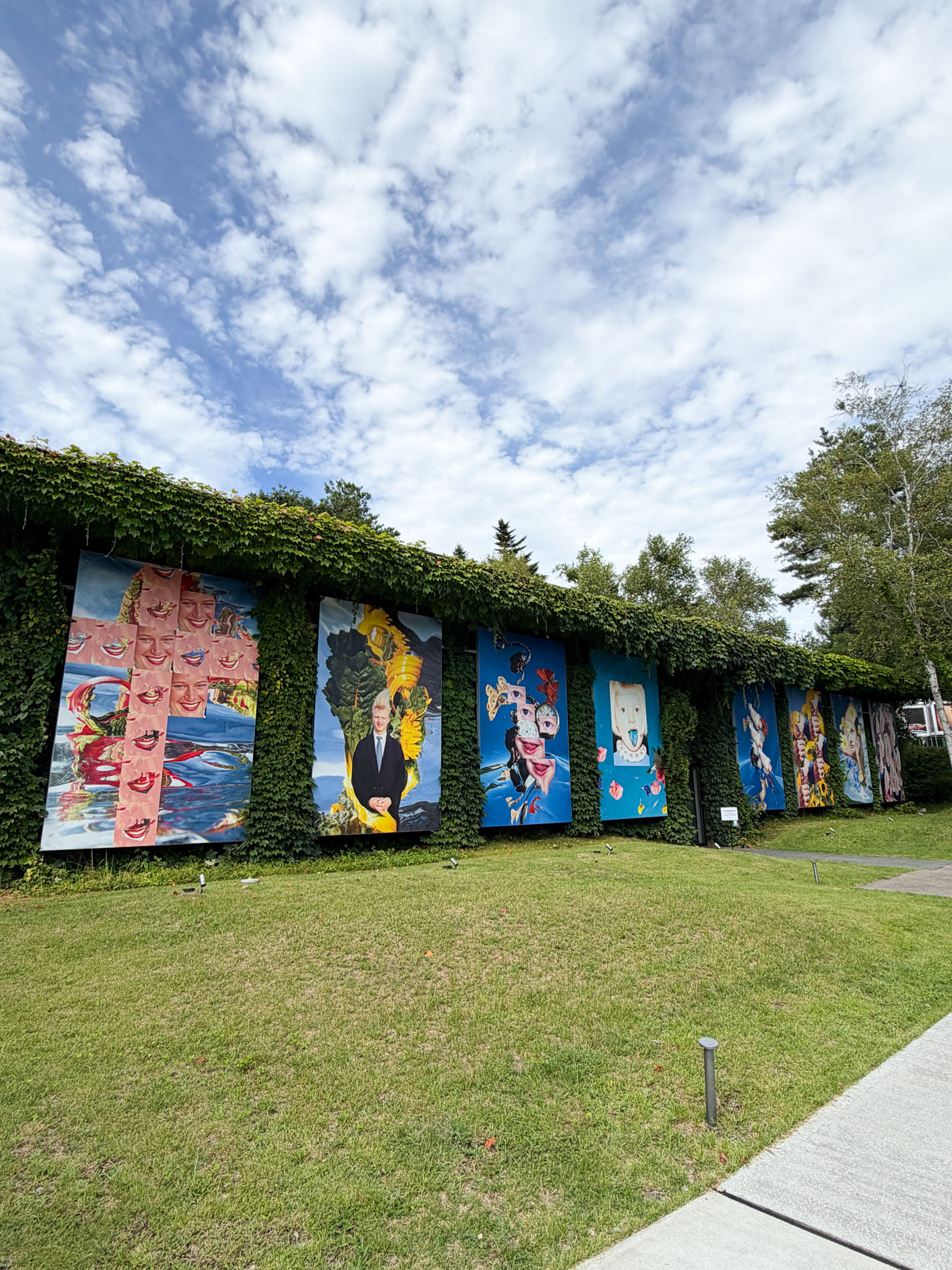
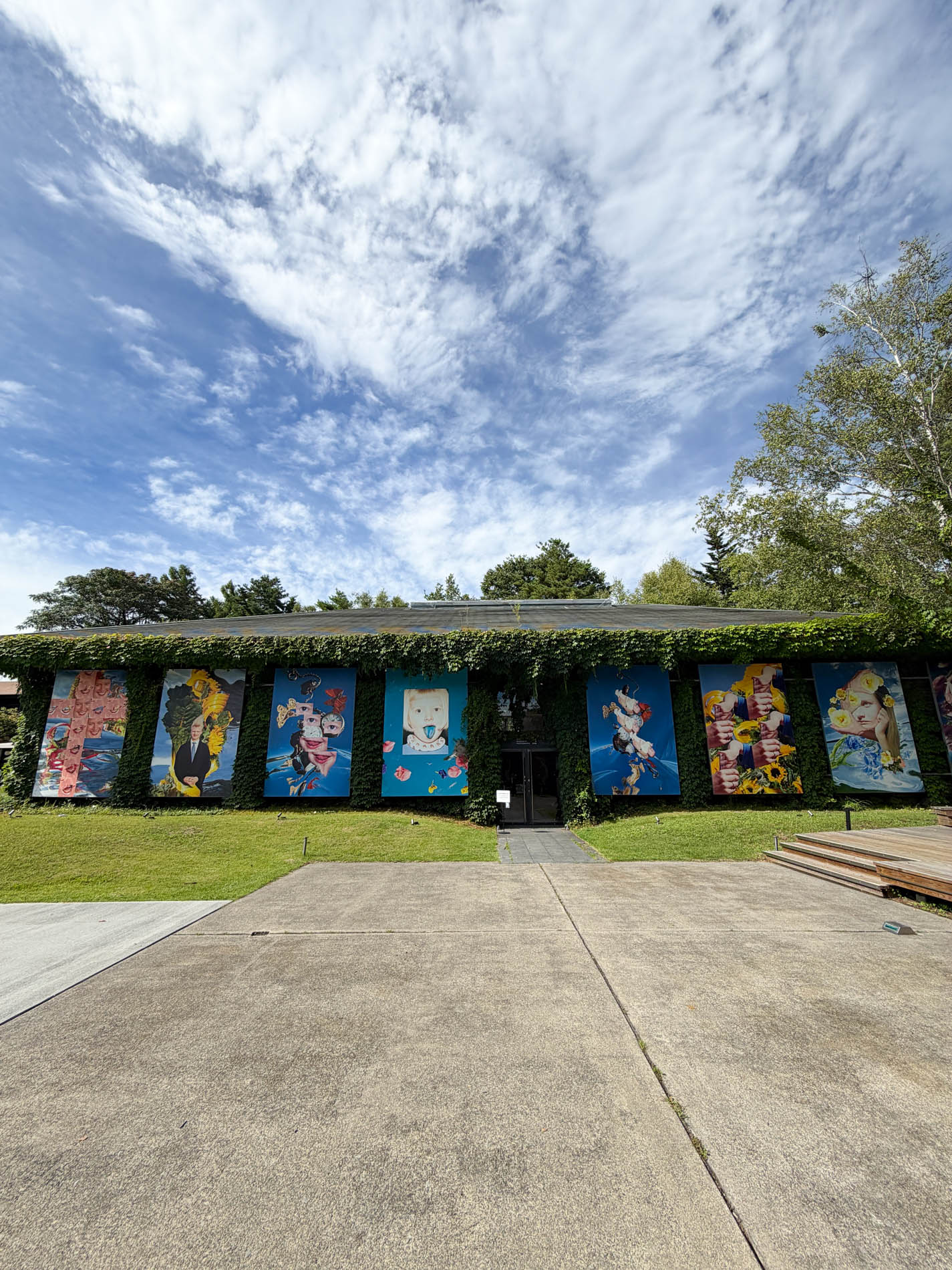
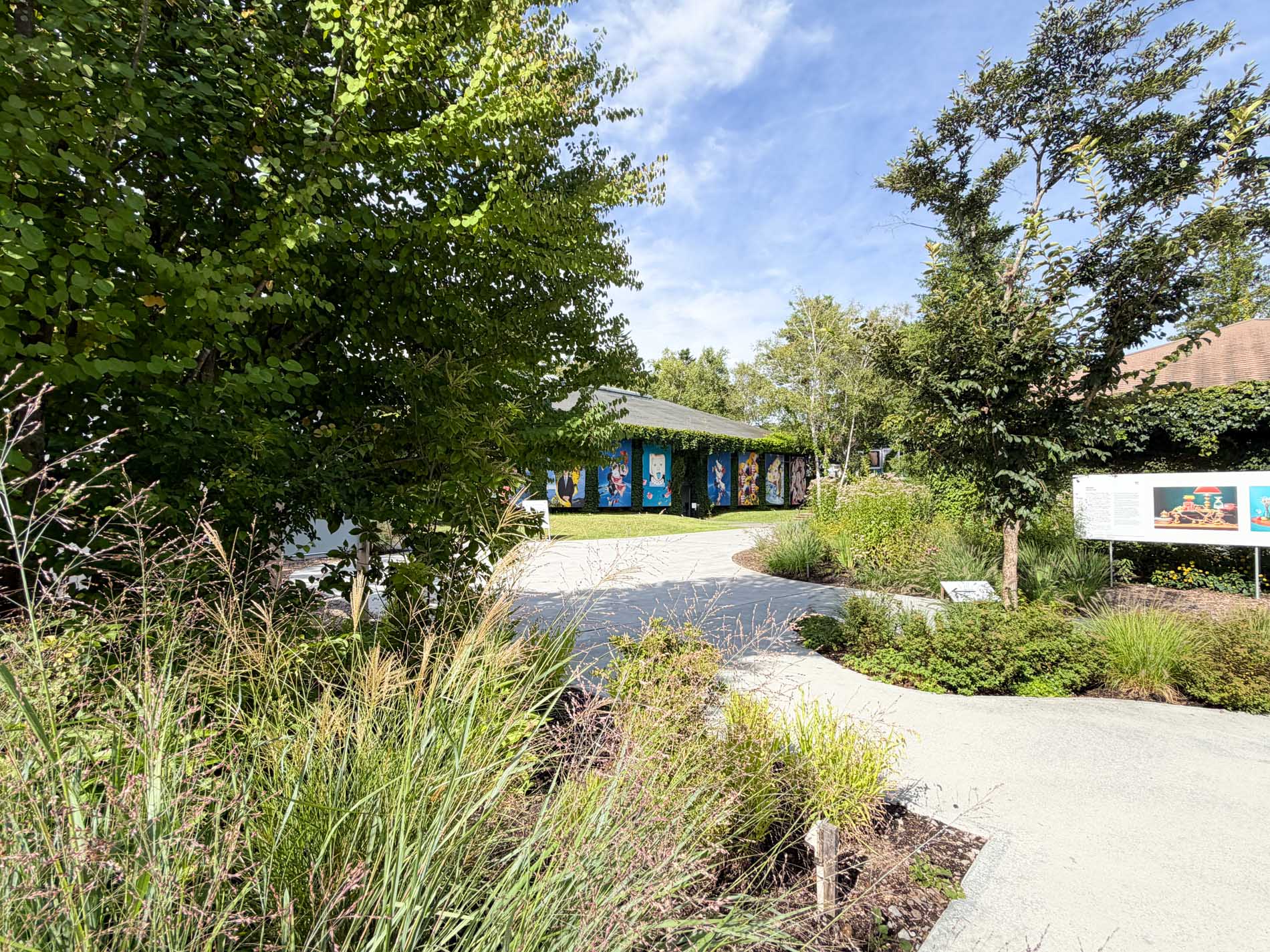
The first thing you see on entering is a run of large-format prints hung the full length of an ivy-covered building: Henriette Sabroe Ebbesen‘s Growing Up (2017–), by the Danish photographer and filmmaker. This year’s key visual was taken from this work as well.
Henriette Sabroe Ebbesen, Growing Up, 2017–. Collages of photographs left in her father’s album and photographs she took herself. The white panel at the far left is the wall text.
Old family photographs from her father’s album, layered as collage with the photographs she is making now. So in front of this wall two spans of time press against each other inside a single frame. A man in a suit surrounded by sunflowers; a screen where lipstick-like mouths repeat in tiles; someone with the face of an animal. Each drifts a little further from whatever the words “family photograph” would lead you to expect.
Eight works in all, printed large. The green of the ivy seems to be doing the work of a frame.From the front of the building. The photographs have become part of the architecture.The piece that became the key visual. This one image is on the entrance signboard and on the roadside sign as well. It enters the field of vision even of people merely driving through the town.Close to evening on a Sunday, and it was not especially crowded. Outdoor work looks better once the crowd has thinned.
Human Outlines and the Grain of Fireworks
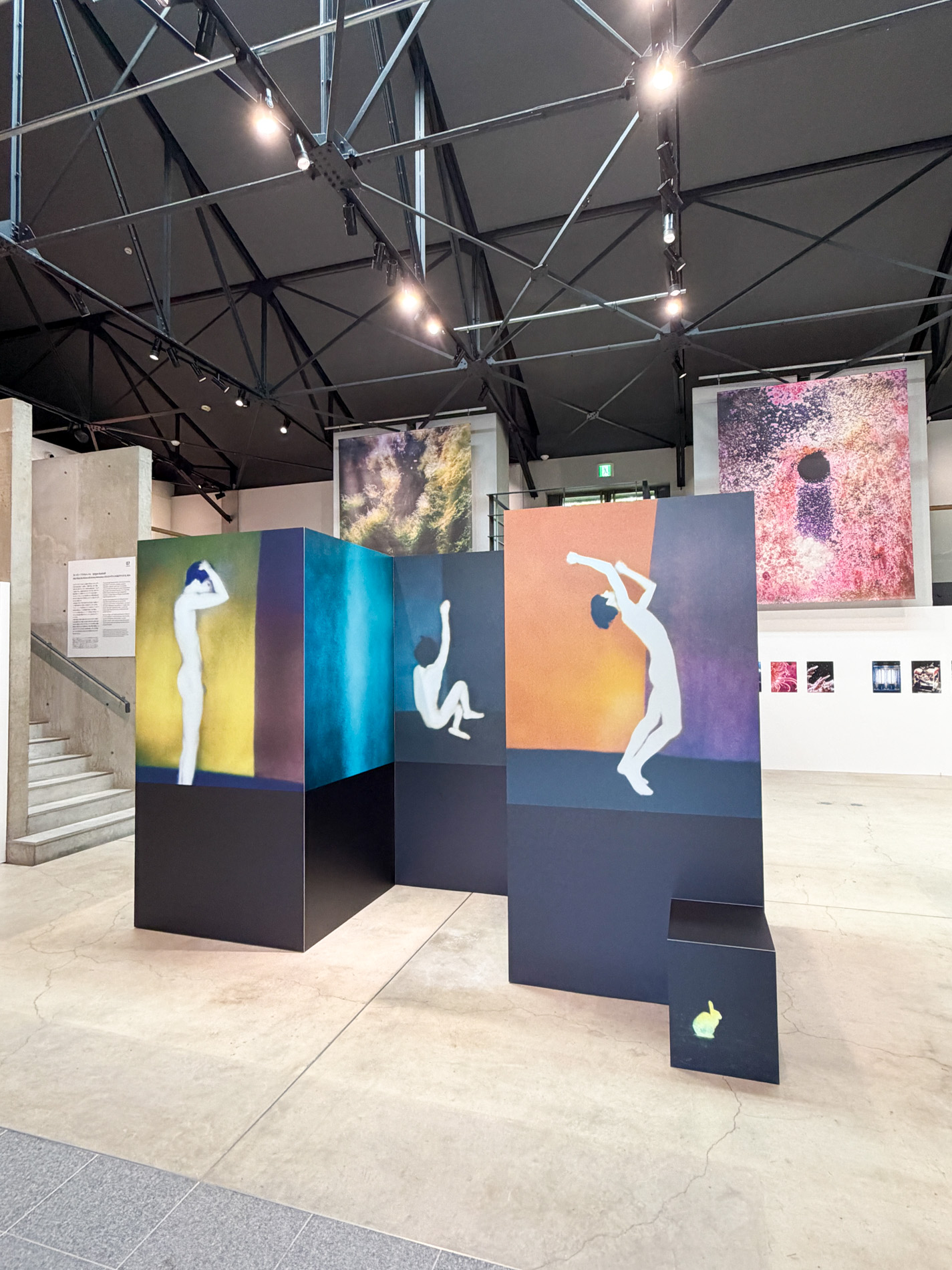
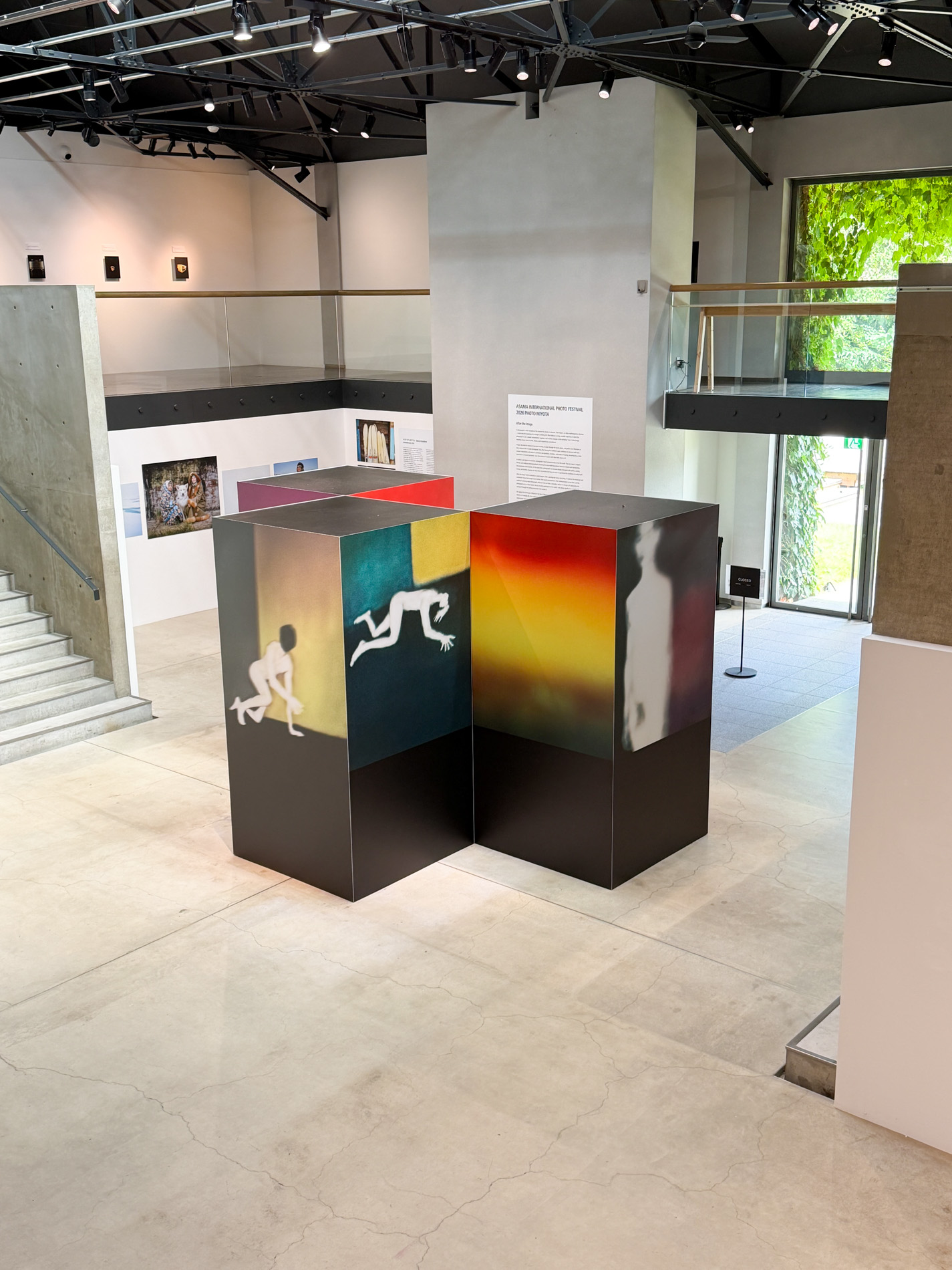
Entering the exhibition room, a black screen-like structure stands directly ahead: Jörgen Axelvall‘s Most likely the flames will destroy themselves / Looking Up. The artist was born in Sweden and lives in Tokyo.
Jörgen Axelvall, Most likely the flames will destroy themselves / Looking Up. The two works hanging high at the back are Taiyo Onorato & Nico Krebs’s Water Column.
Human outlines surfacing faintly, and close-ups of the instant a firework’s brilliant burst scatters, stand side by side in the same view. Both are Polaroids blown up large, so that even the film grain and the noise become visible. Against a strong ground running from orange into yellow, a figure cut out in white. Only the outline, so neither face nor clothing can be read.
Not hung on a wall but applied to the faces of boxes set on the floor. The way it reads changes with where you stand; there is no front.
The large banners hanging at the back are Taiyo Onorato & Nico Krebs‘s Water Column, which grew out of a residency at a research facility on the Red Sea. Using underwater cameras, pigment and photograms, they re-photographed existing images with corals and shells placed in front of them. One work scatters pink grain across the whole surface with a black circle opened at its centre; the other is a swirl of gold and green. The roof trusses are left bare, so you have to raise your eyes before the whole thing comes in.
Sky Hung Out to Dry Among the Trees
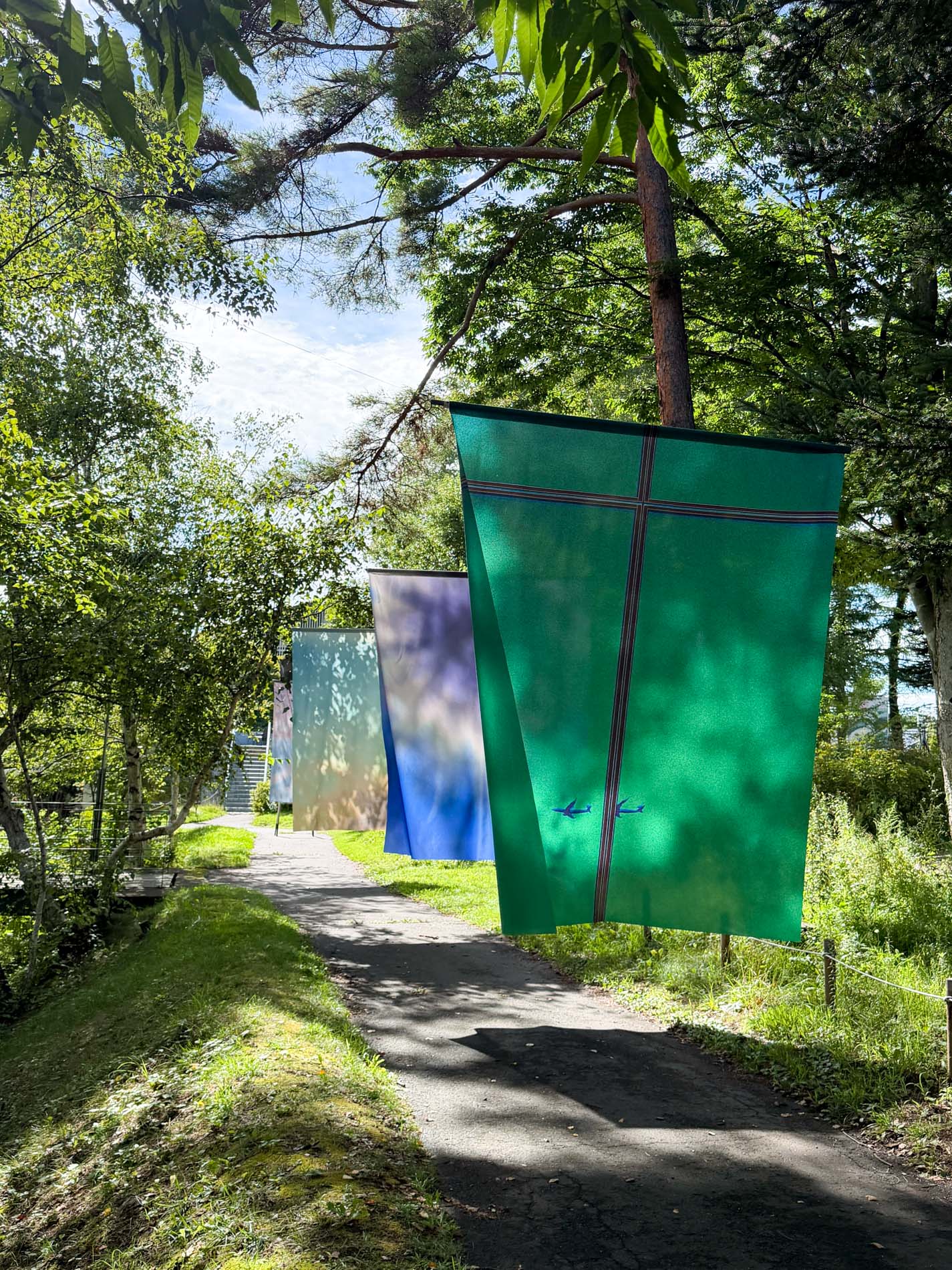
Round the back of the building, large lengths of fabric hang one after another along a woodland path. This is Jörgen Axelvall again — Looking Up: a series photographing aeroplanes crossing the Tokyo sky, made with the solarisation technique.
The fabric is semi-transparent, so the stand of trees behind shows through; when the wind blows it sways, and the shadows of real branches cross over the photographed sky. Photographs of the Tokyo sky rise up into the sky of Miyota.
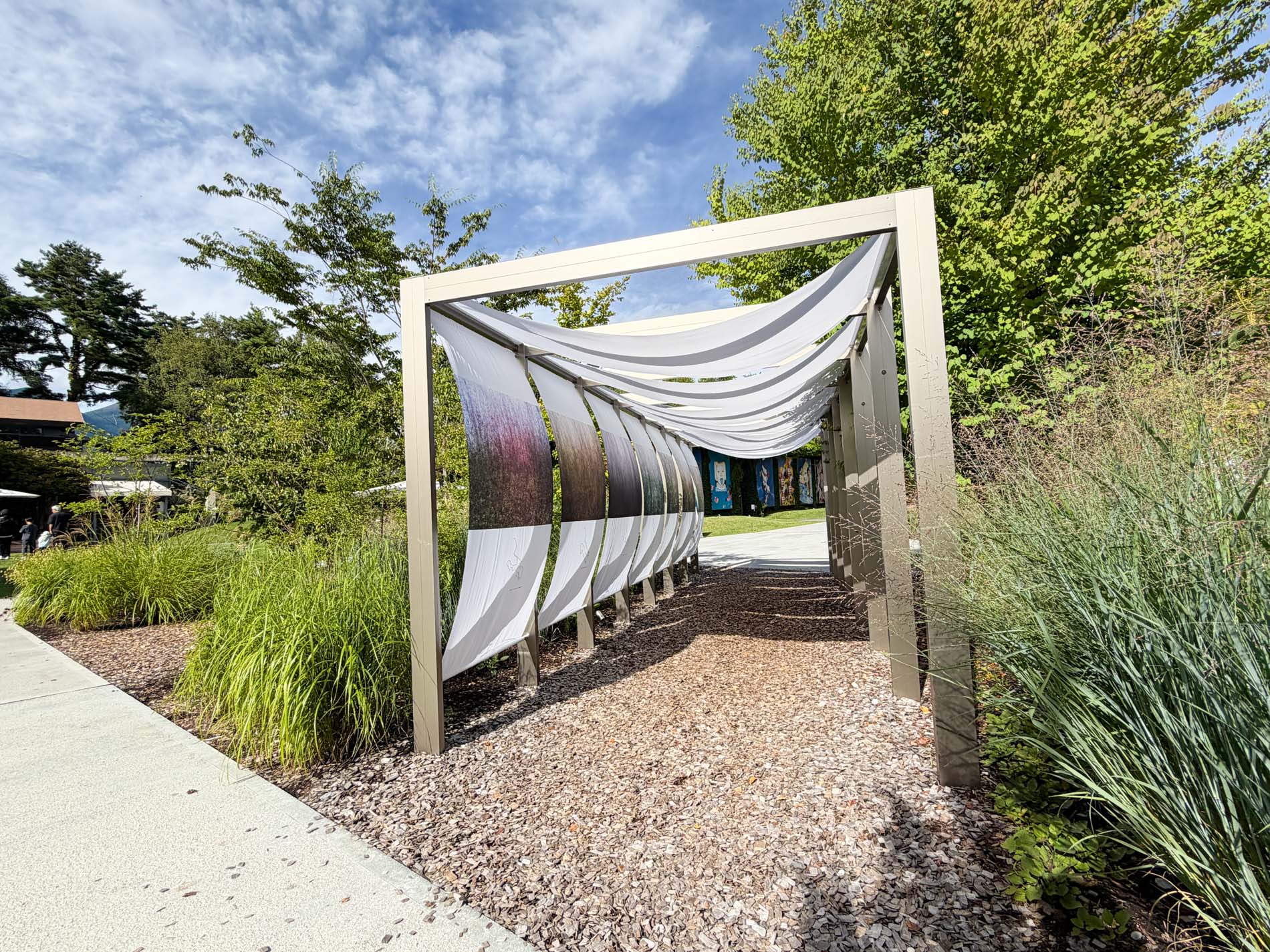
Jörgen Axelvall, Looking Up, 2022. Two small blue aeroplanes at the centre of the green field. As you walk the path the colours change over — green, blue, grey. This turned out to be my personal favourite spot.Under the pergola, Hideyuki Ishibashi’s Trails (2020). Several hundred photographs taken while walking through a forest, layered along the track recorded by GPS. A record of walking, passed through on foot.
Godzilla Standing in an Old Ethnographic Photograph
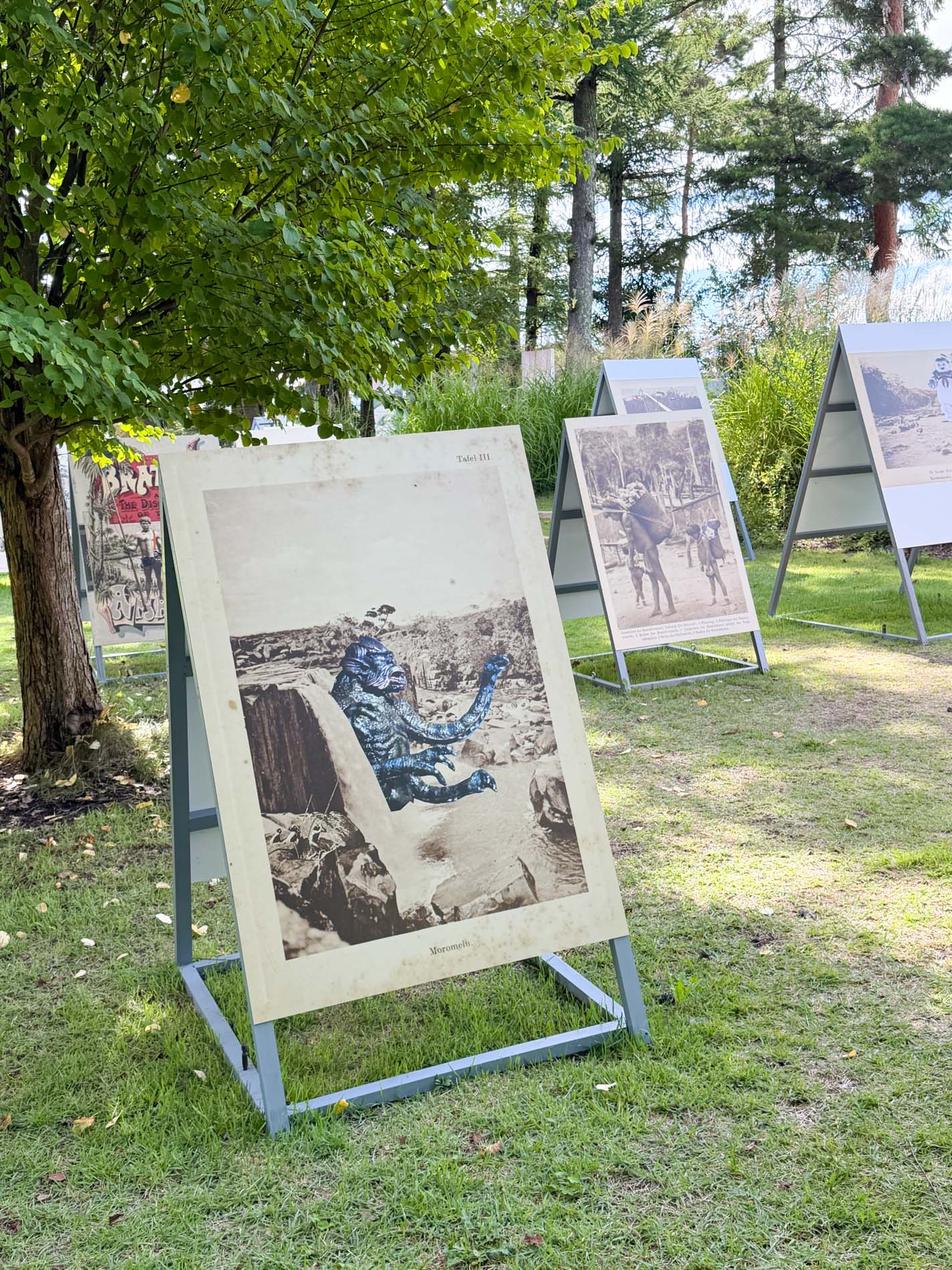
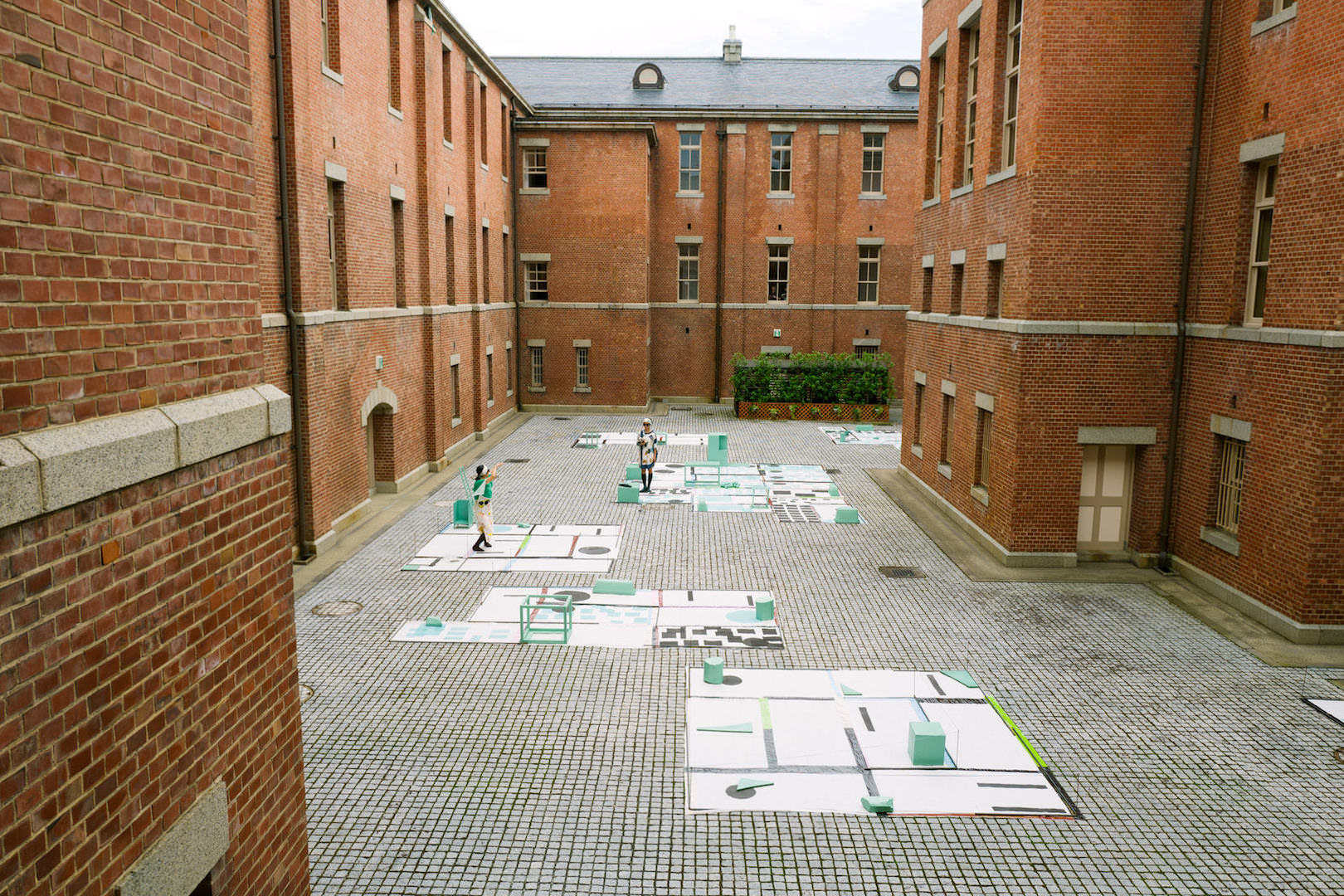
An area where easel-like panels are scattered across the lawn. Denilson Baniwa, an artist of the Baniwa people of the Brazilian Amazon: Colonial Fictions (2021).
Denilson Baniwa, Colonial Fictions, 2021. Godzilla, standing in a nineteenth-century ethnographic photograph.
Photographs taken from the nineteenth into the early twentieth century by Western expeditions and anthropologists to document “primitive peoples.” Into them, images from the movies — King Kong, Godzilla, the Alien, the Kraken — have been composited without apology.
The Marshmallow Man, in the rapids of “59. In der Stromschnelle von Karaiuamelu, Rio Uraricuera.” The original caption is left inside the work.The wall texts are in Japanese and English, standing outdoors one per work. Easy to read, which was good.
Walking the Garden
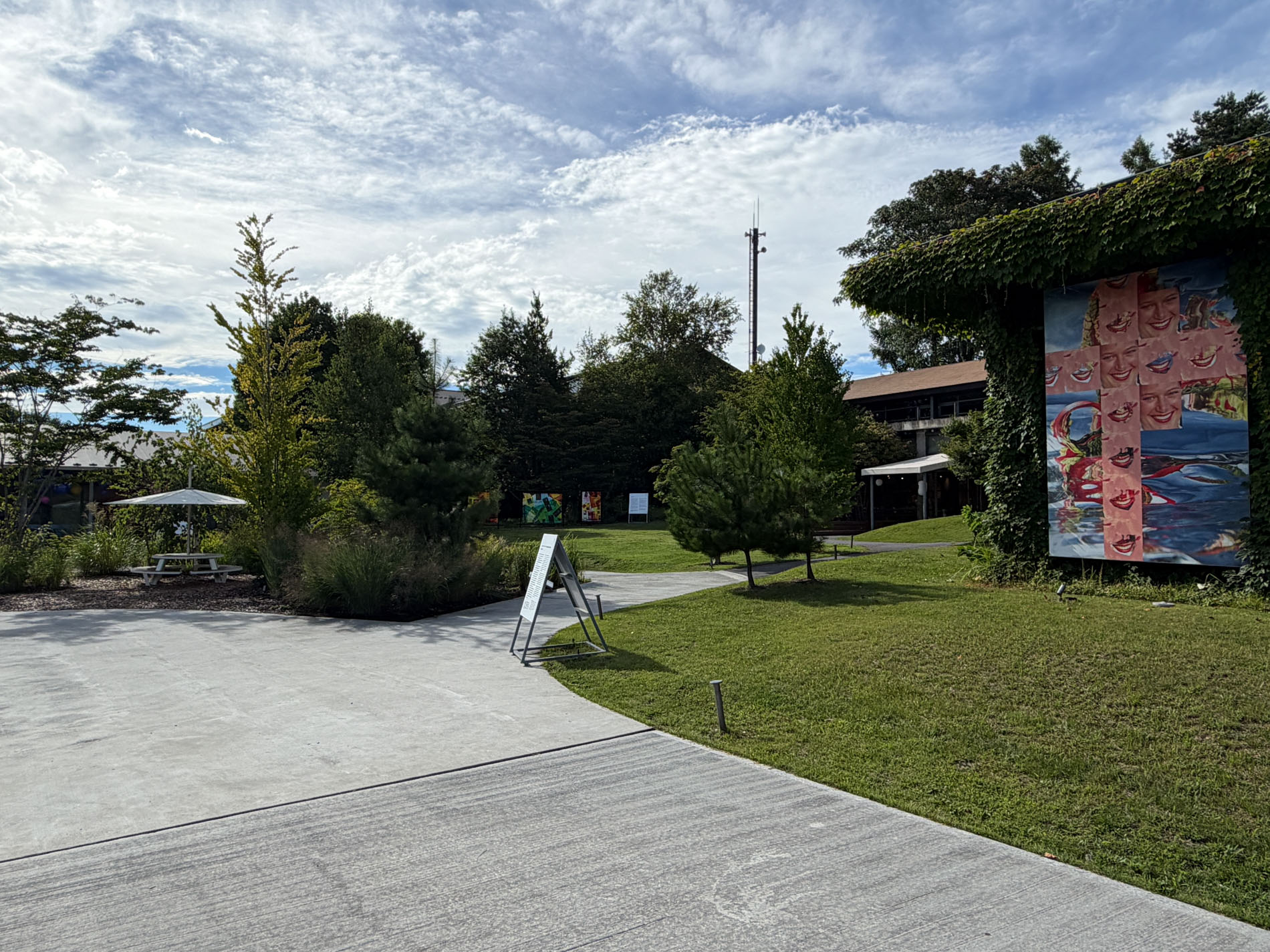
Three at the edge of the woods: Ayaka Endo’s Kamuy Mosir (2020). A white snake, a horse’s eye, red bleeding into rock. The series began from the experience of being abruptly cut off from society during the COVID-19 pandemic, and it asks how much of what we call “nature” is in fact inseparable from human activity. A spot where Mt. Asama can be seen behind.Beside the path, three still lifes on a long horizontal panel: ARCHIVES’s Vanitas. The fruit, game consoles and tablets arranged here are all fictional images generated by AI, and none of the lettering that looks like brand logos actually exists.Looking at the facade from the path. Planting is everywhere, and I got to enjoy the nature as much as the photographs.A bench and a parasol. There is somewhere to rest between one work and the next.
Taking Photographs Out from Under the Roof
An hour and a half from Tokyo by Shinkansen and local line; twenty minutes by train from Karuizawa. On until 27 September. ¥1,500 lets you return as often as you like during the run, so there may also be pleasure in going twice, to see the difference between summer light and early-autumn light.
在「59. In der Stromschnelle von Karaiuamelu, Rio Uraricuera」的急流中,站着棉花糖人。原本的图说被留在作品之中。说明是日英双语,一件一块地立在户外。读起来很方便,这一点很好。
在庭园里走
林缘三件,是远藤文香《Kamuy Mosir》(2020)。白蛇、马的眼睛、渗入岩面的红色。这一系列始于新冠疫情下与社会的联系被骤然切断的经验,追问我们所称的「自然」,其中有多少其实与人的作为无法分割。是一处能望见浅間山的位置。园路旁,横长展板上三张静物,是 ARCHIVES《Vanitas》。画面里排列的水果、游戏机与平板,全都是由 AI 生成的虚构影像,看似品牌标志的文字也无一真实存在。从园路望向立面。植栽遍布各处,能像看照片一样享受感受自然的时间。长椅与遮阳伞。作品与作品之间,有可以歇脚的地方。
MMoP 입구입니다. 키 비주얼은 헨리에테 사브로 에베센 《Growing Up》(2017–). 파란 혀를 내민 아이의 사진 한 장이 그대로 간판이 되었습니다.
아사마산 남쪽 기슭, 나가노현 미요타초. 시나노 철도 미요타역에서 걸어서 10분쯤, 완만한 언덕 위에 MMoP라는 복합시설이 있습니다. 잔디와 그라스류가 펼쳐진 부지에 크게 프린트된 사진이 야외에 전시되어 있습니다. 아사마 국제 사진 페스티벌 2026 PHOTO MIYOTA, 올해의 주제는 「After the Image|이미지의 그 후」입니다.
사진은 셔터가 눌린 순간에 완성되는 것이 아니라, 보여지고 공유되고 기억되는 가운데 계속 의미를 바꿔갑니다——그런 주제를 내건 전시입니다. 그래서 이 포토 페스티벌은 사진을 담쟁이 벽에 전시하고, 숲속에 매달고, 잔디에 세워, 바람과 비와 빛에 드러나는 자리로 옮겨 놓습니다. 참가 작가는 국내외 22팀, 전시 작품은 약 300점.
담쟁이 벽에, 아이들이 늘어선다
들어서면 가장 먼저 눈에 들어오는 것이, 담쟁이로 뒤덮인 건물 벽면 가득 걸린 대형 프린트들입니다. 덴마크의 사진가이자 영상작가 헨리에테 사브로 에베센의 《Growing Up》(2017–). 올해의 키 비주얼도 이 작품에서 채택되었습니다.
헨리에테 사브로 에베센 《Growing Up》 2017–. 아버지의 앨범에 남아 있던 사진과 작가 자신이 찍은 사진을 겹친 콜라주입니다. 왼쪽 끝의 흰 판이 작품 해설.
아버지의 앨범에 남아 있던 오래된 가족사진과, 작가가 지금 찍고 있는 사진을 콜라주로 겹쳐가는 작업입니다. 그래서 이 벽 앞에서는 두 개의 시간이 같은 화면 안에서 서로를 밀고 있습니다. 해바라기에 둘러싸인 정장 차림의 남자, 립스틱 같은 입술이 타일처럼 반복되는 화면, 동물의 얼굴을 한 누군가. 어느 것이나 「가족사진」이라는 말에서 떠올릴 법한 것으로부터 조금씩 어긋나 갑니다.
크게 출력된 작품은 전부 8점. 담쟁이의 초록이 액자를 대신하고 있는 듯합니다.건물 정면에서. 사진이 건축의 일부가 되어 있습니다.키 비주얼이 된 한 점. 이 한 장이 입구 간판에도, 도로변 사인에도 쓰이고 있습니다. 차로 마을을 지나칠 뿐인 사람의 시야에도 들어옵니다.일요일 저녁에 가까운 시간대였는데 그리 붐비지 않았습니다. 사람이 빠진 뒤가 야외 전시는 더 잘 보입니다.
사람의 윤곽과, 불꽃의 입자
전시실에 들어서면 정면에 검은 병풍 같은 구조물이 서 있습니다. 스웨덴 출신으로 도쿄에 거주하는 요르겐 악셀발 《Most likely the flames will destroy themselves / Looking Up》입니다.
요르겐 악셀발 《Most likely the flames will destroy themselves / Looking Up》. 안쪽 높은 위치에 매달린 두 점은 타이요 오노라토&니코 크렙스 《Water Column》입니다.
어렴풋이 떠오르는 사람의 윤곽과, 불꽃의 선명한 폭발이 흩어져 가는 순간의 클로즈업이 같은 시야에 나란히 놓여 있습니다. 둘 다 폴라로이드를 크게 확대한 것으로, 필름의 입자와 노이즈까지 보이도록 되어 있습니다. 오렌지에서 노랑으로 흐르는 강한 색의 바탕에 하얗게 도려낸 인영. 윤곽뿐이라 얼굴도 옷도 알 수 없습니다.
벽에 거는 것이 아니라, 바닥에 놓인 상자의 면에 붙여져 있습니다. 자신이 서는 각도에 따라 보이는 방식이 달라지고, 정면이 없습니다.
안쪽에 매달린 대형 천은 타이요 오노라토&니코 크렙스 《Water Column》입니다. 홍해의 연구시설 레지던시에서 태어난 작품으로, 수중 카메라와 안료와 포토그램을 사용해 산호와 조개껍데기를 기존 사진 앞에 놓고 다시 촬영했습니다. 한 점은 분홍 입자를 온 면에 흩뿌리고 중앙에 검은 원이 뚫린 것, 다른 한 점은 금과 초록의 소용돌이. 천장 트러스가 그대로 드러난 공간이라 시선을 올리지 않으면 전체가 들어오지 않습니다.
숲속에, 하늘이 널려 있다
건물 뒤편으로 돌아가면, 숲길을 따라 커다란 천이 여러 장 매달려 있습니다. 이쪽도 요르겐 악셀발의 작품으로, 《Looking Up》입니다. 솔라리제이션 기법으로 도쿄의 하늘을 가로지르는 비행기를 찍은 시리즈.
천은 반투명이어서 뒤의 나무들이 비쳐 보이고, 바람이 불면 흔들리며 하늘 사진 위를 진짜 나뭇가지의 그림자가 건너갑니다. 도쿄의 하늘을 찍은 사진이 미요타의 하늘에 떠오릅니다.
요르겐 악셀발 《Looking Up》 2022. 초록 면의 중앙에 파란 비행기가 두 대. 오솔길을 걸으면 초록, 파랑, 회색으로 색이 바뀌어 갑니다. 개인적으로 여기가 가장 좋았던 곳이 되었습니다.퍼걸러에는 이시바시 히데유키 《Trails》(2020). 숲을 걸으며 찍은 수백 장을 GPS 궤적을 따라 겹쳐 놓은 작품입니다. 걸어서 남긴 기록을, 걸어서 통과합니다.
오래된 민족지 사진에, 고질라가 서 있다
잔디에 이젤 형태의 패널이 점점이 놓인 구역입니다. 브라질 아마존 바니와족 출신 작가 데닐손 바니와 《Colonial Fictions》(2021).
데닐손 바니와 《Colonial Fictions》 2021. 19세기의 민족지 사진에 고질라가 서 있습니다.
19세기부터 20세기 초에 걸쳐 서양의 탐험대와 인류학자가 「미개한 민족」을 기록하기 위해 찍은 사진입니다. 거기에 킹콩, 고질라, 에이리언, 크라켄 같은 영화의 이미지가 당당하게 합성되어 있습니다.
「59. In der Stromschnelle von Karaiuamelu, Rio Uraricuera」의 급류에 마시멜로맨. 캡션은 작품 안에 그대로 남아 있습니다.해설은 일영 병기로, 야외에 한 장씩 세워져 있습니다. 읽기 편해서 좋았습니다.
정원을 걷는다
숲 가장자리에 3점. 엔도 아야카 《Kamuy Mosir》(2020)입니다. 하얀 뱀, 말의 눈, 암벽에 번지는 붉은색. 코로나로 사회와의 연결이 끊긴 경험에서 시작된 시리즈로, 우리가 「자연」이라 부르는 것의 많은 부분이 사람의 영위와 떼어놓을 수 없다는 되물음이 있습니다. 뒤로 아사마산이 보이는 자리입니다.산책로 옆에, 가로로 긴 패널로 정물이 3점. ARCHIVES 《Vanitas》입니다. 과일과 게임기와 태블릿이 늘어선 이 정물은 전부 AI가 생성한 가공의 이미지이고, 브랜드 로고처럼 보이는 글자도 어느 것 하나 실재하지 않습니다.산책로에서 파사드를 바라봅니다. 식재가 여기저기에 있어서, 사진과 마찬가지로 자연을 느끼는 시간을 즐길 수 있었습니다.벤치와 파라솔. 작품과 작품 사이에 쉴 곳이 있습니다.
사진을, 지붕 아래에서 꺼낸다
도쿄에서 신칸센과 재래선으로 한 시간 반, 가루이자와에서라면 전철로 20분입니다. 9월 27일까지. 1,500엔으로 회기 중 몇 번이든 들어갈 수 있으니, 여름과 초가을의 빛의 차이를 보러 두 번 가는 즐거움도 있을지 모릅니다.