I visited Ryo Shinagawa’s solo exhibition “Nature’s first green is gold,.”
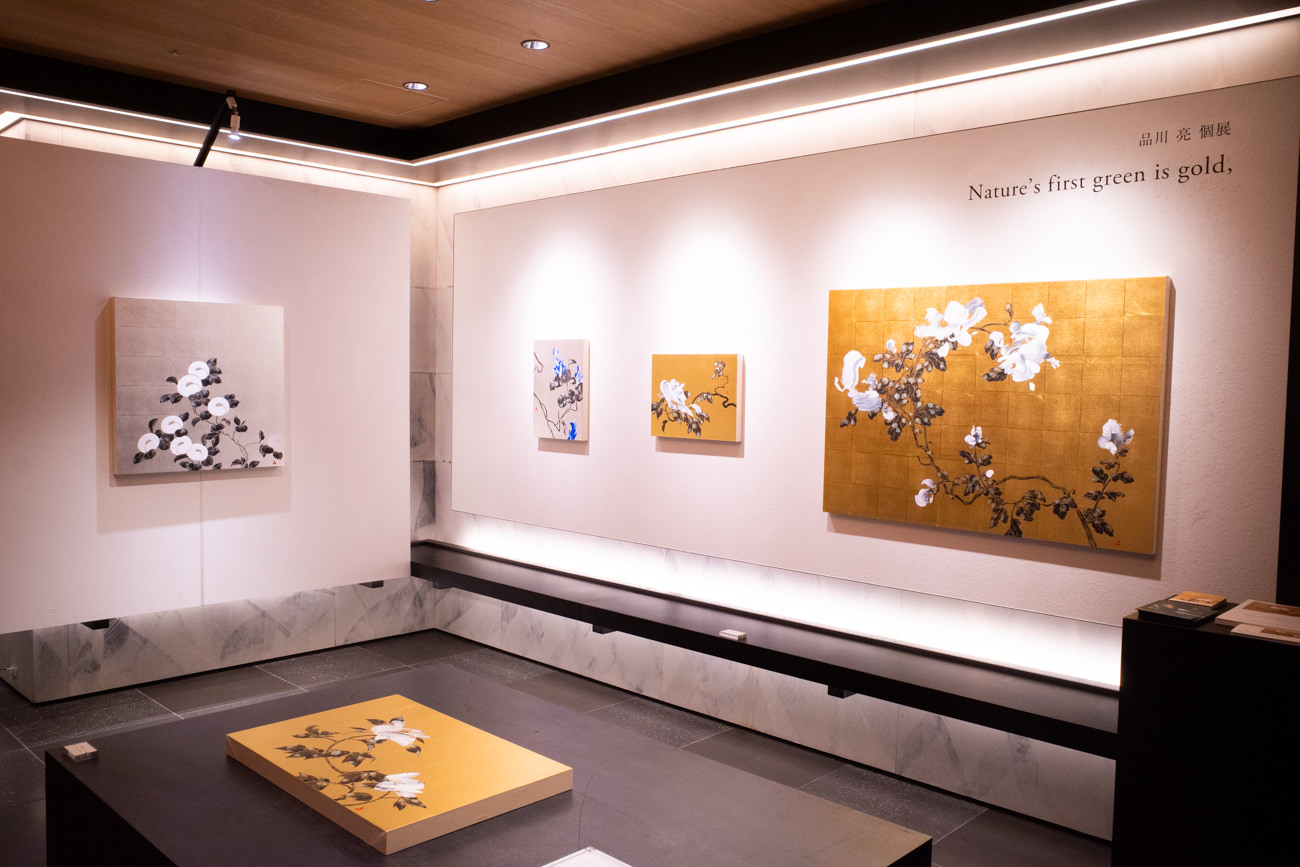
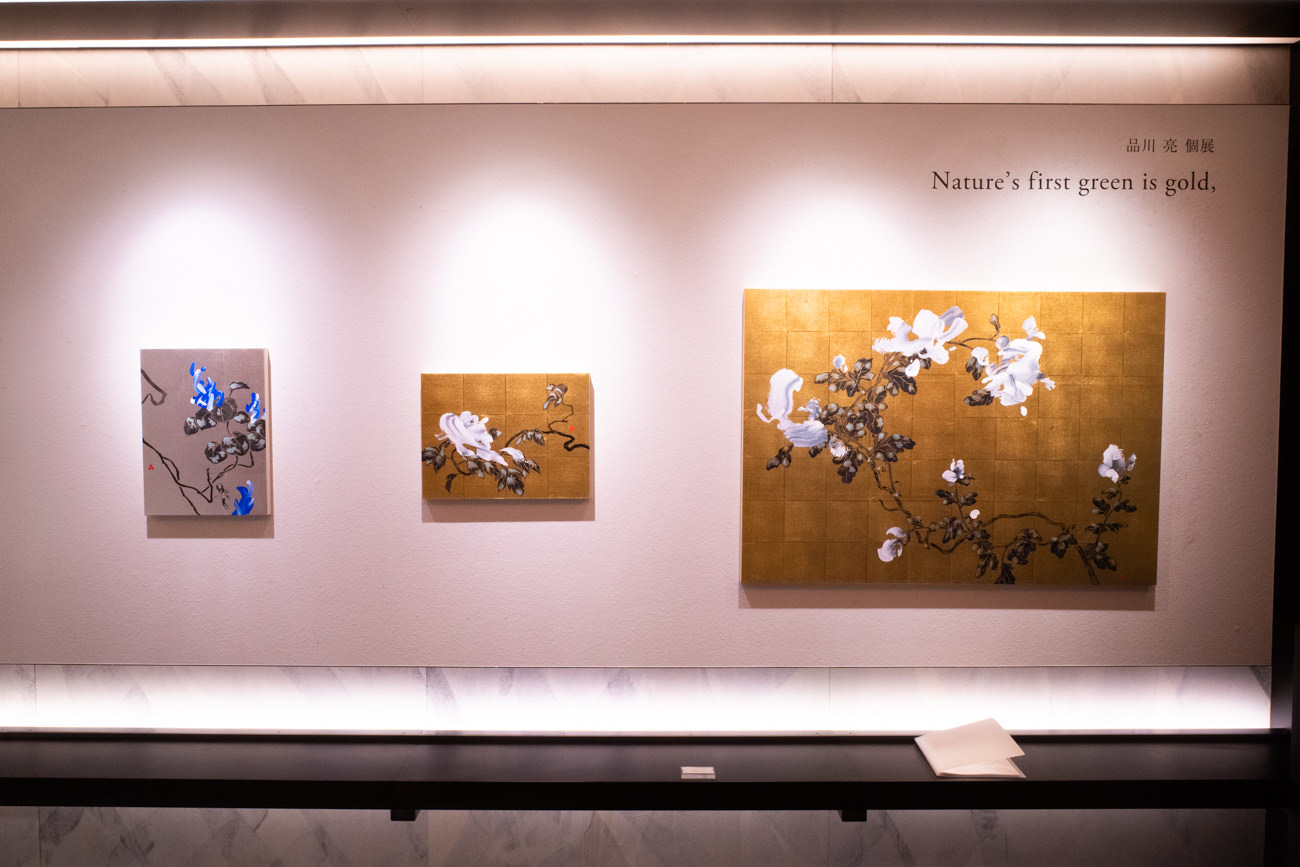
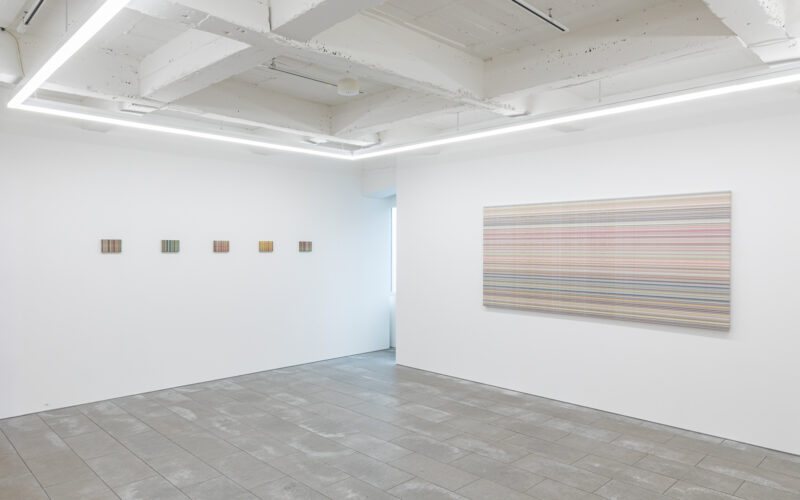
The venue is the Art Wall Gallery of Ginza Tsutaya Books (the exhibition space in front of Starbucks) on the 6th floor of GINZA SIX.
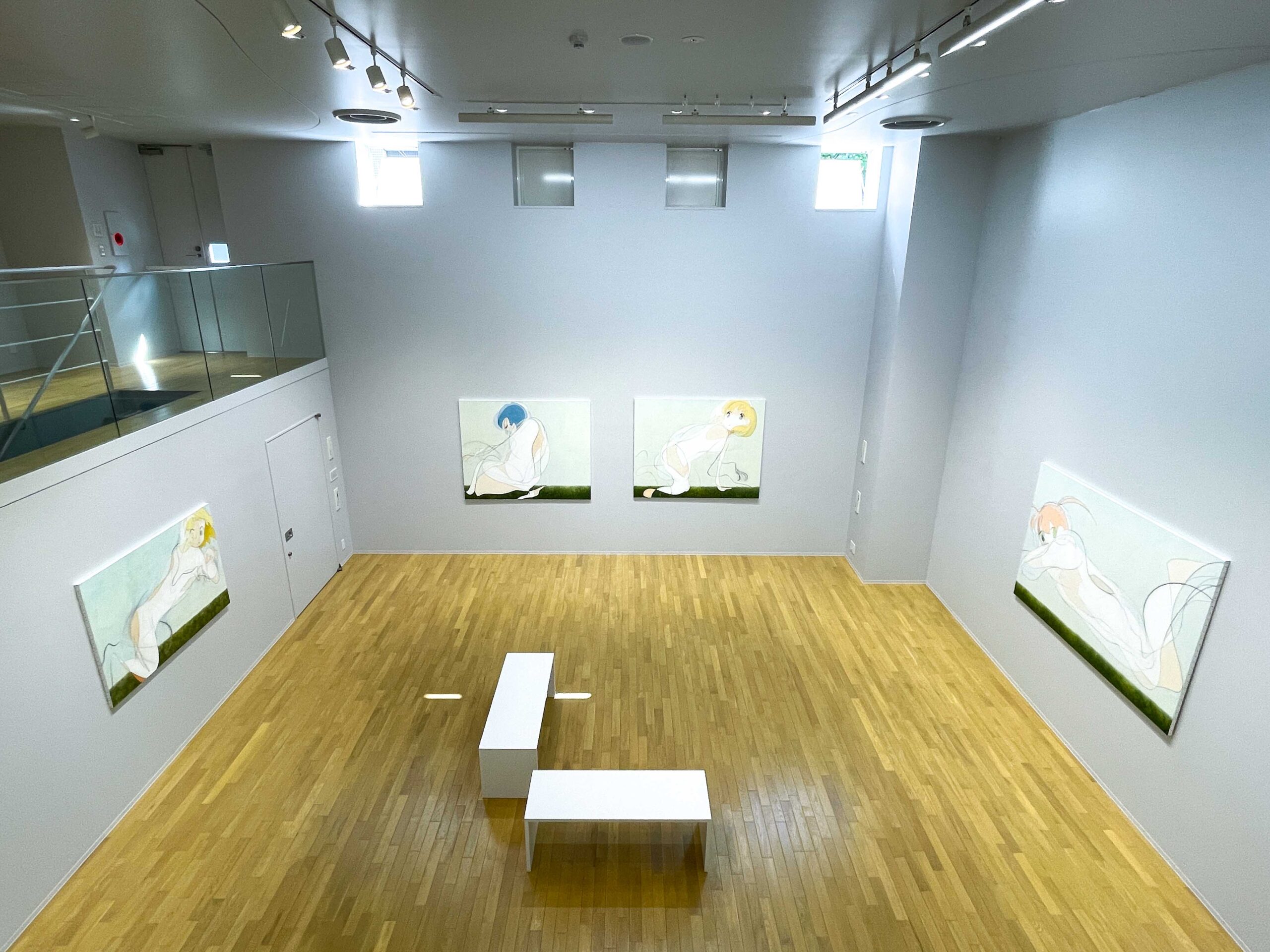
Installation view
After graduating from high school, Ryo Shinagawa spent two years working part-time, then stayed in Italy for one year. After returning to Japan he worked for another year, and entered the Japanese-painting course at Kyoto University of Art and Design four years behind schedule.
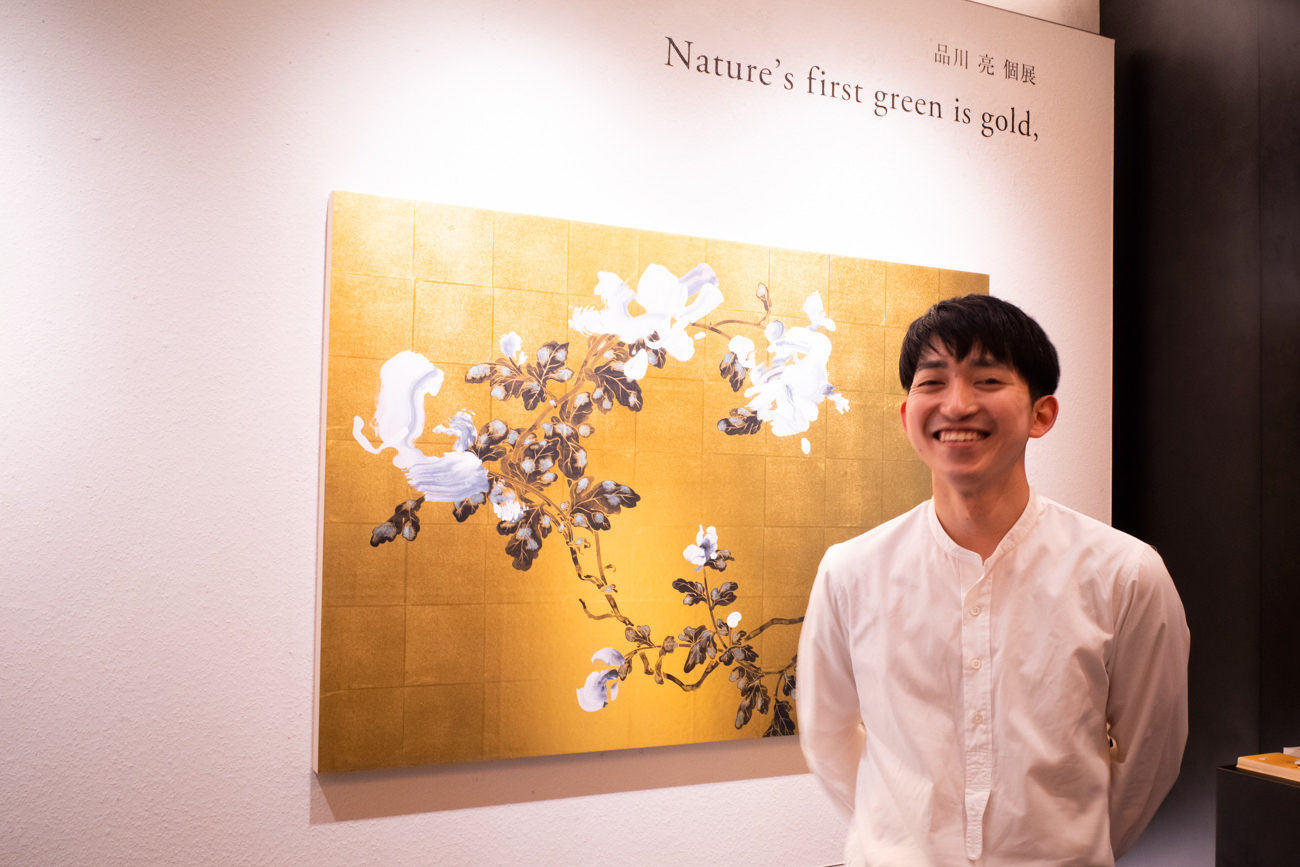
Interview with Ryo Shinagawa
I had the chance to talk with Ryo Shinagawa on the opening day of the exhibition.
Q: Could you introduce your background?
Until I went to Italy I had always painted oils, but after going to Italy I began to think seriously about Japanese painting. I entered the Japanese-painting course at university, but during a six-month exchange to Geneva partway through, the work I had been making—aimed at the Inten exhibition—was harshly criticized, which led to my current style.
While a student, I also helped with Tabaimo’s production at the Venice Biennale and received all sorts of advice. She is still the artist I respect most.
Q: Could you explain your works?
I am presenting two series: a sumi-ink series and a gold-leaf series.
The ink works come from thinking about why I paint—by the arrow analogy, they are inward-facing works.
The gold-leaf works think about Japanese painting and Japanese culture—by the arrow analogy, they are outward-facing works.
The solo exhibition being held simultaneously in Ginza, including both series, expresses the present Ryo Shinagawa.
Here at Ginza Tsutaya Books, thinking it a chance to be seen by many people, I decided to exhibit works using leaf, my representative series.
Ryo Shinagawa, who answered our interview
Q: When it comes to Japanese painting, which era are you conscious of?
This is just my own view, but I think painting distinctly as Japanese emerged around the Muromachi to Sengoku periods. In the Sengoku period everything was burned to the ground; then, as people rebuilt, castles were made, wide spaces appeared, and large works came to be hung. In that era, gold-ground wall paintings appeared and ink-wash painting came from China, and I think the painting at the core of the Japanese is made using “gold leaf” and “sumi ink.” So when I think of Japanese painting, I mean from the Muromachi period through Edo to around Meiji. I paint wanting to update those into the present.
Q: Why are there so many plants as motifs?
I paint plants thinking they are a motif that East Asians can draw unconditionally, as a kind of privilege.
Q: The prices are low and works sell out immediately—what do you think about that yourself?
I want to keep painting no matter what, and I want to be a painter for life. Thinking about that, rather than raising prices right away, I want everyone to collect my work at a somewhat accessible price, and to build a presence where “anyone can see at a glance that it’s a Ryo Shinagawa.” That connects to my driving force for painting.
In a first-grade essay I wrote “I will become a painter in the future,” and someday I’d like to be featured on “Jōnetsu Tairiku” (a Japanese documentary program) (laughs).
Q: I heard a rumor that if you ask you for a commission (made-to-order work), it’s a “three-year wait”—is that true?
Sorry, right now it’s about a four-year wait.
I’ve received many orders and am very grateful.
Works on display
He also told us about the works shown in this exhibition.
Simplification
Ryo Shinagawa:
“From kanji to hiragana, from Zen to wabi-sabi, the Japanese have used a method of ‘simplification’ when taking in continental culture and making it their own. This series draws inspiration from such things.”
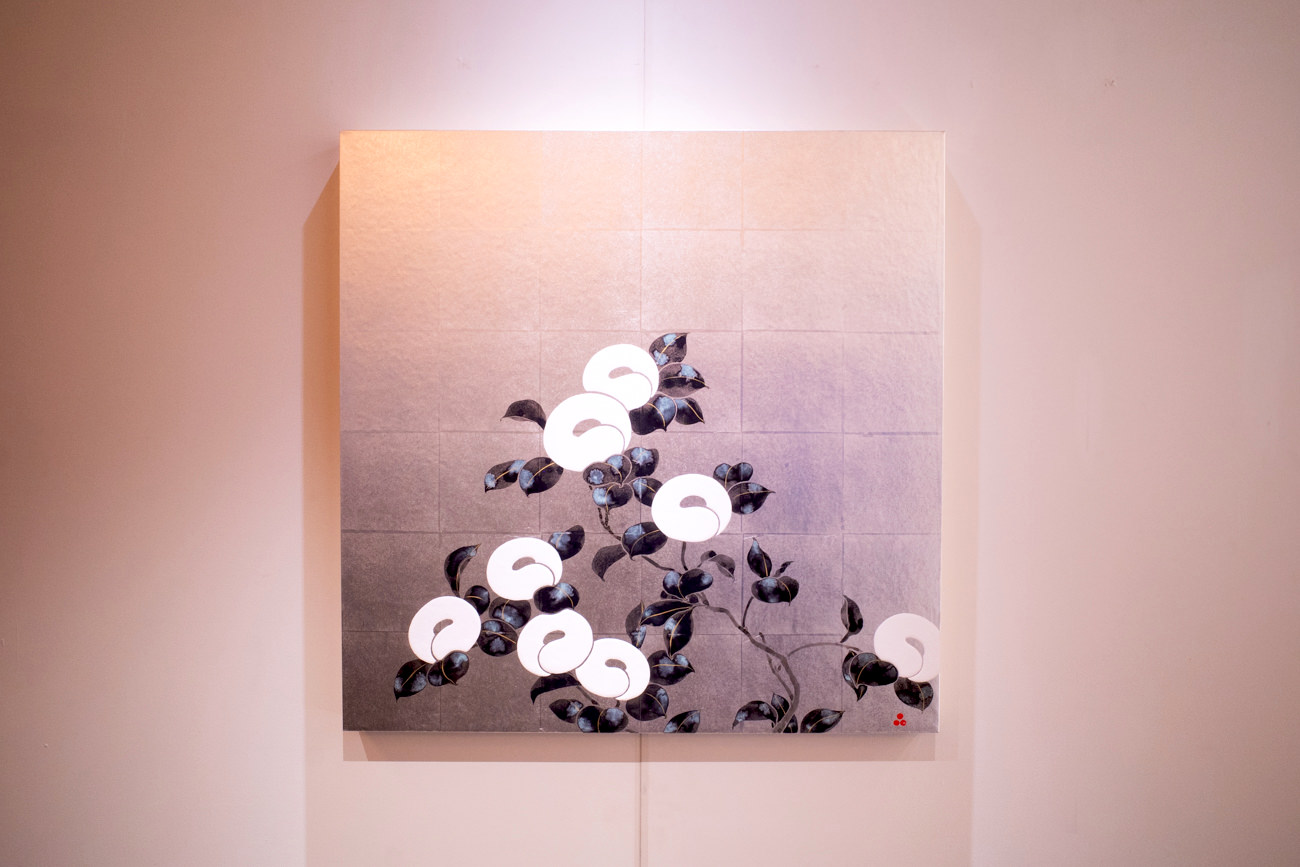
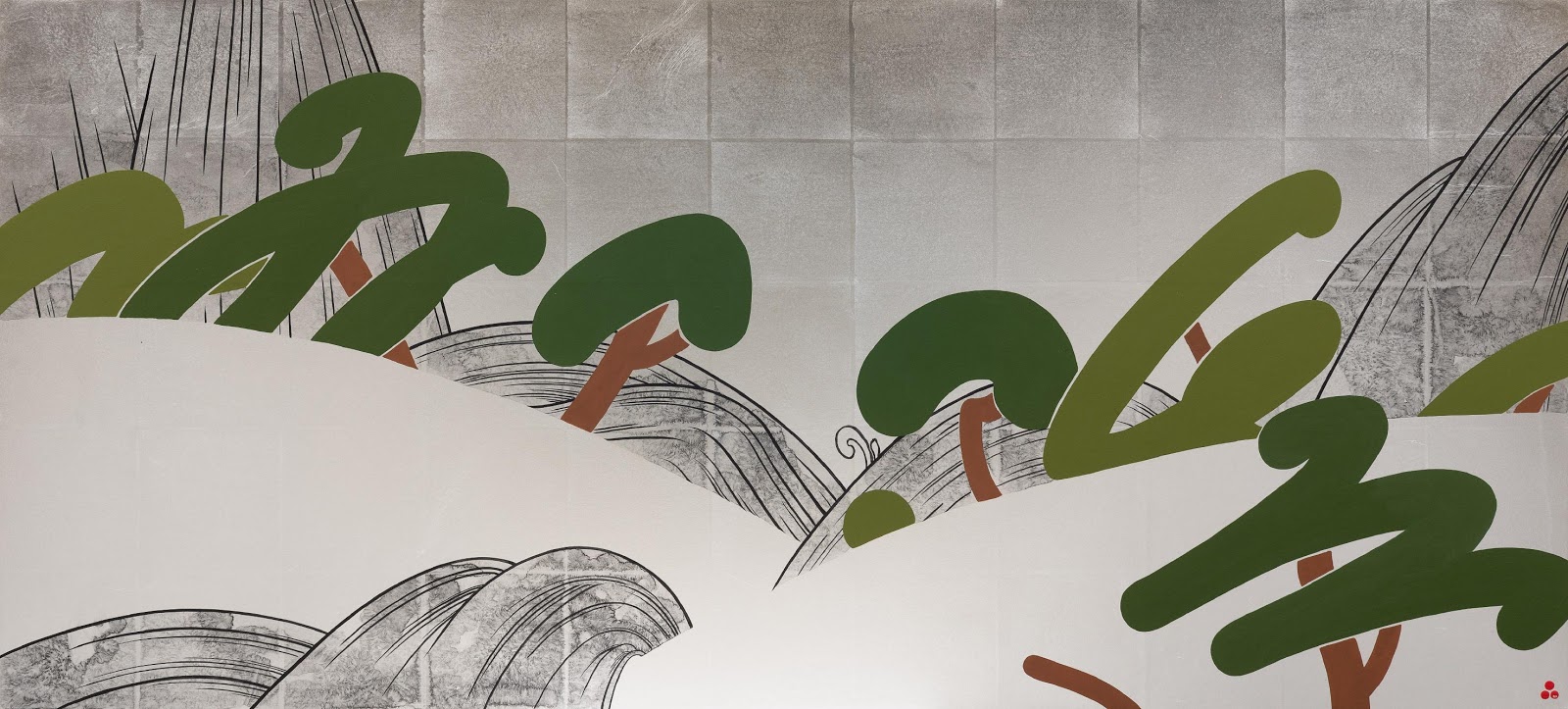
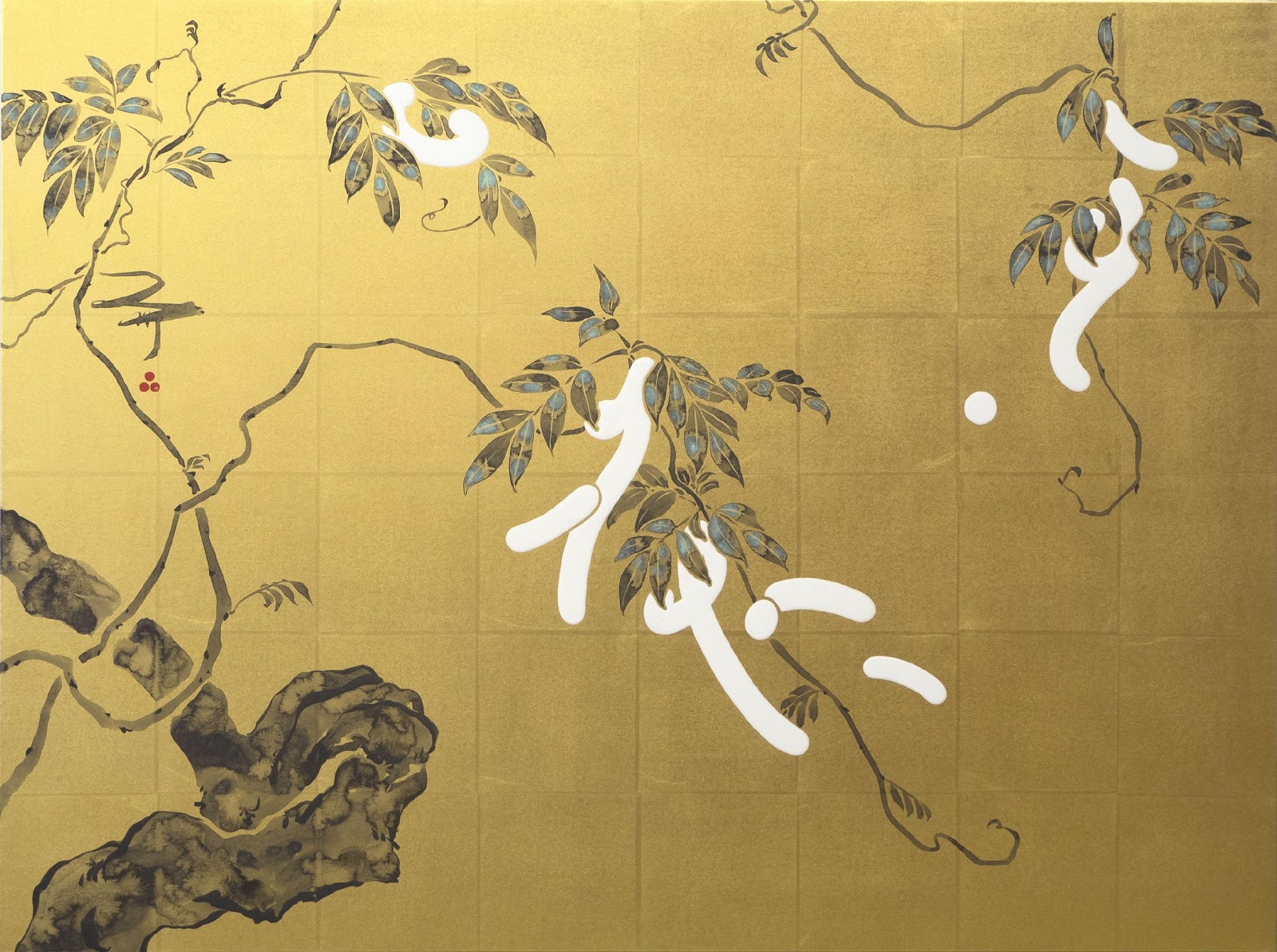
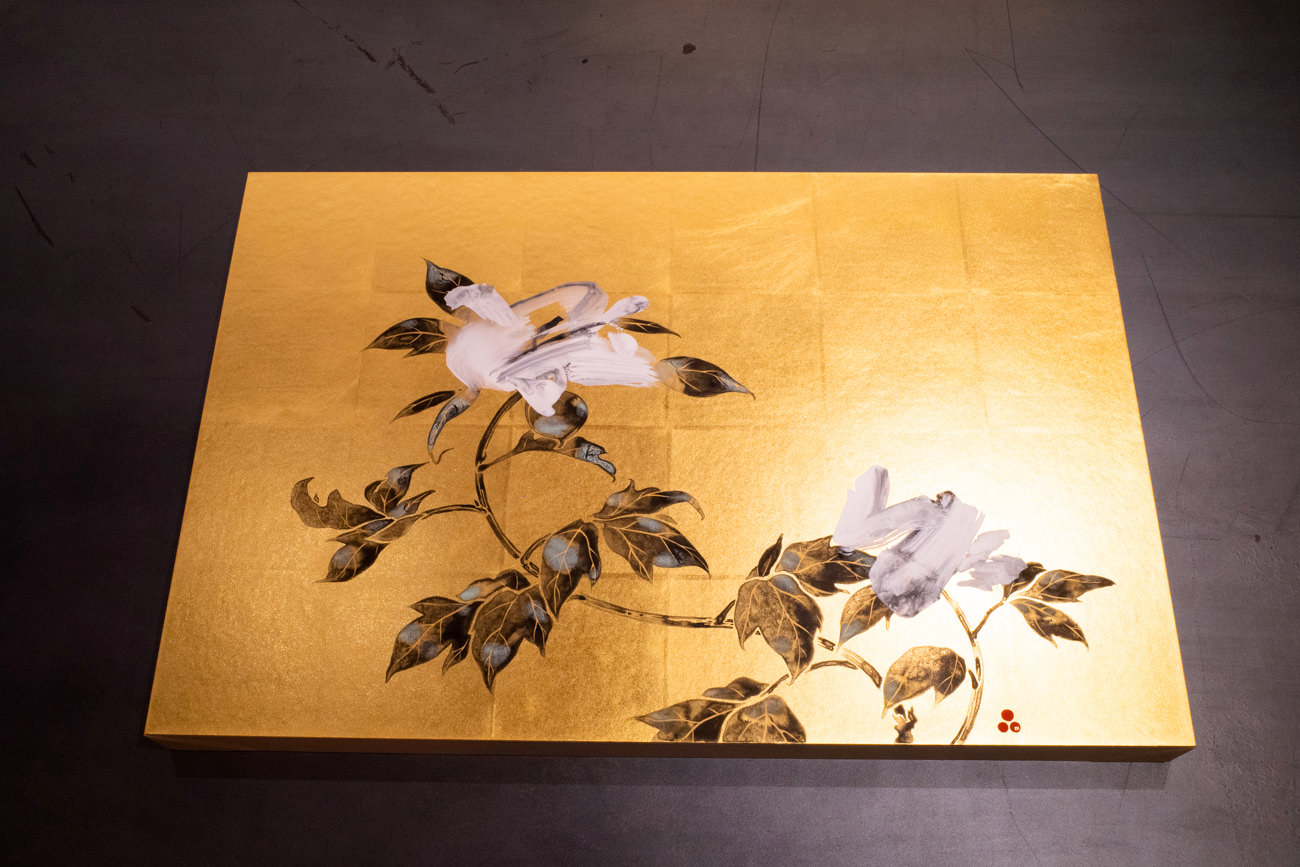
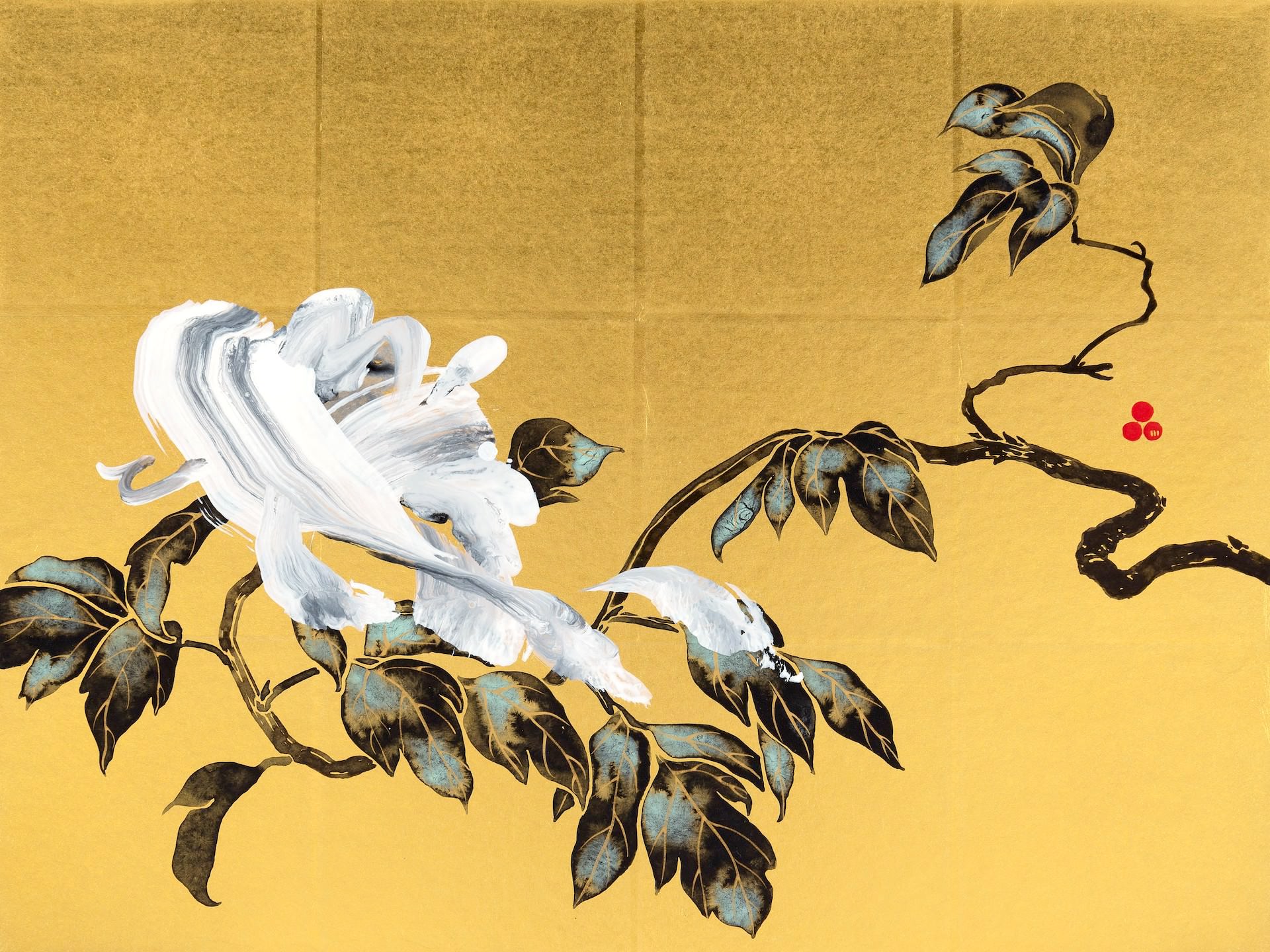
Ryo Shinagawa, 《白椿 (White Camellia)》, 2020, 750×750×50mm, pigment, sumi ink, silver leaf, nikawa glue, washi, wood panel A work that simplifies only the flower parts of the plants depicted on the picture plane—a production method based on the act of replacing them with Japan’s distinctive “kata” (form).Ryo Shinagawa, 《松に流水図 (Pines and Flowing Water)》, 2020, 625×1375×40mm, pigment, sumi ink, silver leaf, nikawa glue, acrylic, washi, wood panel *Work not on displayRyo Shinagawa, 《藤 (Wisteria)》, 2020, 750×1000×50mm, pigment, sumi ink, gold leaf, nikawa glue, washi, wood panel *Work not on display
Brushstroke
Ryo Shinagawa:
“Lately I’ve been making works that incorporate brushstrokes, and series such as 《菊図 (Chrysanthemums)》 are the works I most want people to see right now.
The painting I make is, in the end, local painting. Mingei (folk craft) is one example; in the old days ‘local’ meant using your own local to update the local.”
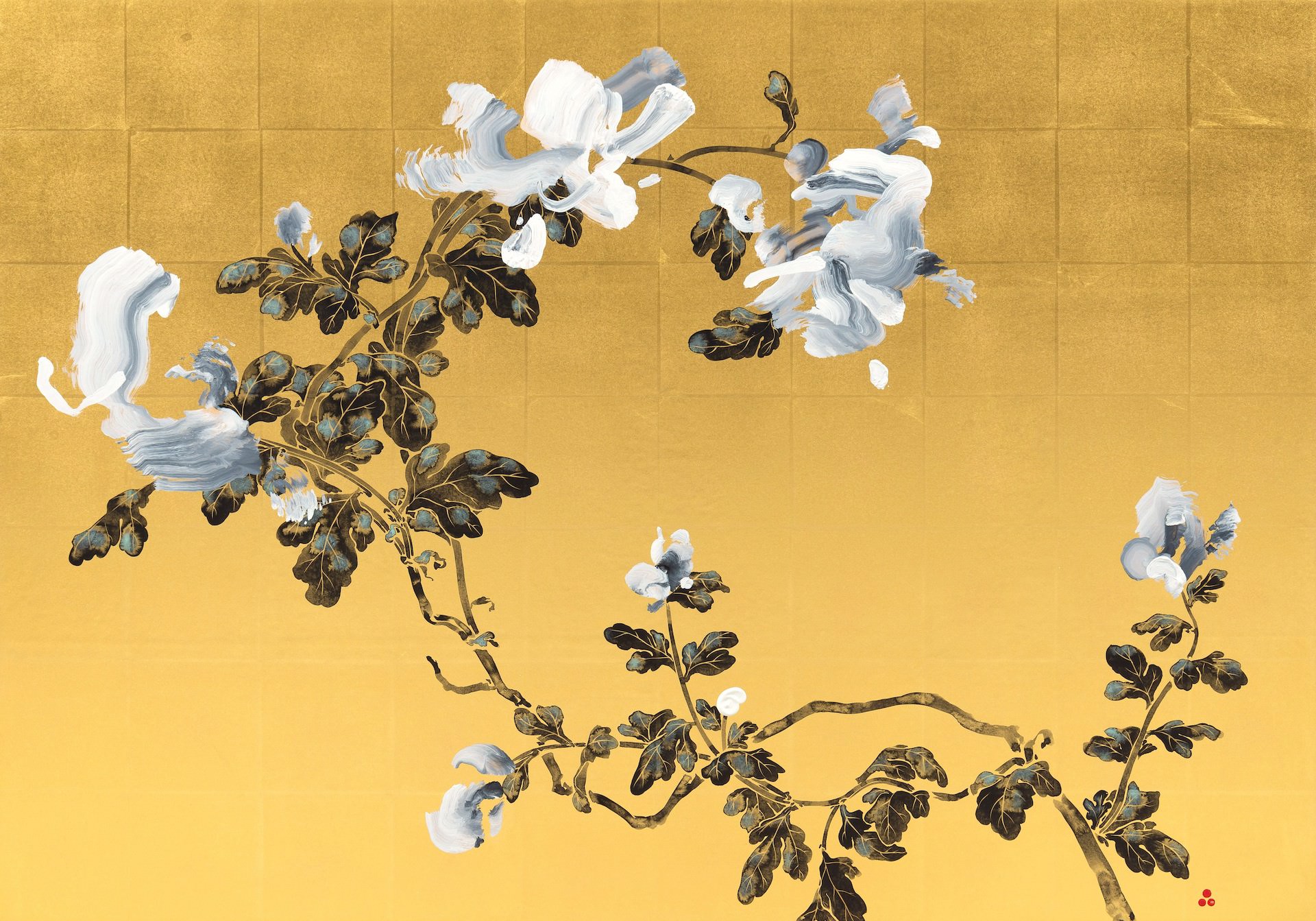
Ryo Shinagawa, 《菊図 (Chrysanthemums)》, 2020, 1250×875×40mm, pigment, sumi ink, silver leaf, nikawa glue, washi, wood panel Flowers drawn with bold brushwork—while quoting the brushwork seen in ink-wash painting and calligraphy, they attempt to update Japanese painting by incorporating the brushstroke often seen in modern painting since Abstract Expressionism.
Ryo Shinagawa:
“When I think about ‘local’ in the present day, I think it means also quoting the global as an object of sampling, and using those to update the local. As one part within the global, I think Japanese painting can be updated by quoting the painter’s breath and brushstroke since Impressionism in a calligraphy-like form—so I’m doing these experiments.”
Ryo Shinagawa:
“I admire Western painting, and I love Gerhard Richter. I like Laura Owens too, and Michaël Borremans too; I can’t purely follow them, but I love the painterly. I also really like Yukimasa Ida, whose work is on display next door.”
Ryo Shinagawa:
“For my works, I sometimes quote past works in terms of motif combinations and composition, and there are also motifs I devise myself. This time, I considered the whole space for the exhibition and decided each work’s size. The leaf panel works are all multiples of 125mm. I also carefully finish the support so that it can be seen as part of the work.”
Ryo Shinagawa:
“Large sizes are very fun because I paint using my body. I paint large works while moving, and that’s really fun. The matière (paint surface) of artists who have used oils all along is thrilling to look at, but I’m still not that good at using paint… Still, I feel there’s a romance of painting in texture and breath!”
Installation view
Summary
Ryo Shinagawa creates many distinctive works—beauty of the visuals, calculated composition, the lively touch of Western brushstrokes, pop and contemporary elements, and the beauty of a craft-like finish.
Based on a firm concept, his work fascinates many collectors and viewers, and it will surely keep evolving and updating in the future.
品川亮「Nature’s first green is gold,」
我造访了品川亮的个展「Nature’s first green is gold,」。
会场是GINZA SIX 6楼、银座 茑屋书店 艺术墙画廊(星巴克前展示空间)。
시나가와 료의 개인전 「Nature’s first green is gold,」에 다녀왔습니다.
회장은 GINZA SIX 6층, 긴자 쓰타야 서점 아트 월 갤러리(스타벅스 앞 전시 공간)입니다.
전시 풍경
시나가와 료는 고교 졸업 후 아르바이트로 2년을 보낸 뒤, 이탈리아에 1년간 체류했습니다. 귀국 후에도 1년간 일하고, 4년 늦게 교토조형예술대학의 일본화 코스에 입학합니다.
시나가와 료 인터뷰
회기 첫날 타이밍에 시나가와 료와 이야기할 기회를 얻었습니다.
Q:프로필을 소개해 주실 수 있나요?
이탈리아에 가기 전까지는 계속 유화를 그렸는데, 이탈리아에 가서 진지하게 일본화에 대해 생각하게 되었습니다. 대학은 일본화 코스에 들어갔지만, 재학 도중 반년간 제네바로 교환 유학을 갔을 때, 그때까지 그리던 인텐(院展)을 목표로 하던 작품이 혹독하게 비평받아, 지금의 작풍에 이르렀습니다.
재학 중 베네치아 비엔날레 때 다바이모의 제작을 도운 적도 있어 여러 조언을 받았습니다. 지금도 가장 존경하는 작가입니다.
Q:작품에 대해 해설해 주실 수 있나요?
먹 시리즈와 금박 시리즈 두 가지를 발표하고 있습니다.
먹 작품은 제가 왜 그림을 그리는가를 생각하는, 화살표로 말하면 내향적인 작품입니다.
금박 작품은 일본 회화와 일본 문화에 대해 생각하는, 화살표로 말하면 외향적인 작품입니다.
두 시리즈를 포함해 현재의 시나가와 료를 나타낸 개인전이, 긴자에서 동시 개최 중인 이 개인전입니다.
이곳 긴자 쓰타야 서점에서는 많은 분이 볼 수 있는 기회라고 생각해, 대표적인 시리즈인 박을 사용한 작품을 전시하기로 했습니다.
인터뷰에 응해 주신 시나가와 료
Q:일본 회화라고 하면, 어느 시대를 의식하고 계신가요?
제 생각이긴 합니다만, 일본인으로서의 회화가 두드러지게 나타난 것이 무로마치 시대에서 전국 시대 무렵이라고 봅니다. 전국 시대에 불탄 들판이 되어, 재건하려 하며 성이 만들어지고, 넓은 공간이 생겨 큰 것을 거는 상황이 되었습니다. 그 시대에 금벽장벽화가 나오거나 중국에서 수묵화가 들어오거나 하여, 일본인의 핵심이 되는 회화가 「금박」과 「먹」을 사용한 것이라고 생각합니다. 그래서 일본의 회화라고 하면 무로마치 시대부터 에도, 메이지 무렵까지라고 생각합니다. 저는 그것들을 현대로 업데이트하고 싶어 작품을 그리고 있습니다.
Q:모티프에 식물이 많은 것은 어째서인가요?
식물은 동양인이 특권적으로 무조건 그릴 수 있는 모티프라고 생각해 그리고 있습니다.
Q:가격이 저렴하고 금방 완판되는데, 스스로는 어떻게 생각하시나요?
저 자신 무슨 일이 있어도 그림을 계속 그리고 싶고, 평생 화가이고 싶습니다. 그것을 생각했을 때, 지금 당장 가격을 올리기보다, 어느 정도 구하기 쉬운 가격으로 여러분이 컬렉션해 주시고, 「누가 어떻게 봐도 시나가와 료다」라는 존재감을 만들어 가고 싶습니다. 그것이 그림을 그리는 원동력으로 이어지고 있습니다.
초등학교 1학년 작문에 「장래에 화가가 되겠습니다」라고 적혀 있어, 언젠가 「정열대륙(情熱大陸)」(일본 다큐멘터리 프로그램)에서 소개되고 싶다고 생각합니다(웃음).
죄송합니다, 지금은 4년 정도 기다려 주시는 상황입니다.
많은 주문을 받아 대단히 감사드립니다.
전시 작품
본 전시의 전시 작품에 대해서도 이야기해 주셨습니다.
단순화
시나가와 료;
「한자에서 히라가나로, 선(禅)에서 와비・사비 등, 일본인은 대륙 문화를 받아들여 독자적인 문화로 만들 때 『단순화』라는 방법을 취해 왔습니다. 이 시리즈는 그러한 지점에서 착상을 얻어 제작하고 있는 작품입니다.」
시나가와 료 《白椿》 2020년 750×750×50mm 안료, 먹, 은박, 아교, 와시, 목제 패널 화면에 그려진 식물의 꽃 부분만을 단순화한 작품은, 일본 특유의 「형(型)」으로 치환하는 행위를 바탕으로 그려진 제작 방법입니다.시나가와 료 《松に流水図》 2020년 625×1375×40mm 안료, 먹, 은박, 아교, 아크릴, 와시, 목제 패널 ※전시 외 작품시나가와 료 《藤》 2020년 750×1000×50mm 안료, 먹, 금박, 아교, 와시, 목제 패널 ※전시 외 작품
브러시 스트로크
시나가와 료;
「최근에는 브러시 스트로크를 도입한 작품을 만들고 있어, 《菊図》 등의 시리즈는 지금 가장 봐 주었으면 하는 작품입니다.
제가 만드는 회화는 어디까지나 로컬한 회화라고 생각합니다. 민예 등이 그 예로 꼽히지만, 예전의 로컬이라고 하면 자신들의 로컬을 사용해 로컬을 업데이트해 갔구나 하고 생각합니다.」
시나가와 료 《菊図》 2020년 1250×875×40mm 안료, 먹, 은박, 아교, 와시, 목제 패널 대담한 필적으로 그려진 꽃은, 수묵화나 서예에서 보이는 필치를 인용하면서, 추상표현주의 이후 현대 회화에 많이 보이는 브러시 스트로크를 도입함으로써 일본 회화의 업데이트를 시도하고 있습니다.
시나가와 료;
「지금 현대에 로컬을 생각하면, 글로벌도 샘플링의 대상으로 인용하고, 그것들을 사용해 로컬을 업데이트해 가는 것이 아닐까 생각합니다. 글로벌 안의 하나로서, 인상파 이후 화가의 숨결이나 브러시 스트로크를 서예와 같은 형태로 인용함으로써 일본의 회화를 업데이트할 수 있지 않을까 하여, 이런 실험을 하고 있습니다.」
시나가와 료;
「저는 서구의 회화에 동경이 있어, 게르하르트 리히터를 무척 좋아합니다. 로라 오언스도 좋아하고, 미하엘 보레만스도 좋아하고, 순수하게 좇을 수는 없지만 페인터리를 무척 좋아합니다. 옆에서 전시 중인 이다 유키마사도 정말 좋아합니다.」
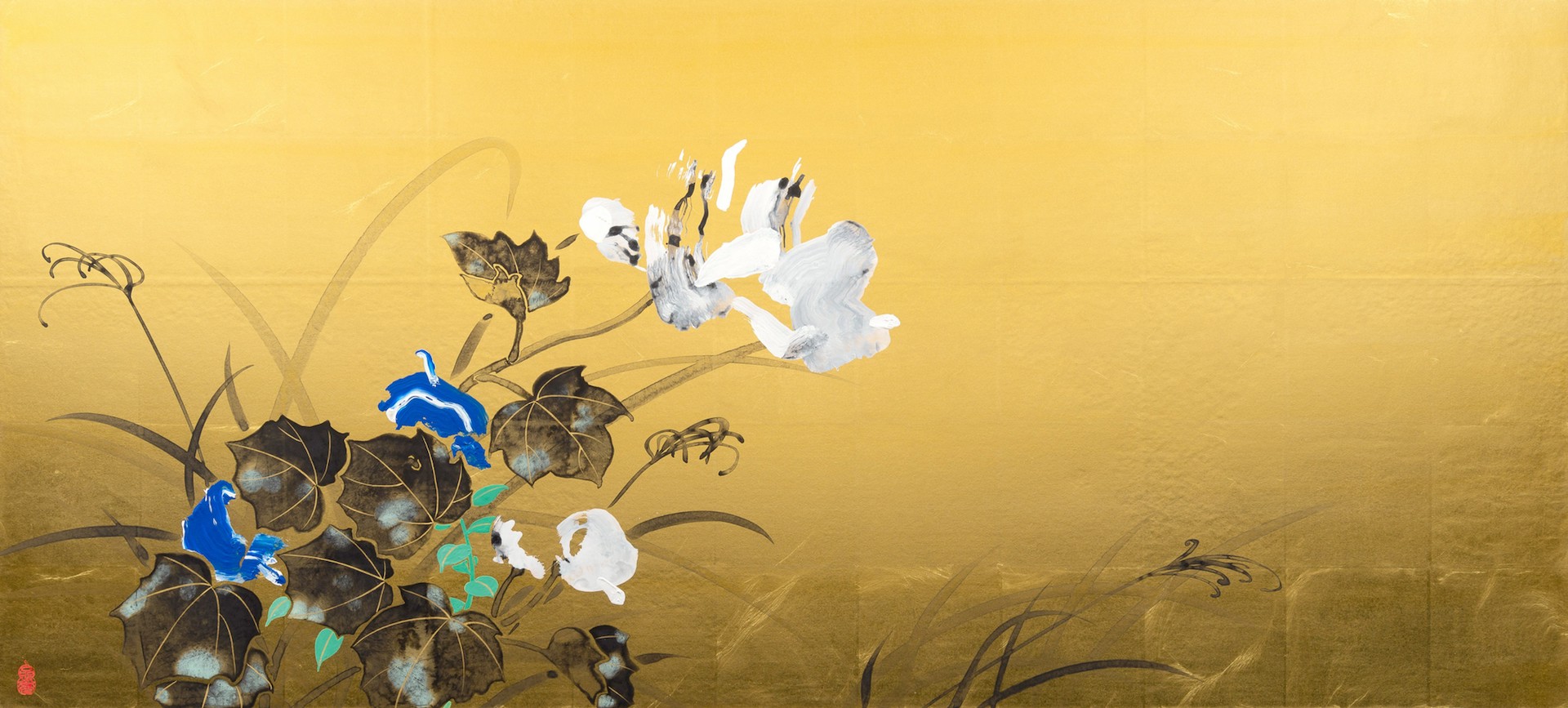
시나가와 료 《秋草図》 2020년 625×1375×40mm 안료, 먹, 금박, 아교, 아크릴, 와시, 목제 패널 ※전시 외 작품
시나가와 료;
「작품은 모티프의 조합이나 구도 등, 과거의 작품을 인용하기도 하고, 스스로 생각한 모티프도 있습니다. 또한 이번에는 전람회를 위해 전체 공간을 고려하여 각 작품의 사이즈를 정했습니다. 박을 사용한 패널 작품은 모두 125mm의 배수입니다. 또한 지지체의 마감에 대해서도 작품의 하나로서 봐 주시도록 정성껏 만들고 있습니다.」
시나가와 료 《牡丹》 2020년 375×500×40mm 안료, 먹, 금박, 아교, 아크릴, 와시, 목제 패널 ※전시 외 작품
시나가와 료;
「큰 사이즈는 몸을 사용해 그리기 때문에 매우 즐겁습니다. 큰 작품은 움직이면서 그리기 때문에 그것이 정말 즐겁습니다. 유화 물감을 계속 사용해 온 작가의 마티에르(그림 표면)는 보고 있으면 두근거리지만, 저는 아직 물감을 사용하는 것이 서툴러서…. 그래도 질감이나 숨결의 부분에 회화의 로망이 있는 것 같습니다!」
전시 풍경
정리
비주얼의 아름다움, 계산된 구도, 서양적인 브러시 스트로크의 약동감 있는 필치, 팝하고 현대적인 요소, 공예적인 마감의 아름다움 등, 특징적인 작품들을 제작하는 시나가와 료.
확실한 콘셉트에 기반하여 많은 컬렉터와 감상자를 매료하는 그 작품은, 앞으로도 진화하며 업데이트를 거듭해 갈 것입니다.